
Chief financial officers (CFOs) are grappling with a tension between short-term cost-cutting imperatives and long-term growth investments for their 2026 top priorities and challenges, according to a survey by Gartner.
“CFOs are navigating a complex, volatile environment where they need to keep tight control over costs and be more agile with financial forecasting,” says Dennis Gannon, vice-president analyst in the Gartner Finance practice.
“Financially conservative themes focused on improving financial strength and downside risk mitigation are the most common among top five priorities for CFOs heading into 2026.”
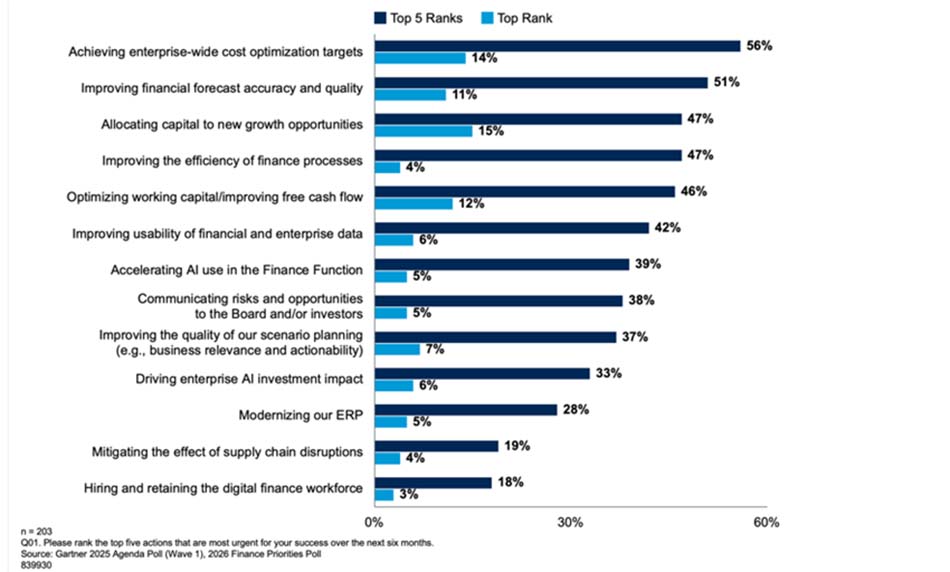
The survey of more than 200 CFOs, taken during August 2025, showed that 56% of CFOs rank achieving enterprise-wide cost optimisation targets in their top five, while 51% of respondents rank improving financial forecast accuracy and quality in their top five.
Most urgent CFO actions/questions for success over the next six months
Source: Gartner (December 2025)
“The strain between the competing priorities of cost and growth is clear in the results: a major subset of CFOs report that allocating capital to new growth opportunities is at the top of their priority list,” says Gannon.
“Although being cited as a top five priority by less than half of all CFOs, capital allocation for growth had more CFOs ranking it as their number one priority than any other item, showing a bifurcation between some CFOs hyper focused on growth and a majority acting conservatively.”
Gartner research has shown the emphasis on cost optimisation presents some notable risks for CFOs.
Investors often view cost reductions skeptically, recognising that unsustainable cuts can negatively impact stock prices.
CFOs who achieve lasting cost optimisation set their organisations apart by cultivating a cost-conscious culture that prioritises transparency, ownership, and financial acumen among decision makers.
These leaders tend to take a strategic approach, directing more resources toward areas that differentiate the business, while reducing spending in areas that competitors can easily replicate.
AI concerns
The report also revealed growing concerns about AI, and finance digital transformation and talent. Only 36% of CFOs express confidence in their ability to drive enterprise AI impact, despite increasing investments in AI across corporate functions. This presents a significant risk to future financial performance.
Similarly, just 44% of CFOs feel confident about accelerating the use of AI in finance, and only 42% are confident in their ability to hire and retain digital talent for finance roles.
“The low confidence in driving value from AI and digitalising finance talent is a wake-up call,” says Gannon. “CFOs must adopt a dual-path approach – leveraging embedded AI in vendor software for immediate gains while building the culture, governance, and skills needed for long-term success.”
Gartner analysts advise that CFOs should not focus their transformation plans on process and technology while expecting digitally skilled finance employees to materialize in the interim.
Instead, they must create clear targets and a plan of action for finance to reach desired digital talent levels by connecting talent targets to their transformation objectives.