
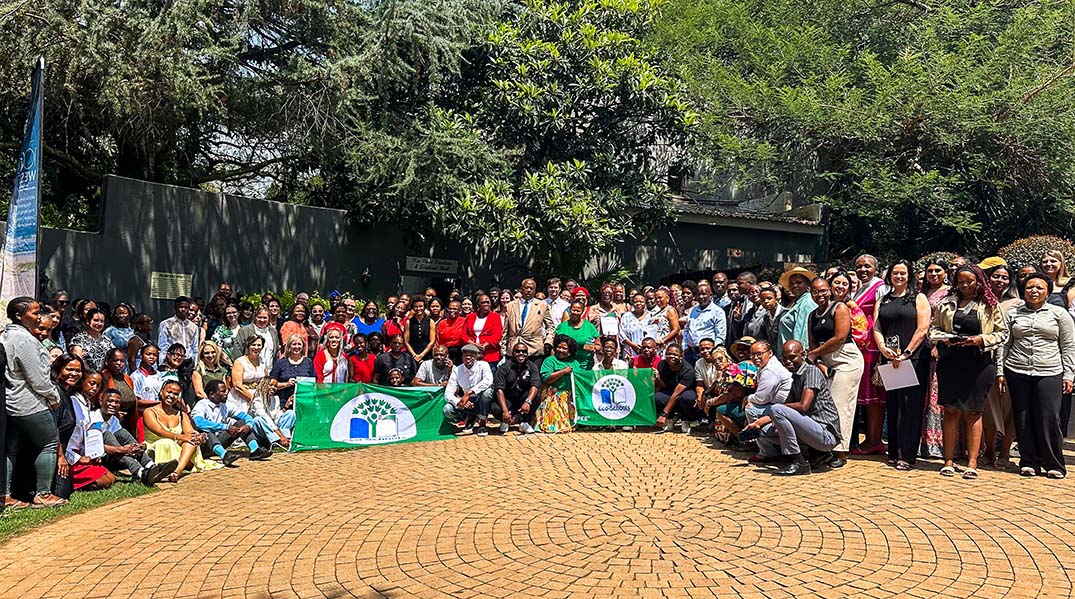
Gauteng schools took centre stage at the WESSA Eco-Schools Awards Ceremony in February, where educators, learners, partners and government representatives gathered to recognise measurable environmental action across the province.
Hosted by WESSA (The Wildlife and Environment Society of South Africa) during its centenary year, the ceremony recognised schools implementing practical sustainability initiatives ranging from biodiversity restoration and waste management to water stewardship and community outreach.
WESSA CEO Cindy-Lee Cloete comments: “Whether you’ve been with us for decades or just a couple of days, today you are part of something extraordinary, because we sit at 100 this year – 100 years of citizen action, 100 years of environmental leadership, 100 years of believing that education is the lever that will make a change in our communities and in our schools.”
She emphasises that the Eco-Schools programme represents more than environmental awareness. “EcoSchools in South Africa is one of the most impactful environmental education programmes in this country, not just a WESSA programme, but a teacher movement and a learner-led action campaign.”
Cloete highlights the enduring power of classroom leadership. “Policy can shift, funding cycles can fluctuate, governments can change, economies can wobble – but a teacher in a classroom committed to raising environmentally conscious citizens, that is nation building; that is long-term change.”
She reminds schools that their work extends far beyond compliance with curriculum requirements. “You are not just delivering a curriculum; you are shaping citizens for the future and raising a generation that will not see sustainability as a project, but as a way of being.”
Dululu Hlatshaneni, deputy director: social cohesion and equity in education at the Department of Basic Education, affirms the programme’s provincial impact.
“In this cycle alone, 622 schools are participating nationally, and here in Gauteng we celebrate over 100 schools whose commitment to environmental education is transforming their communities. These achievements reflect leadership, innovation and a shared vision for sustainable development.”
Selected schools showcased projects demonstrating the depth of environmental action taking place across Gauteng:
- ADvTECH Schools reported 98 environmental projects implemented across 42 participating schools in 2025 alone, alongside 253 environmental days and 254 environmental lessons delivered.
- The eWASA & WESSA SA Schools Waste Management and Education Project reached more than 2 700 learners and 70 teachers, with schools recycling over 16 000 kilograms of waste.
- Under the UNICEF Green Rising Project, Phase 1 reached over 12 000 people across 66 schools and communities nationally, planted 2 148 trees, cleaned 700 tons of waste and rehabilitated 260 hectares of land.
Several schools were recognised for exceptional thematic leadership:
- Biodiversity Stewardship Award: Ipontshe Primary School
- Circular Economy Champion Award: Diepsloot Secondary School No. 3 (recycling over 8 000kg of waste and demonstrating innovation in reuse initiatives)
- Water Wise Warriors Award: Moduopo Primary School
- Ubuntu for Nature Award: Pinnacle Colleges Rynfield
- Eco-Innovation Award: Waterkloof House Preparatory School
“When young people feel connected to nature, they feel connected to themselves and through our Eco-Schools programme we are raising a generation that will protect who we are into the future,” adds Cloete.