
All-time high greenhouse gas concentrations in Earth’s atmosphere continue to drive heat records on land and sea, with long-lasting consequences for humanity, the World Meteorological Organisation (WMO) warned today (23 March 2026).
Hot on the heels of a scorching decade, the UN’s weather agency says the planet’s climate is “more out of balance than at any time in observed history”.
According to WMO’s deputy executive secretary Ko Barrett: “Between 2015 and 2025, we experienced the hottest 11 years on record.”
Last year was about 1,43 °C above the 1850 to 1900 baseline, in addition to breaking an ocean heat record, she explains.
Grim state of climate
Presenting a grim overview of the state of the climate in 2025, Barrett stresses that as glaciers continue to retreat and ice continues to melt, “the warming ocean and melting land-based ice are driving the long-term rise in global mean sea level rise”.
She says the findings are an inspiration “to work harder to get lifesaving forecasts and early warnings into the hands of those who can protect lives and livelihoods” so that they can mitigate the devastating impacts of the ongoing climate turmoil on the most vulnerable.
For its part, WMO has been issuing annual climate updates for more than 30 years, and the record figures in the last decade have been an increasing cause for concern.
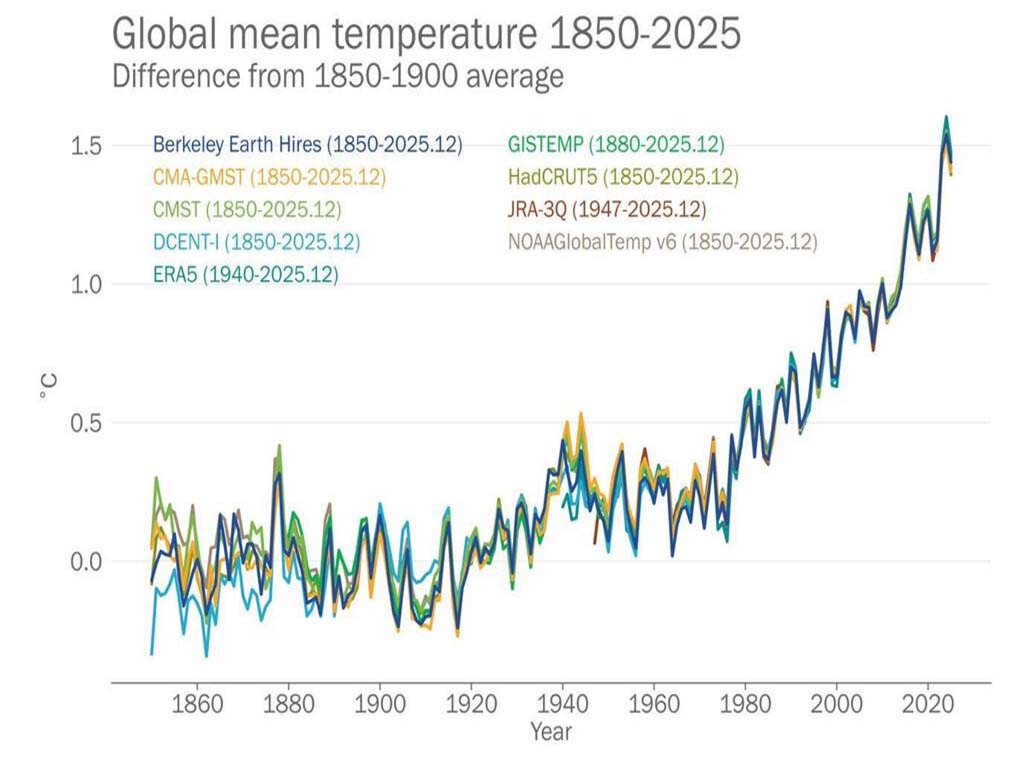
Annual global mean temperature anomalies relative to a pre-industrial (1850–1900) baseline
© WMO
Record greenhouse gas levels
The agency’s scientific officer John Kennedy says concentrations in the atmosphere of three key greenhouse gases (carbon dioxide, methane and nitrous oxide) reached record levels in 2024, the last year for which there are consolidated global numbers.
This marked the single-largest year-on-year increase.
“Data from individual sites around the world indicates that levels of these greenhouse gases continue to increase in 2025” and to modify “the energy balance of the planet”, he adds.
Worrying energy imbalance
Kennedy explains that, under a balanced system, incoming energy from the sun is about the same as the amount of outgoing energy. But this is not the case at present.
“There’s less outgoing energy due to the increased concentrations of greenhouse gases,” he says. “More energy coming in than going out means that energy is accumulating in the Earth’s system.”
The Earth’s energy imbalance is a new indicator WMO has started tracking, with results pointing to a notable acceleration in the rate at which warming has been progressing between 2001 and 2025.
“The largest fraction of that absorbed energy is going to the oceans, around 90 per cent of the excess energy in the climate system,” Kennedy says.
“This matters because over 3-billion people depend on these marine and coastal resources for their livelihoods. They’re living off the ocean, and nearly 11% of the global population live on low-lying coasts directly exposed to coastal hazards.”