
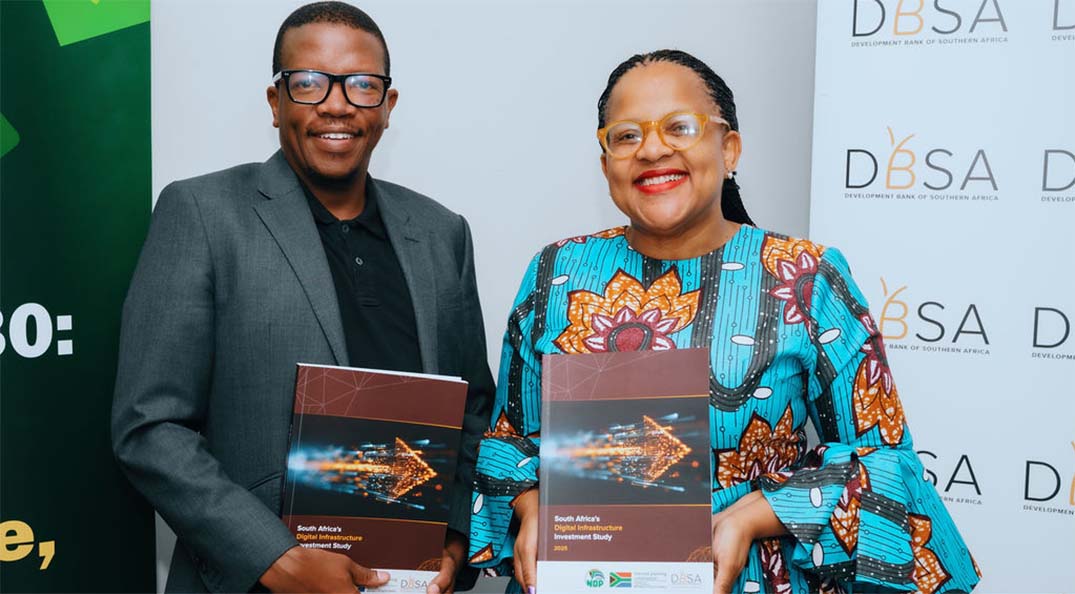
Kathy Gibson reports – Digital investment is not an end in itself: it is the foundation for a more inclusive, more resilient South Africa.
This is the word from Boitumelo Mosako, CEO of Development Bank of South Africa (DBSA), introducing a Digital Infrastructure Investment study carried out jointly by DBSA and National Planning Commission ( NPC) that aims to identify funding gaps for infrastructure over the next two decades.
“Will South Africa move fast and boldly enough to position itself in the digital economy, or will we fall behind?” Mosako asks.
“Nations around the world are reorganising themselves around digital infrastructure and data, with investment flowing into digital capabilities.”
The new study is a strategic instrument and a road map that quantifies the investment required to improve lives through digital infrastructures.
“We found that the access gap is too big,” Mosaka explains. “The core infrastructure is in place; the majority of households are in reach of connectivity; and the private sector continues to innovate
“But most South Africans remain excluded.”
To achieve inclusive connectivity, the study concludes that between R108-billion and R141-billion will be needed.
“But the central message is that connectivity mut be meaningful, Mosaka adds. “Investment decisions cannot be guided by coverage alone. We must consider affordability, inclusivity and usage.”
This is particularly important for South Africa, as one of the most unequal societies in the world, with the highest youth unemployment rate.
“Co-ordination is critical,” she adds. “We are at a strategic inflexion point. The choices we make now on policy, investment and institutional reform will determine if we become a player in the digital economy or are left behind.
“The pathway is clear: we know where the gaps are, what is will cost, and the policies that are required. Now we just need to get it done.”
The roadmap identifies investment gaps, priority actions, and partnership opportunities required to expand reliable high-speed broadband and accelerate South Africa’s progress toward an inclusive digital economy.
The research undertaken translates digital policy ambitions into a rigorous, costed, and fiscally aligned investment roadmap for Digital Connectivity Infrastructure (DCI). It directly supports the National Development Plan (Vision 2030), SA Connect, the National Infrastructure Plan 2050 (NIP2050), and the Sustainable Development Goals (SDGs).
Commissioner Mark Swilling from the NPC, comments: “This roadmap provides the country with a current, comprehensive, costed view of what is required to bridge the digital divide and achieve universal access to digital connectivity by 2035. It outlines a common, evidence-informed basis for coordinated planning across the public and private sector, in order to drive investment and delivery of the roadmap.”
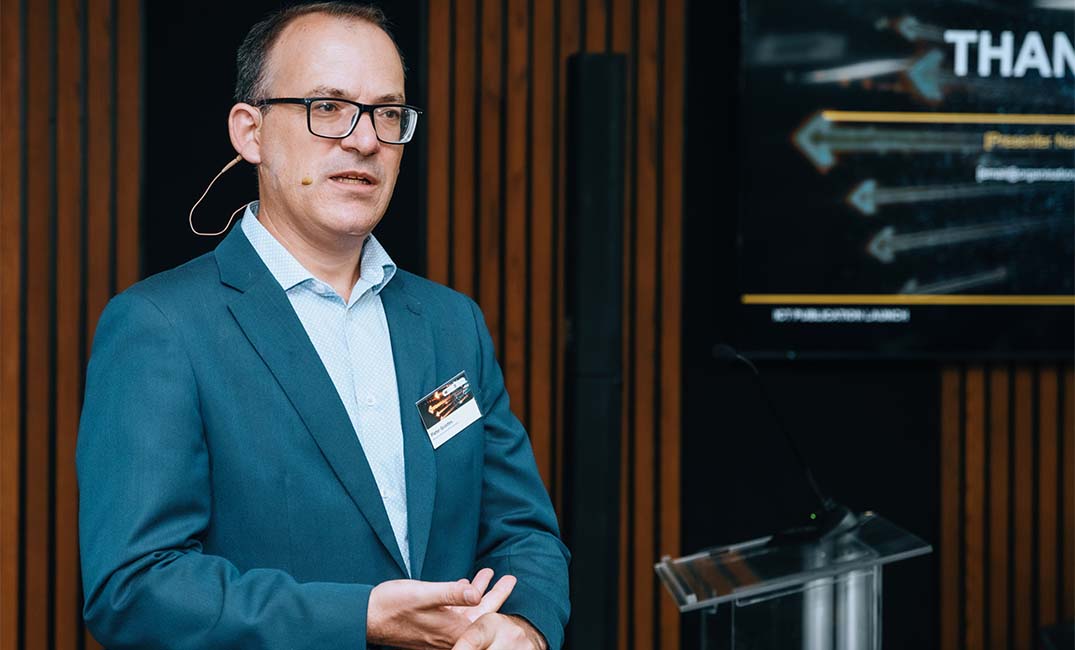
Pieter Grootes, digital infrastructure economist at Networks Anonymous.
Unpacking the results
Pieter Grootes, digital infrastructure economist at Networks Anonymous, points out that South African faces several challenges to achieving the goal of connecting all households at 100MBps by 2035.
The first critical roadblock is that South Africa has got multiple targets in multiple policies – but implementation lags significantly.
At the same time, there are persistent gaps in access, affordability and digital skills. “Infrastructure spend alone will not achieve meaningful connectivity and build growth,” Grootes adds. “There needs to be a reset in our policy, moving from universal access to meaningful use of that infrastructure.”
The study aimed to define the gap, and found that it is largely in the last mile.
In the first mile, there are multiple international cable connections, with additional new connections under review.
“South Africa has a glut of international cables, and this has the capacity to drive the digital economy,” Grootes says.
In the middle mile, we are seeing expansive growth in data centres – only country in southern Africa where this is happening.
“The capacity brought online in South Africa is significant,” Grootes says.
National transmission links are dominated by traditional operators, while smaller regional operators emerging to build missing backhaul. At the same time, there is a strong government presence which could be leveraged.
“In the last mile, we have growing mobile and fibre networks, but we don’t know who has been left behind,” Grootes says. “It’s knowing who hasn’t got connectivity that drives investment requirements.”
Because there was no available information defining who is connected, the team built a GIS database and mapped it, ensuring that the statistics are clean and up to date.
A key takeaway from this is that 98% of the population has 4G mobile access, with just 400 000 homes – 2,2% of the total – still unconnected.
Mpumalanga, Northern Cape and KwaZulu-Natal are among the least developed.
The model also shows that 70% of South African households are within 10km of a fibre node.
But there still an inter-provincial fibre divide, with Western Cape enjoying 78,2% fibre reach compared to Limpopo with just 19%.
“This GIS data enables targeted, efficient investment by identifying underserved households and facilities,” Grootes says. “It aligns infrastructure supply with demand and enables prioritisation of high-impact investment areas supporting co-ordinated, cost-effective rollout.”
Government already has a strong middle mile presence. If it was co-ordinated, this could be leveraged to overcome the largest cost barrier to high-speed connectivity.
“A key takeaway is that greater co-ordination can unlock value,” Grootes says.
Device affordability constraints are a big inhibitor. The cost of a decent device is 18,4% of the minimum wage. And, at R300 per month for usage the cost of running the device precludes many households.
“Macro-economics means many households can’t afford connectivity,” Grootes concludes.
Skills remains a key constraint: 52% of school leavers are estimated to be digital ready, and just 38% of university graduates.
“So the significant skills constraint will be with us for a while,” Grootes says.
To support implementation, the study outlines three structured investment pathways for the period 2025 to 2035:
- A mobile-centric, least-cost model suited to constrained economic conditions;
- A hybrid mobile and fibre pathway balancing efficiency and performance; and
- A fibre-dominant, high-capacity trajectory aligned with economic recovery and enhanced competitiveness.
Depending on which scenario is followed, the investment required would range from R108-billion to R141,95-billion.
Importantly, the economy could potentially grow by 3% just be improving access to broadband.
“A key takeaway is that skills and institutional capacity are critical multipliers.”
The study concludes that universal access does not equal universal use, and demand side barriers must be addressed.
It stresses that different geographical areas require different solutions.
Market forces alone will not achieve universal and meaningful connectivity because low income or rural locations are neglected. Government infrastructure could play a big role here.
Public investment must be rationalised and affordable, with a co-ordinated strategy to invest in the middle mile strategy, linking government and private sector activity.
Critically, institutional reform will drive success. Currently, there are too many fragmented mandates across too many entities. Weak local government capacity affects last mile rollout, so co-ordination across DCDT, Icasa, BBI and other actors is needed to ensure regulatory bottlenecks don’t persist.
Key recommendations from the report include the need to develop a clear vision; to plan infrastructure based on geospatial need; to rationalise and mobilise public infrastructure; and to implement targeted impact finding initiatives.
Featured picture: NPC commissioner Dr Tshepo Feela with DBSA MD Boitumelo Mosako