
The Artemis II mission wrapped up a historic seven-hour lunar flyby, marking humanity’s first return to the Moon since Apollo 17 in 1972 and capturing images of the lunar far side.
The day began at 1:56 pm EDT as NASA astronauts Reid Wiseman, Victor Glover, and Christina Koch, along with CSA (Canadian Space Agency) astronaut Jeremy Hansen, set the record for the farthest distance from Earth traveled by any human, surpassing Apollo 13’s distance of 248 655 miles.
During a planned 40-minute loss of signal as Orion passed behind the Moon, the spacecraft and its crew made their closest approach at 7:00 pm, flying at about 4 067 miles above the surface. Two minutes later, the crew reached the mission’s maximum distance from Earth at 252 756 miles, setting a new record for human spaceflight.
As they flew over the Moon’s far side, the crew photographed and described terrain features including impact craters, ancient lava flows, and surface cracks and ridges formed as the Moon slowly evolved over time.
They also noted differences in colour, brightness and texture, which provide clues that help scientists understand the composition and history of the lunar surface.
The crew witnessed an “Earthset” — the moment Earth dropped below the lunar horizon — as Orion traveled behind the Moon and an “Earthrise” as the spacecraft emerged from the opposite edge of the Moon.
As the lunar observation period ended, the crew witnessed a nearly hour-long solar eclipse as the spacecraft, the Moon and the Sun aligned. With a view of a mostly darkened Moon, the crew analysed the solar corona — the Sun’s outermost atmosphere — as it appeared around the Moon’s edge.
During the eclipse, the crew had an opportunity to look for some rarely-seen phenomena that are only visible on an unlit portion of the Moon.
They reported six light flashes created by meteoroids impacting the lunar surface while traveling many thousands of miles per hour.
After the lunar data is downlinked from the spacecraft overnight, scientists will look at images, audio and other data to determine better times and locations of the flashes and seek input from amateurs who were observing the Moon at the same time.
The crew will discuss their observations with the lunar science team today (Tuesday 7 April).
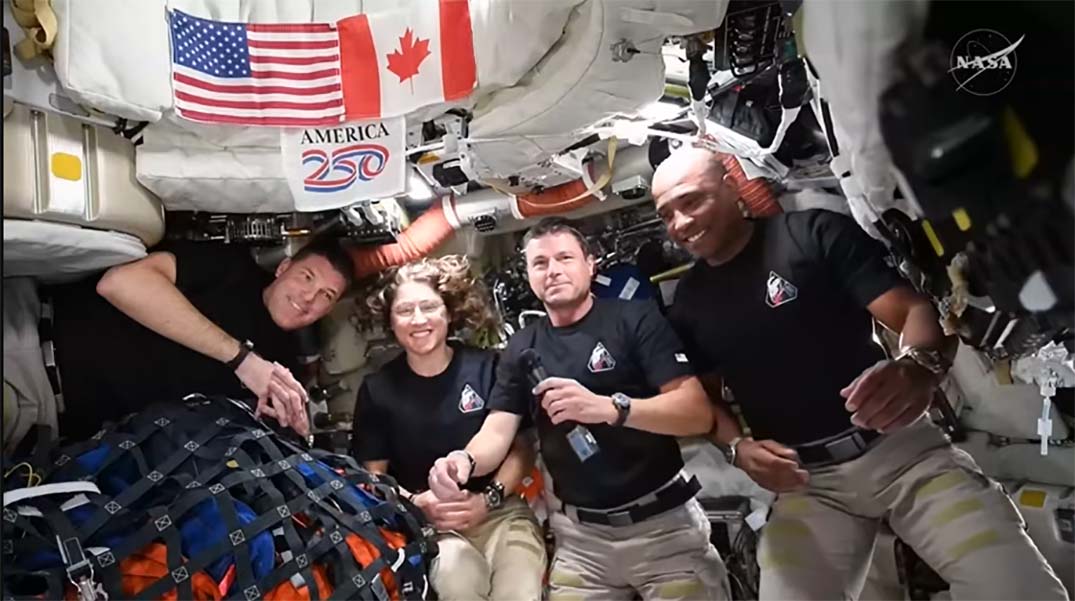
Featured picture: The Artemis II crew – CSA (Canadian Space Agency) Astronaut Jeremy Hansen (far left) and NASA astronauts Christina Koch (centre left), Reid Wiseman (centre right), and Victor Glover (right) – following their historic lunar flyby during Flight Day 6.
NASA