
As the growth strategies that powered the global economy over the past three decades lose relevance, a new World Economic Forum report calls for a renewed blueprint to navigate a rapidly evolving landscape shaped by AI, geostrategic competition, rising debt and inequality, and mounting environmental and demographic pressures.
The report draws on two years of dialogue with nearly 200 global business leaders, policy-makers and experts, and a survey of more than 11 000 executives worldwide.
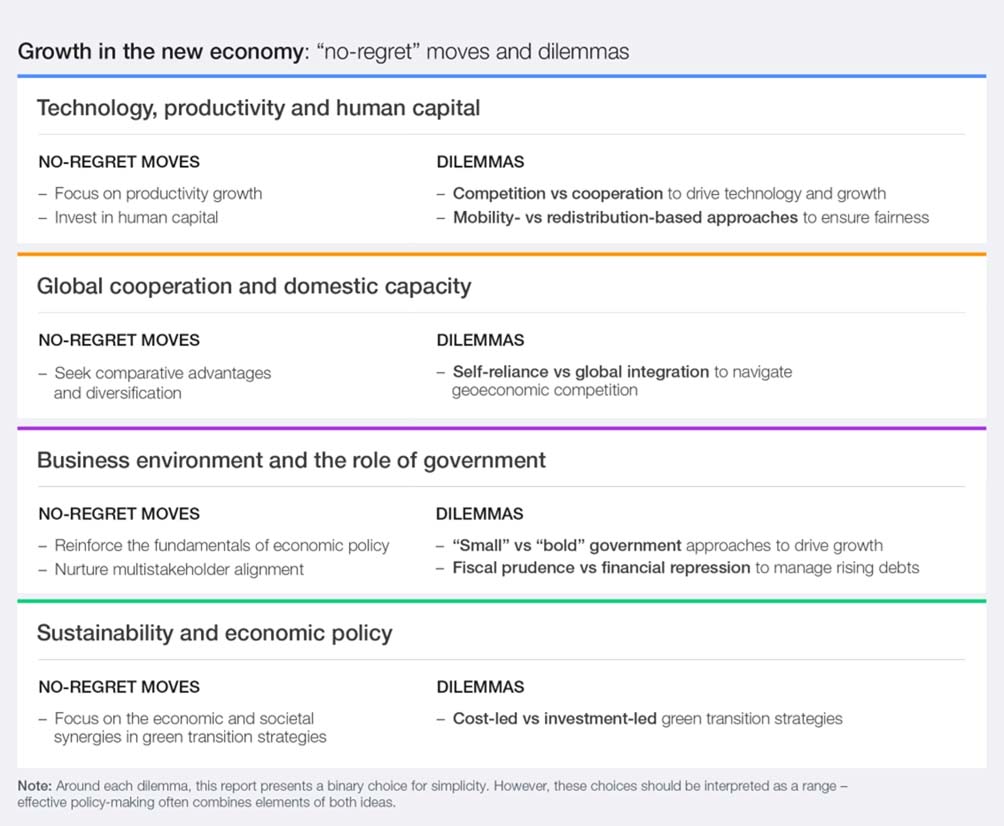
Across four major areas of economic policy, Growth in the New Economy: Towards a Blueprint identifies key “no-regret” strategies and open dilemmas for governments and businesses that will define economic policy in the coming decade:
- Technology, productivity and human capital: Sustained growth in the new economy will depend on strengthening productivity and human capital as technology and knowledge become central to value creation. Governments and businesses must navigate between different approaches to translating innovation into new sources of growth and ensuring its benefits are widely shared, pursuing coordinated or competition-led approaches to harness technology and prioritise redistribution or mobility-based strategies for economic inclusion.
- Global co-operation and domestic capacity: Leveraging comparative advantage and diversification remain “no-regret” strategies that may enable expansion of economic opportunity and resilience. Yet, governments and businesses will need to balance global engagement with stronger domestic capacity, navigating between self-reliance and global integration strategies.
- Business environment and the role of government: In the new economy, reinforcing the fundamentals of economic policy – including credible institutions, high-quality infrastructure and macroeconomic stability – and strengthening multistakeholder alignment continue to be winning strategies. The role of government in economic transformation can range from minimal to more expansive, while policy-makers face hard choices to manage debt levels, shifting between greater fiscal prudence and forms of financial repression.
- Sustainability and economic policy: Focusing on the economic and societal benefits of green transition strategies is essential to unlocking long-term prosperity and resilience. Critical dilemmas around how to manage the costs and trade-offs of greener growth persist, with decision-makers navigating a range of investment-led and cost-led strategies.
“The current context demands bold choices and trade-offs from government and businesses. Investing in productivity, talent and reinforcing the fundamentals of economic policy are clear winning strategies that hold across every country and income level,” says Attilio Di Battista, head of economic growth and transformation at World Economic Forum.
“Yet leaders will need to navigate complex dilemmas while managing record levels of debt and inequalities, rising geostrategic competition, a persisting climate crisis and the fastest technological shift in a generation.”
Shifting engines of global growth
Amid disruptions brought by the current conflict in the Middle East, the report points to long-term shifts in the composition and drivers of economic growth.
Middle-income economies are expected to account for nearly two-thirds of global GDP growth through 2030. Regionally, Asia will continue to be the main driver of growth, accounting for more than 50% of global growth.
Despite registering the fastest growth rates, low-income economies are projected to contribute just 1% of global growth over the same period.
Information technology services, advanced manufacturing, health and healthcare, and accommodation and leisure sectors are expected to drive growth over the next five years, with Asia, Europe and North America as key hotspots. Latin America and the Caribbean will see opportunities in the agriculture, mining and metals sectors.
Opportunities and challenges
Based on the results of the recent survey of 11 000 business leaders, the report highlights high energy costs and policy instability as the two barriers that are constraining an acceleration of economic growth across various geographies and income levels.
Other barriers vary by country income level. In high-income economies, skill shortages and rigid regulations are seen as the top barriers, while in low-income economies, limited access to finance and inadequate infrastructure were top concerns.
In the long-term, frontier technologies and the green and energy transition are identified as trends that will drive growth and investment, while high debt, societal polarization and climate change are seen as potential headwinds across regions and income levels.
Demographic shifts and geoeconomic fragmentation are expected to create divergent growth trajectories, with ageing populations slowing growth in Eastern Asia and Europe, and younger populations supporting growth in the Middle East and North Africa, and Sub-Saharan Africa.
Geoeconomic fragmentation is seen as a drag on growth in most countries, though executives expect South-East Asia to benefit from shifting supply chains and trade patterns.
In addition, domestic corporate investment and foreign demand are seen as the main drivers of growth over the next five years.
Domestic investment is especially important in low- and middle-income economies, while advanced economies look to foreign markets.
Domestic consumption and public spending are expected to play a smaller role due to high public debt and stagnant real incomes.