
Eighty-five percent of customer service and support leaders are expanding human agent responsibilities as AI reduces contact volume and shifts work toward higher-value tasks, according to a survey by Gartner.
Just 31% have implemented, or are planning, frontline workforce reductions through layoffs in response to AI through 1Q27.
A Gartner survey of 321 customer service and support leaders worldwide, conducted from September through October 2025, found that workforce transformation is nonetheless underway, with 80% of service and support leaders reporting pressure to make workforce changes as AI reduces contact volumes and improves agent efficiency.
“Service and support leaders need a plan for how they will reshape their workforce for AI’s impact, otherwise a plan will be handed to them,” said Kathy Ross, vice-president analyst in the Gartner Customer Service & Support Practice.
Rather than pursuing widespread job cuts, more organizations are taking a measured approach to managing these shifts.
Sixty-three percent (63%) of service leaders are reducing frontline headcount gradually through attrition, while reallocating agent capacity toward higher‑value responsibilities that support growth, loyalty and long‑term efficiency.
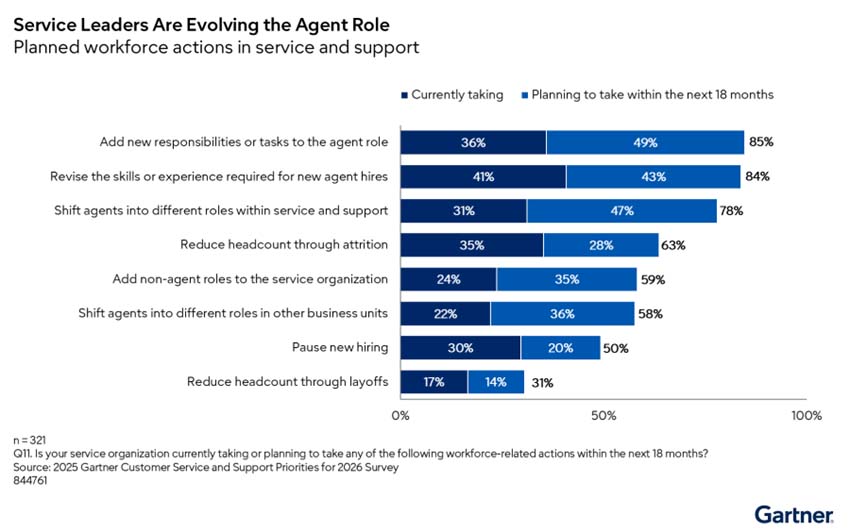
Source: Gartner (October 2026)
“Organisations that only use AI to reduce costs risk missing a strategic opportunity,” says Eric Keller, senior director analyst in the Gartner Customer Service & Support practice. “The real advantage comes from combining AI efficiency with human judgment, empathy and experience to deliver outcomes that technology alone cannot.
“As AI begins to automate simple work, that success creates a new challenge,” he adds. “Service leaders must decide whether to simply do the same work at lower cost or to redeploy human agents into roles that AI cannot replace and that customers value most.”
AI Expands the Scope of Human Work
Rather than using AI efficiency gains solely to reduce costs, the majority of organisations are expanding and redefining the role of the human agent. The survey found that 85% of service leaders are adding new tasks and responsibilities to frontline agent roles, while 75% are shifting agents into entirely new roles within the service and support organisation.
Despite external expectations for rapid workforce reductions, large‑scale layoffs remain the exception rather than the norm, underscoring a broader shift toward workforce redesign rather than elimination.
As agent roles evolve, human interaction continues to play a critical role in customer trust and decision‑making. In a separate Gartner customer survey of 5 801 customers in the US, conducted from January to February 2025, 54% of customers said they trust human agents more than AI for product or service recommendations, compared with 32% who trust AI more, reinforcing the importance of human involvement in complex, high‑stakes or advisory interactions.
“Organisations that only use AI to reduce costs risk missing a strategic opportunity,” says Keller. “The real advantage comes from combining AI efficiency with human judgment, empathy and experience to deliver outcomes that technology alone cannot.”