
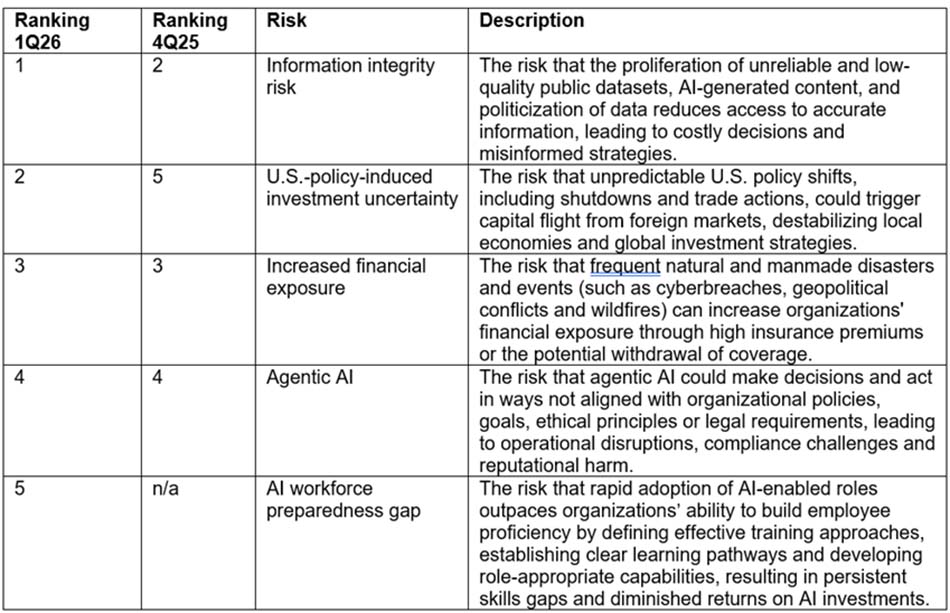
Information integrity risk, caused by the proliferation of AI‑enabled decision-making and uncertain AI transparency requirements, gained the top rank of emerging risks for the first quarter of 2026, according to Gartner.
The Gartner Quarterly Emerging Risk Report series gathers insights and perspectives from enterprise risk management (ERM) leaders, risk management professionals, auditors and senior executives on emerging and over-the-horizon risks.
The survey of 337 senior risk and assurance executives introduced AI workforce preparedness as a critical new risk and features an expanded issue spotlight on responding to geopolitical uncertainty.
“The emerging risks in the first quarter of 2026 show new concern related to AI in the workforce and how preparedness is an increasing issue,” says Gamika Takkar, director: research, in the Gartner Risk & Audit Practice.
The survey also showed that the low-growth economic environment, which relates to financial instability, high unemployment and inflation, no longer ranks as a top emerging risk as it had registered in the survey for the last half of 2025.
Top Emerging Risks of 1Q26
Source: Gartner (May 2026)
Emerging risks are defined as highly uncertain risks whose effects have not yet been substantially realised by most organisations and therefore lend to increased unpredictability and concern.
Concerns related to AI and informational integrity span risk issues related to rapid AI innovation and vulnerabilities related to organizational planning, transparency and regulation, malicious actors and leadership communication.
Geopolitical uncertainty under the spotlight
The 1Q26 Emerging Risks Report noted a rapid concern regarding geopolitical conditions that are creating a stream of new and intensified risks.
These threats are uncertain, volatile and largely external, making them difficult for organizations to determine appropriate and timely responses.
To approach these uncertainties, leaders should use a scenario matrix to define the focal issue, identify driving forces, craft potential scenarios, explore implications and develop action plans.
“Starting with the highest-priority scenario, organisations should create an action plan outlining response options to take now and define early-warning triggers for future action,” says Takkar.