
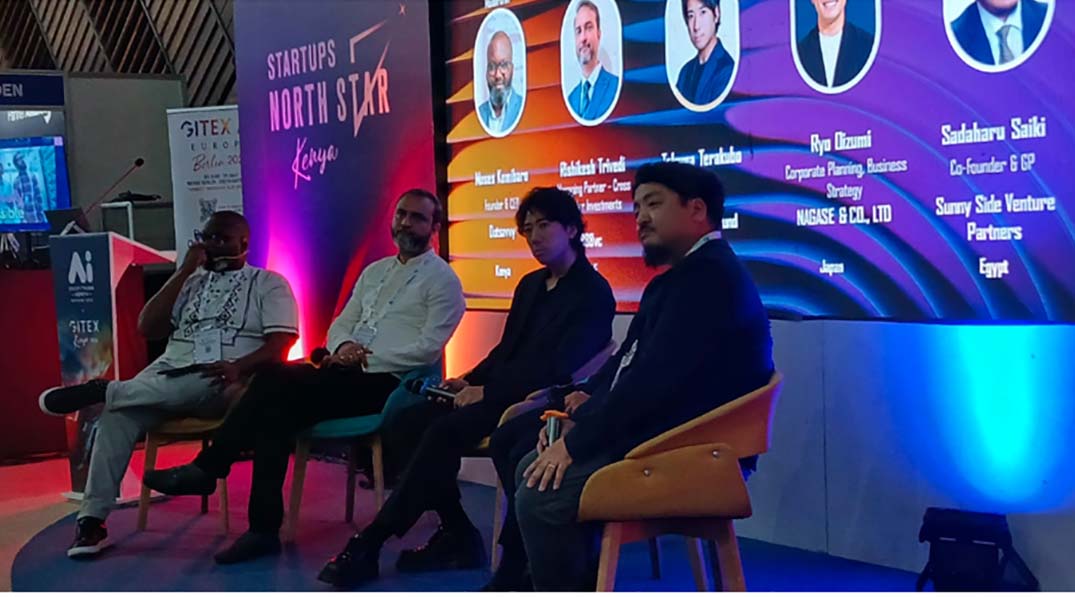
Kathy Gibson reports from AI Everything and Gitex Kenya in Nairobi – Africa’s exciting and innovative start-ups are attracting interest from investors in the Middle East, Europe and Asia.
Investors from these regions are arguably more aligned to the continent’s specific personality and nuances, and are mostly ready to take a long-term position.
Rishikesh Trivedi, MD: cross border investments at 888vc, UAE, stresses that investors from his region are in this for the long-haul.
But he warns that a common mistake is to view Africa as a single entity. “The continent has 54 countries, each with their own maturity and technology standpoint. So you cannot look at Africa as a whole.”
Investors should also modify their return on investment (ROI) expectations when working in Africa, he says. “Typically, an investment takes five to seven years to deliver ROI. But in Africa, the expectation is eight to 20 years.
“So you need to be more careful, more razor-sharp about the countries and companies you look at.”
North Africa, for instance is very close to the GCC market; West Africa encompasses not just Nigeria, but also the Francophone countries which have their own influences from Europe; South Africa is closer to the western world, as a more mature market with returns closer to what would be seen in the developed market.
Takuma Terakubo, CEO and general partner at Uncovered Fune, Japan, agrees that a long-term view is necessary in Africa – and this suits the way Japanese investors prefer to work.
“I always think about where Africa needs to be in the next 100 years,” Terakubo says.
“Japanese companies tend to have been operating for a long time, so they are looking for long-term relationships: they are not interested in quick returns.”
Ryo Oizumi, director: corporate planning division, business strategy office at Nagase & Co, Japan, typifies this long-term approach: his company has been investigating the African market for the last three years and is only now looking to open a branch.
Sadaharu Saiki, co-founder and general partner at Sunny Side Venture Partners, points out that there are many very good reasons for investing in Africa.
“There are two numbers that I want to talk about: 19,8 – which is the average age in Africa; and 48,6 – which the median age in Japan.
“The Japanese population is aging and declining, so we need to tap into growing markets to keep our economy robust.
“While Africa is expected to see 1,7x growth, Japan is predicted to see 1,2x growth. So the growth potential in Africa is tremendous.”
Saiki points out that Africa is the fastest-growing market for startup investment in the world – but, at the same time, it is the most underserved ecosystem in the world compared to its potential.
“So it is the fastest-growing market, but there is still a lot to fill in terms of white space. If venture capitalists bet on the continent now, we are sure it will catch up and we will get great benefit.”
Terakubo cautions that investors and start-ups need to avoid some common mistakes when looking to expand.
“Africa is not one country, and it is huge. A lot of startups battle to expand in the continent, even neighbouring countries. But we have to look for bigger markets.
“Another challenge is the lack of infrastructure on the continent, which can be an impediment to business. But startups, with the right investment, can help to mitigate these challenges.”
Trivedi adds that startups should modify their investment pitches when approaching Middle Eastern or Asian investors.
“Africa has always been connected through global trading, but the capital flows are only starting now. Investors are looking at capital flow, but also ROI, risk, liquidity blockages and more.
“You need to understand that sophisticated investors also look at the impact they can create using money as a tool – both in Africa and in their home countries.
“It is not just about putting capital into the region, but about the Middle East and Africa collaborating. The Middle East can put in the funds, and Africa can offer significant talent and a consumer base. There are also a lot of similarities and synergies between Africa and India.”
Relationship capital is also important, Trivedi adds.
“Often founders tend to believe that the Gulf or Asian investors are only looking at the money return. But if you want to create a compelling story to Middle Eastern or Asian investors, first find out what their priorities are and what they want to achieve apart from financial returns.”
For instance, he points out that the UAE has a big focus on food security, so founders should create a food security narrative as part of the capital flow and model pitch.
“A relationship is necessary, but not always sufficient – as an investor, the first thing I want to see is that I can work with the founder for the next 10 years.”
Saiki adds that founders need to realise that international investors have options and could invest in many other markets. “So come from the perspective that we have different choices, and articulate why you do what you are doing; specify the market size and what is unique about it; and offer comparisons to other companies in other markets.”