
Kathy Gibson reports from Everything AI and Gitex Kenya in Nairobi – For many African start-ups, their biggest challenge is not coming up with solutions or creating systems that work – it is in scaling them effectively.
Once the excitement of the initial idea and prototyping is over, the real work begins in bringing a product to market and ensuring that enough people are willing to pay for it.
This is the only measure of success, says Jehiel Oliver, founder and CEO of Hello Tractor, Kenya. “You need to solve problems that matter to customers to the extent that they are willing to pay for it.”
And this means entrepreneurs must keep disciplined control of the balance sheet while looking to harness the right kind of capital.
“For instance, we looked to strategic capital and partnered with John Deere,” Oliver says.
Because their main market is smallholder farms, Hello Tractor aims to provide added services to build relationships and trust.
“It can’t be about just profit,” Oliver says. “So you need to think about what matters to your customers, be aligned with their outcomes – and this will bring them back to you.”
Farming is a complex undertaking, so part of Hello Tractor’s value-add is in the creation of a timeline of everything that happens in the files, and providing advice.
“If you are a farmer in our network, we make information available that can help in your decision-making,” Oliver says.
Artificial intelligence has a role to play in gathering data, but Oliver says decisions are deterministic to avoid AI hallucinations.
This information has to be easy to understand and in a format that is easy for farmers to consume.
“What we have created is a freemium product that empowers farmers to make the right decisions,” Oliver explains. “That might mean that they don’t need our mechanisation services, but they are more likely to come back next year.”
This helps to build trust, which is vital, Oliver says.
“It is difficult to be an outsider giving farmers mission-critical advice on what is their only source of income. That is why we invest in trust networks. Agents in the communities earn a commission when they book a farmer for a service; and then we can finance them to become tractor owners themselves. We are the biggest financer of tractors in Kenya, with our customers typically unbanked rural entrepreneurs who have acquired the trust of their community.
“When you are serving low-income communities, that trust is doubly important,” he says.
Scaling the model has been challenging, Oliver adds.
Initially the company had a footprint outside of Africa, but pulled back to focus only on the continent.
“The size of the opportunity in Africa is the greatest.”
Hello Tractor now operates in 20 African countries. Because the investment has been mainly into cloud services, the application and the data layer, scaling to new markets generally involves just opening a local office to finance the tractors and provide services.
“Proximity matters,” Oliver points out. “You can’t be extractive: farmers want to see you making an investment into their community.”
Patient capital for infrastructure
When it comes to infrastructure projects, patient capital gives startups the time and latitude to develop and grow their businesses without the short-term pressure of chasing a quick return on investment (ROI).
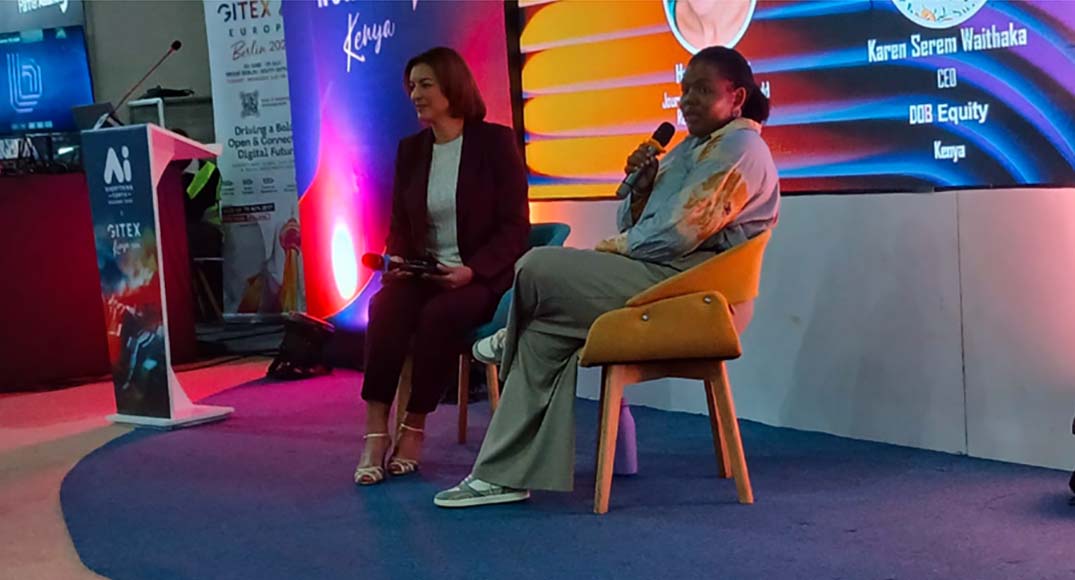
Karen Serem Waithaka, CEO of the impact fund DOB Equity, points out that funds like this are typically beneficial for water, energy, or food businesses.
“Our investments are made with a view to the long haul; and we often continue to invest funds back into the portfolio,” she says.
This doesn’t mean that startups can cruise along without ever generating an ROI, she stresses. In fact, they are usually selected with the same – or more – stringency as a traditional venture capitalist (VC) would use.
“They need to be a viable business and meet the criteria the fund sets.,” she says. “But we are cognizant that it takes longer in the infrastructure space and the agricultural market to gain a footing, build roots, begin to scale, and become viable.”
These funds are not grants or philanthropy, Waithaka adds. “We have a responsibility that we will return the capital deployed back to the fund; and we do require there to be commercial returns as well. And there needs to be exit opportunities.”
Many African startups are still mired in infrastructure issues and are not yet at the stage that most VCs would consider them viable, so they rely on a blended funding strategy or discretionary capital.
In order to get these businesses viable, Waithaka says a number of things are required.
“The infrastructure gap, in general, needs to be addressed,” she says. “At the moment, logistics and deploying solutions to the end user is hard.
“Currency issues are a big challenge. Raw materials cost dollars, while revenue is in shillings,” she adds. “And the regulatory environment needs to be modified to enable these businesses to thrive.
“Until these challenges are fixed they will continue to need subsidies.”
If these issues could be addressed, Waithaka believes enough capital would be available.
“It’s a hoax that there is not enough capital,” she says. “But there is a lot more that needs to be fixed. From a policy perspective, we need to have an enabling environment; and from a positioning perspective start-ups need to demonstrate that their ventures will be able to stand on their own feet.”
Waithaka advises startups to do their research properly before applying for finance.
“Understand what type of capital you will need, how much you’ll need, and what you’ll use it for,” she advises. “When you approach an investor or accelerator understand what you need to get out of their investment – whether it is just capital or other things as well.
“Then think about the next step – always think about what your next moves will be,” Waithaka says.