

New jobs data shows significant variances in how much professionals in different parts of South Africa can earn based on regional, labour market dynamics.
This is according to Pnet’s May 2026 Job Market Trends Report, which includes an exploration of how salary ranges vary for the same job roles across different provinces, based on vacancies posted across the company’s platforms.
Unsurprisingly, professionals in Gauteng command the highest salary premiums in most job categories, due to the province’s status as South Africa’s largest economic hub and the high concentration of corporate headquarters and growth industries. Salaries in the Western Cape are also competitive, particularly for technology roles in a province that has built a dynamic software and services sector.
“Your location has a significant bearing on your earning potential, with professionals in Gauteng and the Western Cape outearning their peers in the other provinces across most job roles,” says Anja Bates, head of data at Pnet. “Variations in salaries across different locations are driven by a number of factors, including the economic activity of each province, industry concentration, labour demand, skills shortages and regional living costs.”
For employers, regional salary benchmarks help inform competitive remuneration strategies. For jobseekers, they provide insight into where specific skills command the highest market value and can support career and relocation decisions.
A breakdown of the numers shows how salaries diverge from the average depending on location (for other roles, access the full report here):
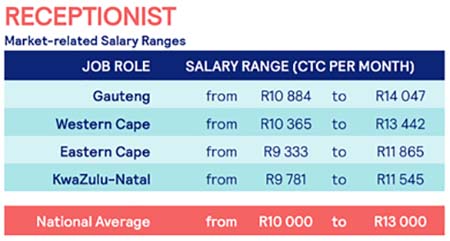
In Gauteng, receptionists earn up to 9% more than the national average for this role, while receptionists in the Western Cape earn up to 4% more than the national average. By comparison, in the Eastern Cape salaries for receptionists are up to 7% lower than the national average. In KwaZulu-Natal, salaries for receptionists are up to 2% lower than the national average.
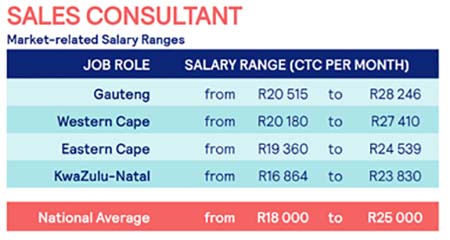
In Gauteng, sales consultants earn up to 14% more than the national average and sales consultants in the Western Cape command a premium of up to 12% more than the national average. On the other hand, in the Eastern Cape salaries for sales consultants are an average of up to 5% lower.
In Gauteng, accountants earn up to 19% more than the national average for this role, while those in the Western Cape earn up to 9% more than the national average. Eastern Cape salaries for accountants are up to 17% lower than the national average and salaries for accountants in KwaZulu-Natal are up to 2% lower than the national average.
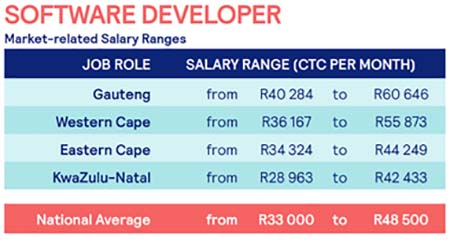
In Gauteng, software developers can command salaries of up to 25% above the national average, while those in the Western Cape can earn up to 15% more. In KwaZulu-Natal, software developers earn up to 4% more than the national average for this role. But Eastern Cape software developers may earn up to 12% less than the national average.
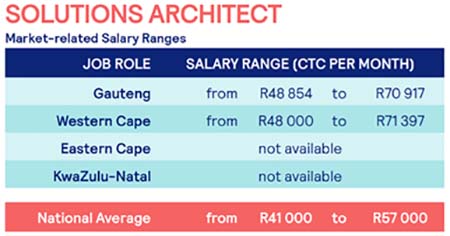
In Gauteng, solutions architects can earn up to 24% more than the national average for this role. In the Western Cape, these professionals earn up to 25% more than the national average.
“For employers, these regional differences highlight the importance of benchmarking remuneration against local market conditions rather than relying on national averages. Understanding where salary expectations are highest can help organisations attract and retain talent in an increasingly competitive labour market,” says Bates.
“For jobseekers, the findings demonstrate that the same skills can command significantly different salaries depending on location. While relocation is not always practical or desirable, understanding regional salary trends can help professionals make more informed career decisions and negotiate compensation with greater confidence.”