
Chief financial officers (CFOs) must learn from frontier finance teams how to position finance, so they can reshape enterprise decision-making by 2030, according to Gartner.
Gartner defines frontier finance teams as finance functions that are furthest along in building AI-enabled decision support, digital talent and new operating models.
Hakan Gunaydin, senior director analyst in the Gartner Finance practice, argues that pioneering finance functions are beginning to show how finance can move beyond traditional reporting and analysis to provide always-on strategic simulations, enable smarter risk-taking and deliver finance services through digital products.
“In the near future, finance will provide insights and answers before even being asked,” says Gunaydin. “It will constantly scan where the enterprise is heading, help business leaders make smarter bets, and develop the workforce and ways of working needed to deliver on that promise.”
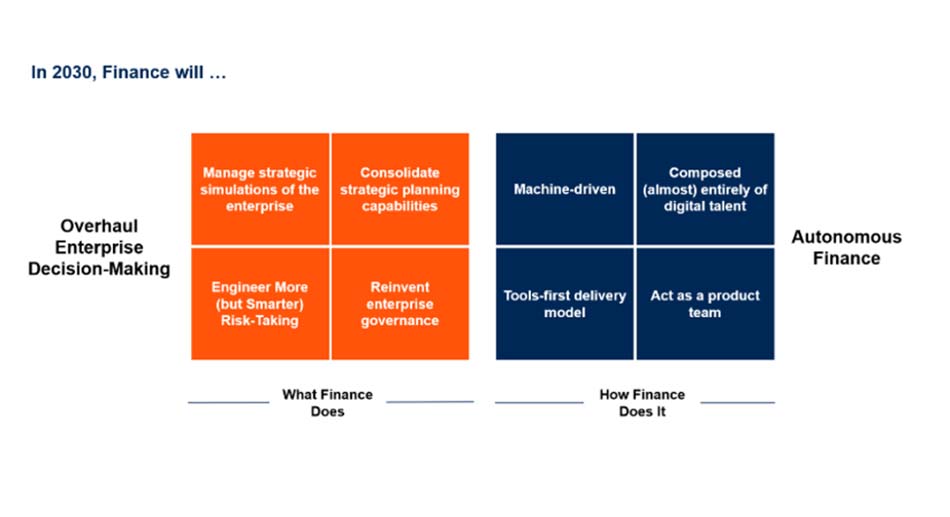
According to Gartner, frontier teams in 2030 will be defined by both their expanded role in the enterprise and the new operating model required to deliver it. They will manage strategic simulations, enable smarter risk-taking, reinvent governance and consolidate strategic planning capabilities. These activities will increase the speed, quality and consistency of enterprise decisions, while gradually creating the autonomous finance function, which will be machine-driven, tools-first, product-oriented and composed almost entirely of digital talent (see Figure 1).
Key Attributes of Frontier Finance in 2030
Source: Gartner (June 2026)
CFOs must build the capabilities to reach the frontier
To get there, CFOs will need to move finance decision support away from bespoke analysis and toward always-on tools, models and simulations that business leaders can use to test choices faster.
“Decision clock speed, the time it takes an organization to move from ‘what if?’ to ‘do it,’ will become a competitive advantage or a liability,” says Gunaydin. “By 2030, finance-built strategic simulations of the enterprise will enable business leaders to make better and faster decisions.”
Finance teams will also need to counterbalance excessive risk aversion and enable smarter risk-taking by removing “growth anchors”, such as inefficient processes, opaque data, misaligned KPIs and internal controls that slow decision making or discourage bigger opportunities.
To deliver these capabilities, Gunaydin says finance teams will increasingly need to adopt a product mindset. This means building scalable tools, models, simulations and insights around defined user needs, with ongoing ownership and continuous improvement. “Finance always wanted to be closer to the business, says Gunaydin. “Acting as a product team makes it possible.”
“Very few companies will be fully at the frontier,” Gunaydin adds. “But once CFOs set the right foundations and start taking the right steps, most will be at the frontier in many places.”