
As organisations accelerate AI adoption to drive growth and efficiency, CHROs must play a more active role in assessing the workforce-related costs of AI transformation.
Jan Bansch, senior director analyst in the Gartner HR practice, talks about how CHROs can help mitigate the hidden workforce costs associated with AI adoption and optimize the ROI on AI investments.
What workforce cost risks are emerging as more organizations implement AI?
There are three main workforce cost risks emerging that have the potential to undermine the expected ROI from AI if not proactively managed:
- Escalating AI talent costs: Demand for AI skills has led to significantly higher compensation, with AI-related roles paid up to three to four times the average worker. At the same time, the relevance of AI skills is declining more quickly, with skill life cycles shortening to as little as two to five years, increasing the risk of long-term cost exposure for skills that may quickly depreciate.
- Pressure on pay-for-performance models: AI is increasing the speed and volume of work, but most organizations have not adjusted performance expectations or compensation structures. This creates a risk of unintended payouts and misaligned incentives.
- Unforeseen costs from reductions in force: AI-driven productivity gains are leading to workforce reductions, particularly in early career roles. However, many of these roles may need to be rehired. Gartner predicts that by 2029, up to 30% of employees displaced by AI are expected to be rehired, often at higher cost.
Utility of AI Roles Impacted by Shortening Skill Life Cycles
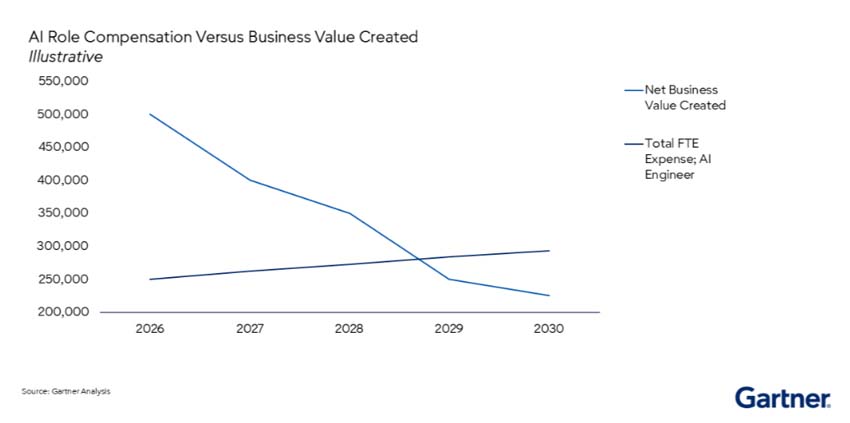
Source: Gartner (April 2026)
How can CHROs manage the risks around workforce costs and AI?
To manage these risks, CHROs must partner with C-suite peers and initiate conversations to align on workforce cost implications and appropriate responses.
We have identified three key areas where CHROs should take the lead:
- Actively manage the high costs for AI talent: CHROs should partner with technology and finance leaders to identify the most critical AI skills and target compensation accordingly. At the same time, CHROs should assess the full cost implications of these roles, including risks such as overpaying for in-demand skills, overhiring for roles that may quickly lose value, and impacts on overall workforce costs.
- Build C-suite understanding of the “hidden” costs of layoffs: CHROs should engage executive leaders to evaluate the longer-term impact of reductions-in-force, including potential rehiring, talent pipeline effects and overall workforce cost implications. For example, CHROs can bring together the CEO and executive leadership team to discuss whether roles eliminated during AI-driven changes may need to be rehired, helping align leaders on longer-term hiring and workforce cost strategies.
- Redefine your pay-for-performance model: CHROs are best positioned to initiate conversations with executive leaders to assess how AI-driven changes in productivity may affect performance metrics and compensation structures, and to identify potential unintended outcomes.
Why are workforce costs becoming a critical risk to AI ROI?
The primary risk to ROI stems from the unexpected and unbudgeted cost of workforce transformation, which can outweigh the cost of the technology itself. As organizations increase their investment in AI, they are simultaneously introducing new workforce cost pressures that are often not fully assessed or incorporated into financial planning.
This issue is likely to get worse – a November 2025 Gartner survey of 469 active CEOs found that 88% of organizations plan to increase investment in AI, heightening the urgency to demonstrate financial returns.
This creates a fundamental challenge: the workforce is one of the largest drivers of enterprise cost, yet AI-related workforce changes are frequently managed without a full view of their financial implications. Without addressing these risks, organizations may struggle to meet the anticipated financial and business objectives tied to their AI investments.