
In November this year, Voyager 1 will make history by becoming the first man-made object to reach one light-day from Earth.
The milestone, expected to take place on 18 November 2026, will mean the spacecraft has travelled 25 902 068 356 kilometres away from Earth — the distance light travels in 24 hours.
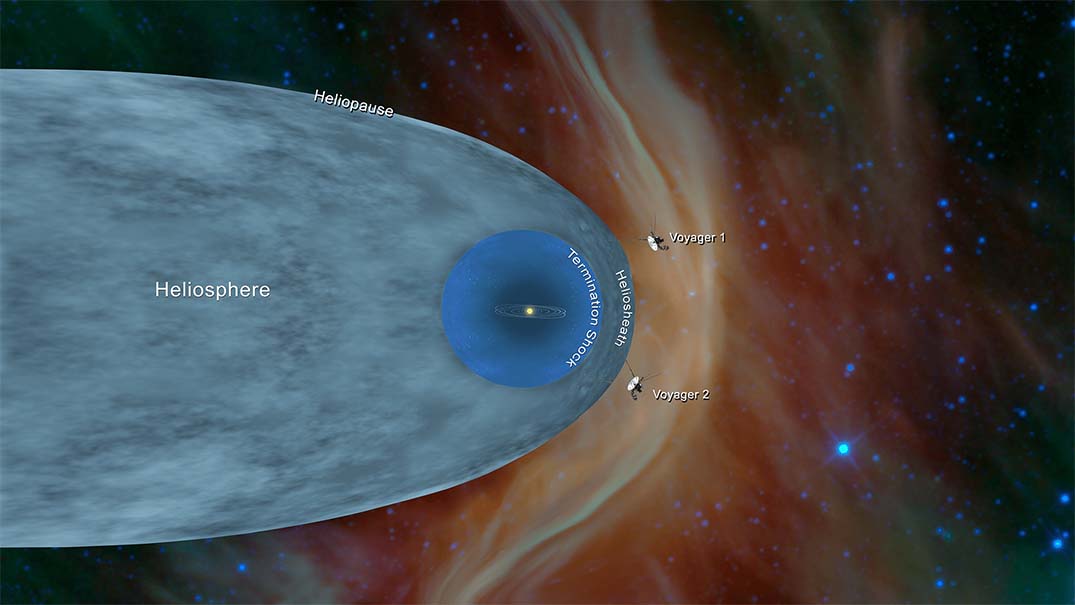
It’s not the only first that Voyager has notched up: With its twin, Voyager 2, they are the only spacecraft to ever operate outside the heliosphere, or the protective bubble of particles and magnetic fields generated by the Sun.
The Voyager Interstellar Mission (VIM) extends Voyager’s exploration beyond our solar system’s outer planets to interstellar space.
Its primary goals are to characterise the outer solar system environment, search for the heliopause (the outer edge of the heliosphere), and study interstellar space, the space beyond the heliosphere.
The probes achieved the first two goals, with Voyager 1 reaching the interstellar boundary in 2012, while Voyager 2 (traveling slower and in a different direction than its twin) reached it in 2018.
Voyager 1 and Voyager 2 are the only spacecraft in history to operate outside of the heliosphere.
Now, the mission is measuring interstellar magnetic fields, particles, and plasma waves in interstellar space.
VIM overview
The VIM is an extension of the Voyager planetary mission that was completed in 1989.
The planetary mission began with close flybys of Jupiter and Saturn by both Voyager 1 and 2, followed by an extension of the planetary mission in which Voyager 2 completed close flybys of the remaining two planetary giants, Uranus and Neptune.
The VIM is an extension of the Voyager planetary mission that was completed in 1989.
The planetary mission began with close flybys of Jupiter and Saturn by both Voyager 1 and 2, followed by an extension of the planetary mission in which Voyager 2 completed close flybys of the remaining two planetary giants, Uranus and Neptune.
At the start of the VIM in 1989, the two Voyager spacecraft had been in flight for over 12 years, having launched in August (Voyager 2) and September (Voyager 1) 1977. At the start of the VIM, Voyager 1 was about 40 AU (astronomical units) from the Sun, and Voyager 2 was about 31 AU away. An AU equals the distance from Earth to the Sun, about 149,5-million kilometres.
The VIM includes three distinct phases: termination shock, heliosheath, and interstellar space.
The termination shock is one boundary of the Sun’s influence. At the termination shock, the solar wind slows down, abruptly dropping from supersonic speed to less than the speed of sound. The plasma particles that make up the solar wind slow down because they start pushing against and interacting with the interstellar medium — the gas, dust, and other material that exists in the space between stars. The pressure of the interstellar medium pushes against the solar wind through the heliosphere, eventually keeping the solar wind from flowing into interstellar space. Also, at the termination shock, the Sun’s magnetic field gets stronger and changes direction.
Voyager 1 passed through the termination shock in December 2004 at 94 AU, and Voyager 2 passed this boundary at 84 AU in August 2007. To check Voyager 1 and 2’s current distance from the Sun, visit the mission status page.
Next, the mission began the phase exploring the heliosheath, or the outer layer of the heliosphere that is still dominated by the Sun’s magnetic field and the particles in the solar wind.
After traveling through the termination shock and entering the heliosheath, the Voyager spacecraft journeyed on until each probe passed through the heliopause and into interstellar space.
Voyager 1 entered interstellar space on 25 August 2012, becoming the first human-made object to do so. Voyager 1 entered interstellar space at about 122 AU, or about 18-billion kilometres from the Sun.
However, it was not immediately clear to the Voyager science team that Voyager 1 had crossed the heliopause. Particle instruments on the spacecraft showed an increase in cosmic rays (which originate outside the heliosphere) and decreases in heliospheric particles.
But what would have been an additional source of confirmation, the probe’s plasma science instrument (PLS), had stopped working in 1980. The PLS was designed to measure the speed and direction of the solar wind while Voyager 1 was inside the heliosphere, and in interstellar space, it would have detected a dramatic drop in those measurements. Without the plasma science instrument, the Voyager science team couldn’t be sure the probe had left the heliosphere.
Thankfully, almost a year later, Voyager 1’s plasma wave subsystem (PWS) detected oscillations in the plasma surrounding the spacecraft, which indicated that Voyager 1 was moving into an increasingly dense region of plasma, a clear indicator that the probe had entered interstellar space.
Voyager 2 crossed this boundary on 5 November 2018, confirmed by data from both its particle instruments and its plasma science instrument. The twin Voyager spacecraft are still the only human-made objects to reach interstellar space.
The golden record
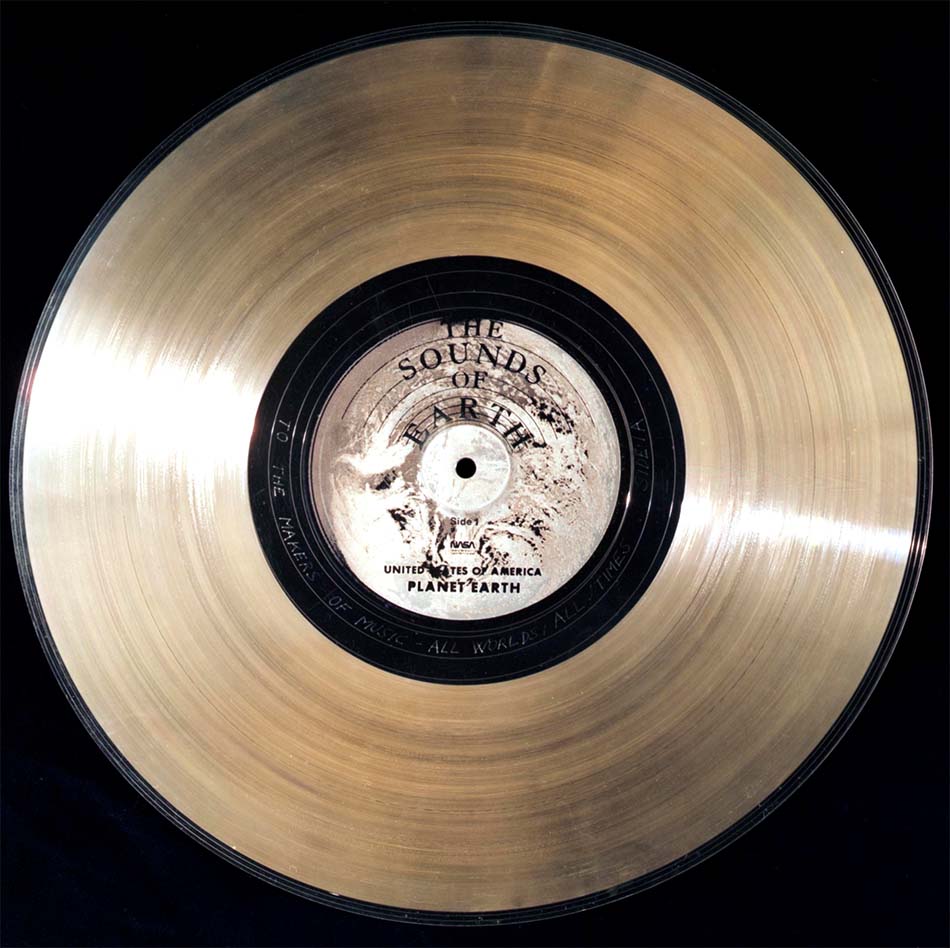
Both Voyager spacecraft carry a unique “time capsule” along with them into interstellar space.
Pioneers 10 and 11, which preceded Voyager, both carried small metal plaques identifying their time and place of origin for the benefit of any other spacefarers that might find them in the distant future.
With this example before them, NASA placed a more ambitious message aboard Voyager 1 and 2, a kind of time capsule, intended to communicate a story of our world to extraterrestrials.
The Voyager message is carried by a phonograph record, a 12-inch gold-plated copper disk containing sounds and images selected to portray the diversity of life and culture on Earth.
The record’s protective cover includes with instructions for playing its contents, finding Earth in the cosmos, and dating how long it has been in space.
The record features images and a variety of natural sounds, such thunder, birds, musical selections from different cultures and eras, and spoken greetings in 55 languages.