
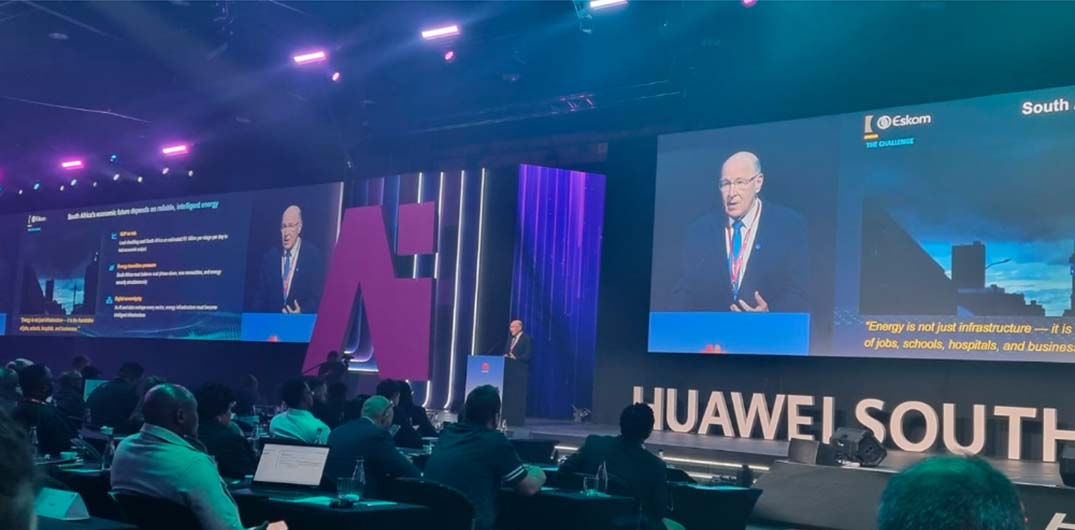
Kathy Gibson reports from Huawei SA Connect 2026 in Sandton – Africa’s biggest energy provider Eskom is in the midst of a major technology reset.
Group chief technology officer Len de Villiers, says the scope of the challenge is huge: with 42 000 staff members and 18 operating divisions – include the big operations of generation, distribution and transmission, the organisation serves 60-million end user customers through 7-million intermediaries in seven countries, providing 90% of the energy in South Africa and 30% in the rest of Africa.
“South Africa’s economic future depends on reliable and intelligent energy,” he points out.
With load shedding costing an estimated R1-billion per stage per day in lost economic output, the provision of electricity has a real effect on the GDP.
At the same time, the country is undergoing an energy transition, having to balance its coal phase-down with new renewables while ensuring energy security.
Any technology transition has to take the vital issue of digital sovereignty into account. “As AI and data reshape every sector, energy infrastructure must become intelligent infrastructure,” De Villiers stresses.
Another consideration that Eskom must make is the growing integration of IT and operational technology.
“Traditionally, IT and IT have been separate – but now they have to work together, under a single cybersecurity strategy.”
Added to that, a big part of the Eskom fleet is aging, much of it approaching end of life, but must still be managed efficiently.
AI and the technology transformation happening at Eskom is huge. “It is the biggest challenge of my career, and the most impactful,” De Villiers says.
It means transforming more than the system, but the people too.
“We are changing the culture: the way our people work, and the way they perform,” De Villiers says. “We are tracking performance, and managing people with scorecards, metrics and smart measurements. Getting people accountable for what they do is a huge project, and we are using AI in various of those components.”
Indeed, the power utility is looking to AI in many of its operations. “It is not just about efficiency, but about survival,” De Villiers says. “The country need more power every day for years to come. Even if we could fire and keep all of our power stations at the maximum, do our nest with nuclear and implement our green energy strategy, I believe we will still need more power.
As the organisations goes through its unbundling process, De Villers says the three entities will be able to drive up efficiency by operating freely and independently, regulated by good business practices.
The first stream of AI-powered solutions will involved the power processes, offering precise prediction, optimal dispatch and realtime balancing.
The second stream is about full asset lifecycle management: planning, construction, operation, and retirement
Steam three is full customer services, including realtime trading, proactive service and two-way interaction, with AI used to embed intelligence into operations.
De Villiers explains that AI will be employed in six areas addressing Eskom’s core business challenges:
- Customer engagement and call centre: customer and experience engagement, proactive outage notification, C&I energy optimisation services, and customer helpdesk automation.
- Smart operations: predictive maintenance and asset intelligence, cybersecurity and OT threat detection, outage prediction and restoration optimisation, environmental and emissions optimisation.
- AI infrastructure: data infrastructure, digital transformation incubator and virtual power plant orchestration.
- AI talent and skills management: GenAI copilots and knowledge assistants, engineering and operations copilots.
- Eskom 2.0 business operation workforce and field force optimisation: engineering and operations copilots, fraud detection and risk analytics, smarter meter data monetisation, vegetation and drone inspection.
- Energy trading and market analytics: dynamic proving and demand response and energy trading.
“But AI doesn’t come without risk, so an AI policy is essential,” De Villiers adds.
Under carefully controlled conditions, digital and AI transformation is accelerating at Eskom, with more than 220 pilot use cases underway, 20 active AI initiative and eight business areas represented.
In addition, seven initiative are already scaled and delivering value, while global utility use cases have been benchmarked, and eight critical and high-priority gaps identified and being addressed.
“We are aiming for smarter grid control, revenue and loss recovery, and human expertise plus AI,” De Villiers says.
“Digitalisation is now a strategic imperative, which is we are pairing engineering expertise with AI to improve reliability, affordability and sustainability.”