
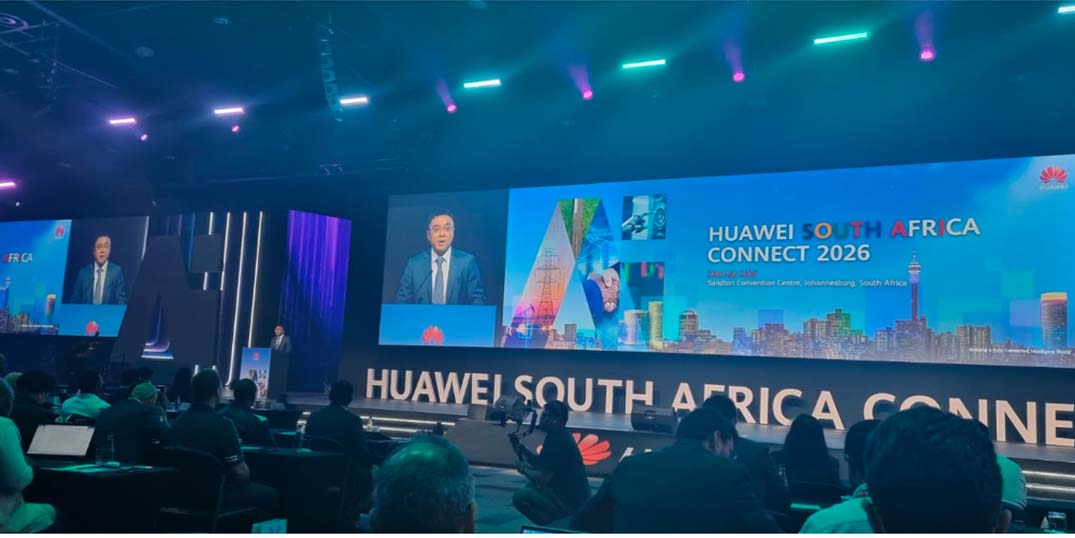
Kathy Gibson reports from Huawei SA Connect 2026 – Huawei has changed the AI acronym – it now speaks about All Intelligence that can create new value for industry.
Nicholas Ma, corporate vice-president, president global government and enterprise key account department at Huawei, points out that AI is accelerating intelligent transformation across industries and fueling the growth of the intelligent economy.
The pace of change is extraordinary: there are currently more than 30-million active AI agents deployed worldwide as AI moves from training to inference. And by 2035, there are expected to be as many as 90-billion AI agents.
IDC predicts that AI investment will exceed $4-trillion in the next five years. But this will be magnified further throughout society, with every dollar invested in AI generating $9.95 in returns, for a $32-trillion boost for the global economy. This translates to more than 3% of global GDP.
These benefits can only be achieved if nations focus on developing their digital infrastructures, Ma believes.
At last week’s World AI Conference in Shanghai, 29 nations – including South Africa – signed an agreement to co-operate on global AI governance, to ensure the orderly development of AI for the benefit of all people.
Ma points out that AI is evolving in leaps and bounds.
First, reasoning models are maturing, moving from pilots to large-scale use. In some fields, these vertical models will outperform expert experience, he believes.
Secondly, agentic workflows are maturing from support tools to core production. By 2028, 15% of daily work decisions will be made by AI agents.
Thirdly, AI is quickly bridging the digital and physical worlds. “AI can understand and interact with the physical world, and make decisions independently,” Ma explains.
However, there are a number of big challenges that must be overcome before we can see large-scale AI adoption.
The first is that AI is not yet integrated into business workflows.
Secondly, data is still trapped in silos. ‘What is needed is seamless data flows that don’t compromise security,” Ma says. This is critical because AI lowers the barriers to malicious attacks while raising the upper limit of the harm they can cause.
The third challenge is talent, Ma points out. “Currently, experts understand either AI or industry, but rarely both. Nations committed to cultivating talent will become the leading AI powerhouses.”
Huawei proposes ACT, a three-step pathway to AI success that encompasses scenario, data and talent.
A stands for accessing high-value scenarios, where businesses assess their business values, scenario maturity and technology maturity and then translate those scenarios into real value.
C is for calibrating AI models with high-quality vertical data. It is about taking knowledge engineering and data engineering into industry-specific models, then training them on open source models and vertical data.
T is for transforming business operations with AI talent, developing talent that understands both the relevant industry and AI. Ma explains that Huawei does this by focusing on helping industry experts share skills, enabling developers to solve industry challenges within open source communities. It is also growing AI talent through its ICT Academy.
The company is also incubating about 1 000 AI-powered core production scenarios and 100 AI operators for efficient data supply, while 4-million AI developers have been empowered and are thriving.
“Our vision is to empower AI intelligence,” Ma says. “South Africa is currently in a critical leapfrog development phase for AI development and integration.”
The South African market for AI is about R50-million today, which is expected to triple by 2030.
And the AI adoption rate has been good: according to BER research, 90% of South African respondents say they use AI during their work week.
“So South Africa can also benefit from the ACT approach,” Ma says. “Innovation will shape the future, and if we act now we can share the prosperity together.