

As South Africans face sharply higher fuel prices from yesterday, new Ipsos research shows that transport affordability is already affecting access to work and education for a significant number of people.
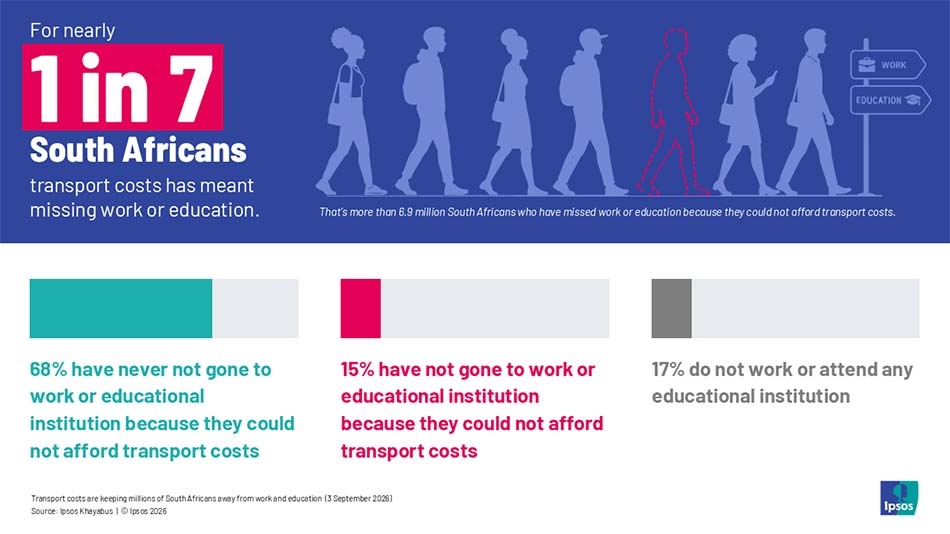
The nationally representative findings, from the Ipsos Khayabus “Pulse of the People” study shows that 15% of South Africans 15 years old and older said they had, at some point, not gone to work, school, college or university because they could not afford transport.
While most South Africans (68%) said they had never experience this, the findings reveal that transport affordability remains a real barrier to participation in education and the economy for a sizeable portion of the population.
The 15% may appear to be a relatively small proportion, but when projected to South Africa’s population aged 15 and older, it represents approximately 6,9-million people who say they have missed work, school, college or university at some point because they could not afford transport.
“Transport connects people to opportunity,” says Natalie Otte, country manager at Ipsos in South Africa. “When people cannot afford to travel, they may be missing job opportunities, losing income, falling behind in their studies, and becoming further disconnected from economic participation. These findings highlight how transport affordability has become a significant social and economic issue.”
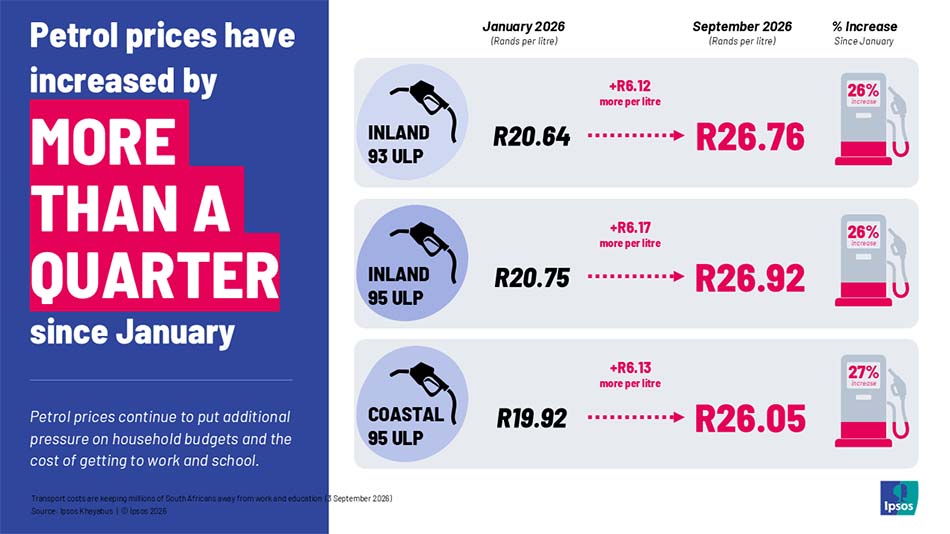
Fuel prices 26% higher than at the start of the year
According to the Fuels Industry Association of South Africa, inland 95 unleaded petrol increased from R25.58 per litre in August to R26.92 per litre in September, while inland 93 unleaded increased from R25.42 to R26.76 per litre. Coastal 95 unleaded increased from R24.71 to R26.05 per litre.
More significantly, petrol is now substantially more expensive than it was at the beginning of the year , placing pressure not only on private motorists but also on public transport operators, freight costs and household budgets.
While the Ipsos survey was conducted before the September fuel-price adjustment and does not measure the impact of the September increase specifically, the findings demonstrate that transport affordability concerns were already present before the current increase.
Younger adults are more affected
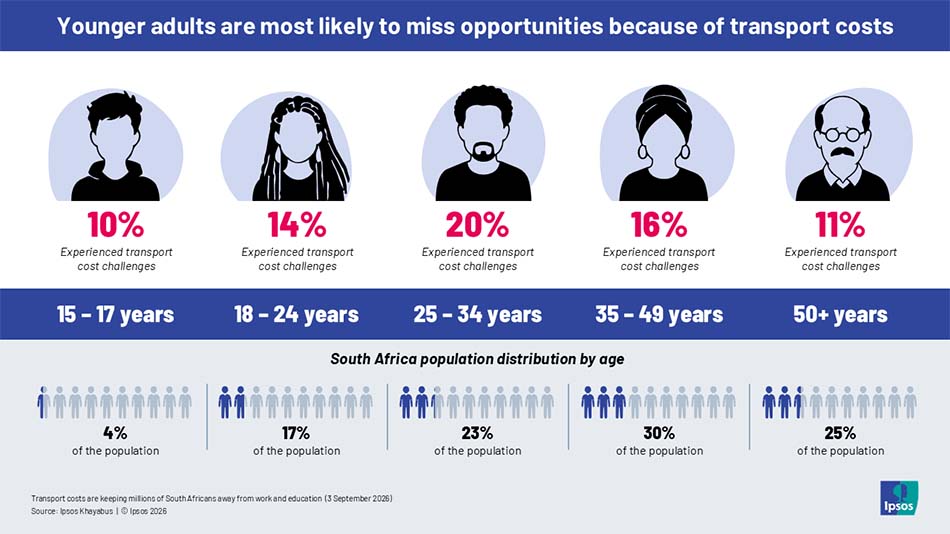
The burden of transport affordability falls disproportionately on younger South Africans. Those aged 25 to 34 represent 23% of South Africa’s population, with one in five (20%) reporting that they have missed work or education because they could not afford transport, the highest incidence of transport-related absenteeism across all age groups.
Among 35 to 49 year olds the figure remains high at 16%, while only 11% of South Africans aged 50 and older report having experienced the same challenge.
“The transition from education into employment is already a challenging period for many young South Africans,” notes Otte. “When transport costs become a barrier, individuals can find themselves trapped in a cycle where the inability to reach opportunities limits their ability to improve their circumstances.”
Transport costs remain an important cost-of-living issue
More than a quarter (27%) of respondents living in households with no household income reported having missed work or education because they could not afford transport.
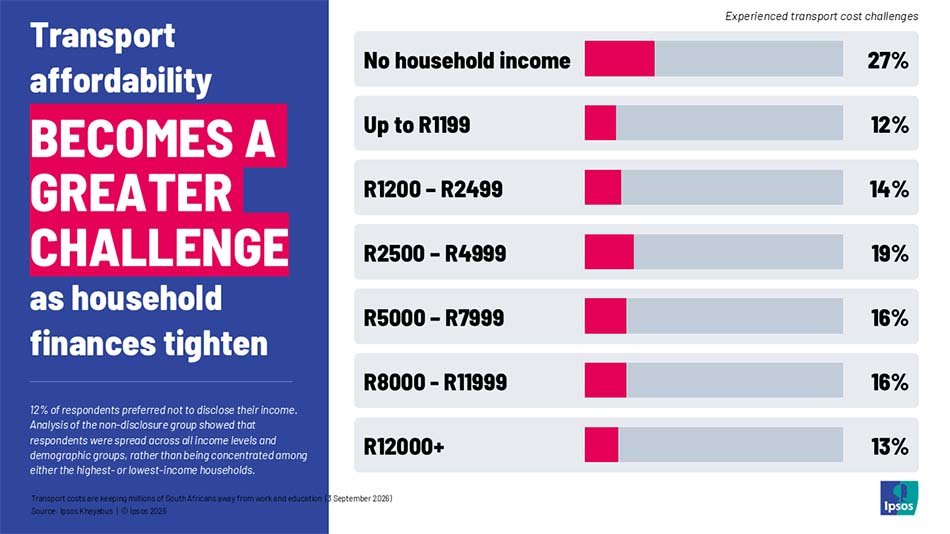
South Africans living in households earning between R2 500 and R4 999 per month are also among the most affected, with 19% reporting that they had missed work or education for the same reason. This remains at 16% among households earning between R5 000 and R7 999 and those earning between R8 000 and R11 999. The incidence falls to 12% among households earning more than R12 000 per month.
“Transportation is often one of the first unavoidable monthly expenses after food and housing,” says Otte. “When fuel prices, taxi fares, bus fares and other transport costs rise, households have very limited room to adjust their spending. For households with very limited or no income, transport costs can become a barrier to accessing exactly the opportunities that could improve their circumstances. It creates a difficult cycle that many South Africans are trying to navigate.”
Provincial differences emerge
The Free State records the highest proportion of residents reporting that they have missed work or education because of transport costs (20%), followed by the Northern Cape (18%), and Gauteng (17%).
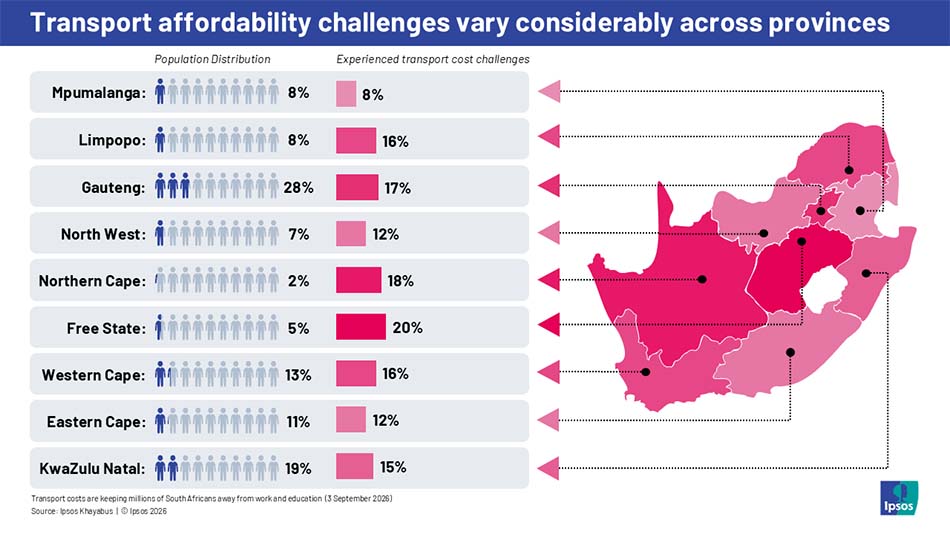
“Provincial differences often reflect a combination of factors including employment opportunities, travel distances, settlement patterns and the availability of transport infrastructure,” says Otte. “These results suggest that transport affordability challenges are experienced differently across the country.”
What this means
The findings highlight transport affordability as an often-overlooked barrier to education and employment mobility in South Africa. While public discussion often focuses on unemployment, skills shortages and economic growth, the ability to afford access to opportunities is also important. Having jobs, schools and universities available is only part of the equation, people also need to be able to afford the journey to reach them.
“South Africa cannot fully unlock its human potential if people cannot physically reach opportunities,” Otte concludes. “When nearly one in seven South Africans report missing work or education because they could not afford transport, this becomes an economic, educational and development challenge.
“Policies aimed at improving mobility and reducing transport costs have the potential to improve both individual livelihoods and broader economic participation.”