
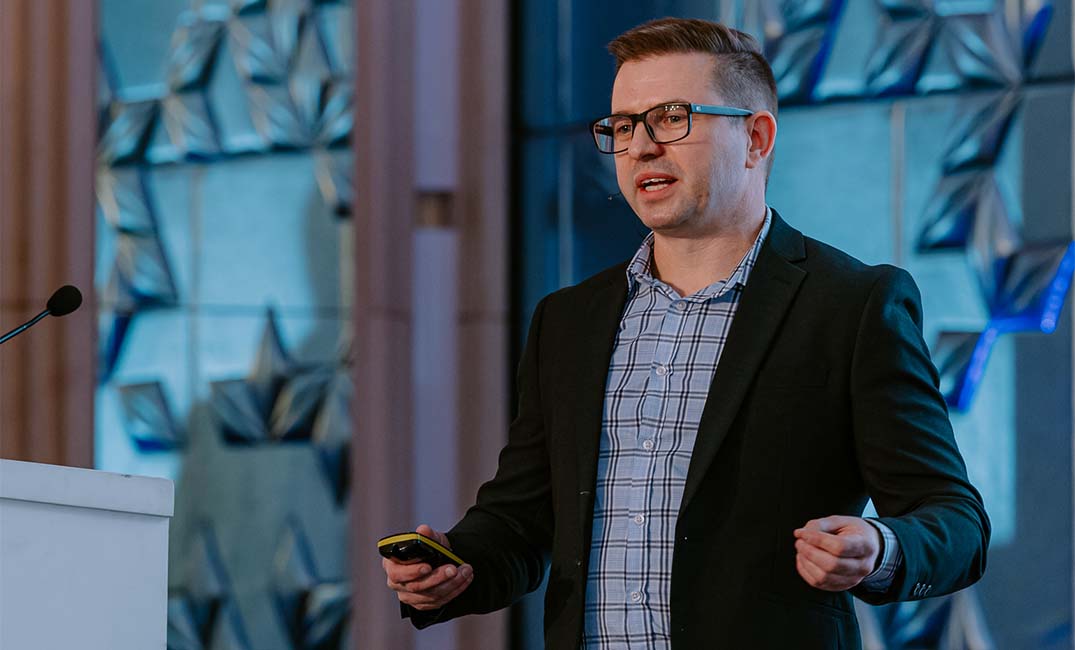
Kathy Gibson reports from Pinnacle TechScape – There’s a new buzzword in the IT industry: RAMageddon. It refers to the current dire shortages and skyrocketing prices of computer memory.
“We live in a paradoxical time,” says Wayne Coetzer, consumer business director: South Africa and SADC at ASUS. “On the one hand, software promises infinite capabilities – it makes the complex feel weightless and magical.
“But behind that is the brutal reality of our finite ability to supply the silicon that can further roll out this world.”
As a result of massive global memory shortages, the South African PC market has taken a significant fall this year. The tangible impact will see users either paying a lot more or settling for lower specifications in their next smartphone, PC or gaming console.
“RAM is essential for smooth and responsive computing, but we are seeing massive amounts of the world’s memory going to the hyperscalers’ data centre builds,” Coetzer says.
“As a result, DRAM contract prices have shot up 350% and more over the last 12 months.”
The net results has been an almost doubling of entry-level PC prices. While high-end machines have also seen incremental increases, the biggest impact is thus on students, SMEs and others that can afford only entry-level devices.
“Consumer technology is losing the tug of war,” Coetzer explains. “And the disruption doesn’t stop at DRAM. The shortages are affecting NAND and SSD as well, with output plummeting and prices rocketing.”
GPUs, originally created for gaming, have found a ready market in high-end AI systems so consumers are being squeezed on this technology as well.
These supply shortages and knock-on pricing effects won’t go away any time soon – in fact, Coetzer says they are expected to get worse during the next year or so.
To plug the gap, the industry is turning to new technologies and architectures to help alleviate the supply issues, and provide customers with affordable machines that perform to the level they expect.
“We are witness a big architecture shift with ARM architecture,” Coetzer points out. Now ARM reduces memory consumption and bandwidth needs through specific architectural updates and compact data type support.
At the same time, Qualcomm is offering solutions with Snapdragon X, and is just days away from the new Snapdragon 8 Elite Gen 6 and Snapdragon 8 Elite Gen 6 Pro.
The new architecture lets all CPU cores share a common pool of cache memory, dynamically allocating it based on the workload.
These new architecture changes will allow for the development of thinner and lighter devices that are energy-efficient and offer longer battery life.
Meanwhile, the big software companies are starting to pivot towards enabling better performance on entry-level device: Microsoft has stated its intention to perform more efficiently on entry-level machines; and Google is optimising Android’s internal memory management for the same outcome.
Coetzer explains that the gaming industry is replacing raw hardware brute force with AI-driven graphics technologies like DLSS and FSR that boost frame rates by rendering games at a lower resolution and using smart algorithms to upscale the image to a high resolution.
OEMs are also optimising direct SSD asset streaming with procedural generation and dynamic memory.
There is also a move to create AI that consumes fewer resources, which is leading to better model efficiency. “There is massive investment happening in small language models and Mixture of Experts techniques that allow simple AI tasks to be handled more efficiently,” Coetzer explains.
Mixture of Experts is a machine learning technique where an artificial intelligence model breaks complex tasks into smaller pieces and sends each piece to a specialised sub-model, or expert, instead of using the whole network. This speeds up processing.
At the same time, we are seeing the emergence of specialised NPUs and AISICs in smartphones and laptops, a trend that is expected to be adopted more widely over the next couple of years.
Perhaps most significantly, new factory capacity is coming online. Coetzer points out that billion-dollar-scale investments will see the new facilities come online in about 2028.
The bottom line, Coetzer adds, is that AI is here to stay and the current crisis is forcing the industry to more creative solutions.
“The current silicon crisis is real – but it is entirely temporary and solvable. Meanwhile, human creativity and ingenuity are infinite.”