
Public sector leaders are under pressure to modernise operations, strengthen cyber resilience, govern AI at scale and meet rising citizen expectations amid economic and geopolitical uncertainty, according to the top technology trends in government unveiled by Gartner.
Dean Lacheca, vice-president analyst at Gartner, says: “Government CIOs are operating in one of the most disruptive periods in recent memory. AI is reshaping how governments deliver services; cyber threats are evolving faster than traditional defenses can respond; and agencies are under increasing pressure to achieve more with finite resources. The challenge is no longer identifying technology opportunities, but building organizations that can adapt quickly enough to capitalise on them.”
He adds that government technology leaders should assess how the following trends will influence investments, operating models and service delivery strategies in 2026 and beyond.
Gartner Top Technology Trends in Government
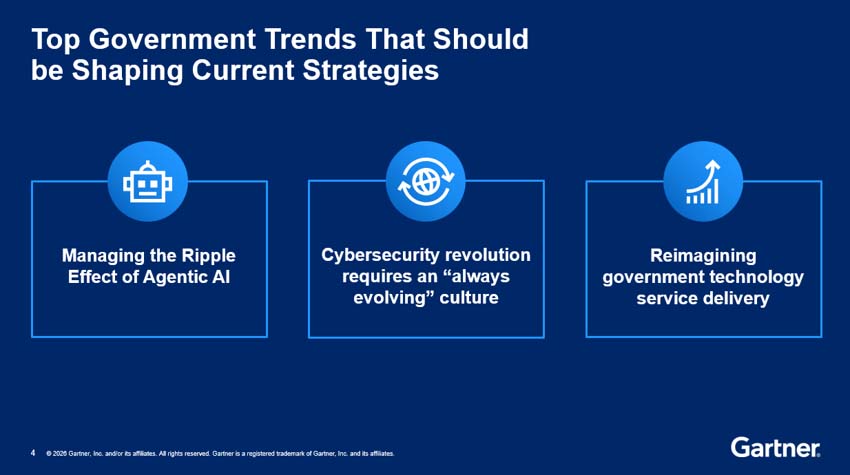
Source: Gartner (September 2026)
Trend 1: Managing the ripple effect of agentic AI
As governments move beyond AI experimentation toward enterprise-scale adoption, AI agents are emerging as a key catalyst for transformation. Agentic AI will increasingly support government operations, enhance citizen experiences, accelerate software development and automate routine decision-making processes.
“The conversation around AI must shift from technology implementation to organizational transformation,” says Lacheca. “Success with agentic AI will depend on modern governance, workforce readiness and the ability to redesign business processes, while creating an adaptable foundation for future innovation.”
Gartner research indicates that many governments are already exploring governance frameworks, digital identities and operational models to support the growing use of AI agents. They must also establish outcome-based AI roadmaps and develop clear metrics to measure value from AI investments.
Trend 2: Cybersecurity requires an ‘always evolving’ culture
Advances in AI, increasing geopolitical tensions and the emergence of quantum computing are fundamentally changing the cybersecurity landscape. Government organizations must move beyond periodic reviews and compliance-driven approaches toward adaptive, continuously evolving cyber strategies.
“Cybersecurity can no longer be treated as a static function,” says Lacheca. “AI is reducing the time between the discovery of vulnerabilities and their exploitation, while quantum computing is forcing governments to rethink how they protect sensitive information. Resilience, automation and crypto agility must become core components of every cybersecurity strategy”
Gartner recommends government organisations automate security operations where possible; improve digital supply chain visibility; establish post-quantum cryptography readiness plans; and strengthen governance around data sovereignty and third-party risk.
Trend 3: Reimagining government technology service delivery
Emerging technologies, increasingly digitally literate workforces and demand for new technical skills and capabilities are forcing governments to rethink how technology services are delivered.
Future-ready organisations will be built around digital and AI-literate workforces. This means technology service delivery will require adaptive operating models and governance structures that enable technology innovation across the organisation while maintaining accountability.
“Technology will only ever be a tool or a trigger; transformation is ultimately about people,” says Lacheca. “Government IT areas that maintain their relevance will be the ones that invest in workforce capabilities, redesign how work gets done and build a technology operating model that can evolve as quickly as technology itself.”
According to a Gartner survey of 1 219 CIOs and IT leaders conducted in January 2026, 78% of government respondents anticipate investing in their people to advance their key technology initiatives.
Gartner recommends they focus on prioritising AI literacy, workforce modernization and organisational flexibility to meet growing service demands, while improving operational efficiency.