
With their long necks, distinctive limbs and ornamented heads, giraffes are among Africa’s most iconic megafauna. Yet, despite being reasonably well studied in terms of their biology and ecology, remarkably little is known about pathologies and developmental irregularities affecting their skulls.
Now, an international study involving researchers from the University of Cape Town (UCT), the Namibia-based Giraffe Conservation Foundation, Universidad Autónoma de Madrid and institutions from around the world is helping to close this important knowledge gap.
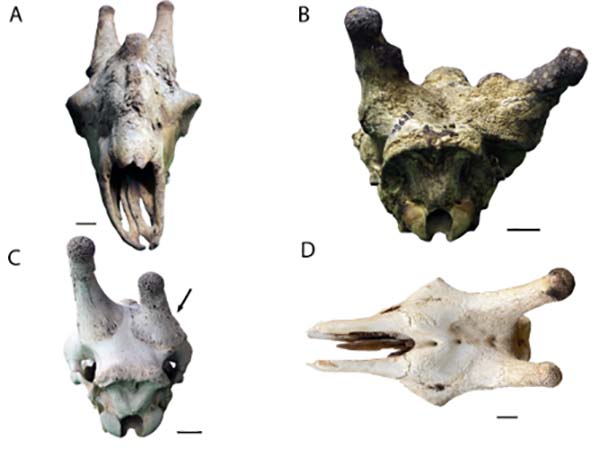
Examples of cranial pathologies in giraffe skulls
Photo: supplied
The study examined 516 giraffe skulls collected from across Africa, representing all four giraffe species and individuals of different ages and sexes, creating one of the most comprehensive datasets of its kind.
Lead author and UCT postdoctoral fellow, Dr Nikos Kargopoulos, who is funded by the Giraffe Conservation Foundation, says: “More than half of the studied specimens showed evidence of at least one pathology or irregularity, while about 16% showed more than one.”
Teeth were commonly affected, showing misalignment, absence, irregular dental wear and fractures. These irregularities were more common in adult Giraffa giraffa and least common in Giraffa tippelskirchi. Periodontitis, caused by gum inflammation, appeared to be quite common, having been observed in 206 individuals. Its incidence appeared to be higher in older individuals but was unrelated to specific species or sex.
The findings offer a rare window into the health, behaviour and development of one of Africa’s most recognisable animals, while also highlighting the value of international research collaboration led in part by UCT expertise.
During the mating season, male giraffes swing their necks and heavy heads, armed with pronounced horn-like ossicones, at each other to assert dominance and win mating rights. This aggressive fighting behaviour can lead to severe trauma and even death.
In the study, researchers linked deviant or irregular ossicones among male specimens to this distinctive “necking” behaviour. They also found that differences in the size and orientation of ossicones in other individuals may have resulted from abnormal growth processes.
Aside from deformities in the dentition and ossicones, the researchers observed other irregularities in the giraffe skulls that were very likely due to congenital defects. For example, they observed a rare case of “wry nose”, which causes a twisting of the animal’s snout; as well as a cleft nose, caused by incomplete fusion of the skull bones.
UCT palaeobiologist from the Department of Biological Sciences, Professor Anusuya Chinsamy-Turan, said the findings demonstrate the remarkable ability of some animals to adapt and survive despite significant developmental abnormalities.
“Despite these deformities, it appears that these giraffes somehow adapted to these deviant conditions, which likely affected the way they fed, and survived to adulthood,” she says.
The researchers also found one adult male skull that showed several bony growths, or neoplasia. These appeared to be malignant, although further histological analyses are needed to confirm the diagnosis.
The study of more than 500 giraffe skulls shows that the pathologies observed can arise from several causes, including congenital conditions such as wry nose, behavioural factors such as fighting injuries; and environmental or disease-related factors, including diet-related tooth damage and periodontitis.
Dr Julian Fennessy from the Giraffe Conservation Foundation said: “Our results tell us more about the abnormalities and defects that affect giraffe and provide an unprecedented dataset for wild giraffe that can be used for comparative studies of other large megafauna.”
Co-investigator Professor Jesús Marugán Lobón adds: “This study provides fresh perspectives on Africa’s enigmatic giraffe.”