
Organisations risk turning AI from a strategic opportunity into a source of enterprise exposure, according to Gartner.
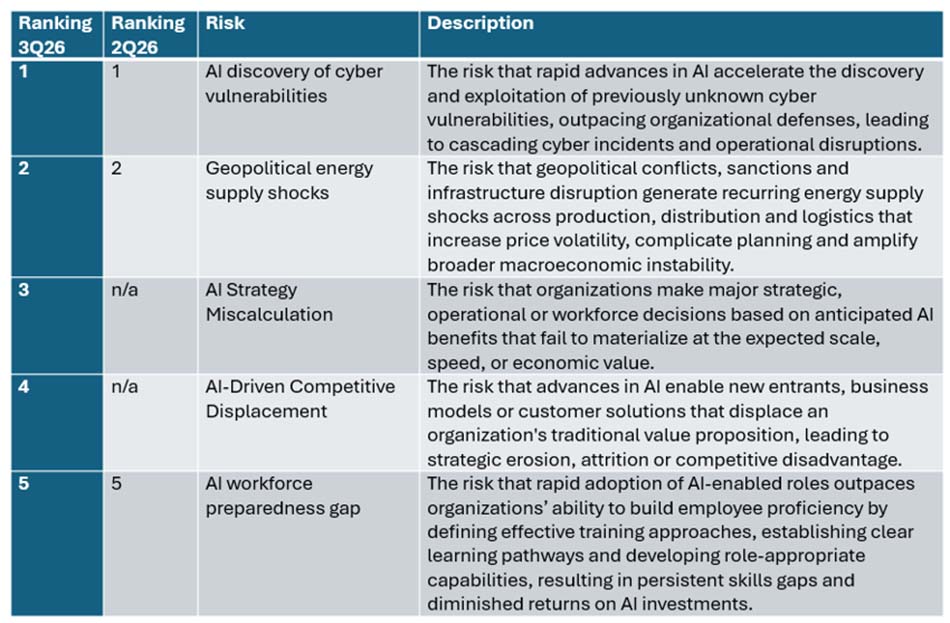
Appearing for the first time in Gartner’s Quarterly Emerging Risk Report, AI strategy miscalculation was cited as the third most concerning issue by the 308 enterprise risk management (ERM) leaders, auditors and senior executives surveyed. The issue ranks behind AI discovery of cyber vulnerabilities, and geopolitical energy supply shocks (see Table 1), which held the top two risk concerns for last quarter as well.
“AI risk is moving beyond technology and governance concerns into the core of enterprise strategy,” says Kevin Mercado, senior principal analyst: research in the Gartner Risk & Audit Practice.
“The emergence of AI strategy miscalculation and AI-driven competitive displacement reflects growing concern that organizations could either make major decisions based on anticipated benefits that fail to materialize or lose ground to competitors that use AI more effectively.”
Top Emerging Risks of 3Q26
Source: Gartner (November 2026)
AI strategy miscalculation involves investing in AI too aggressively, selecting unsuitable use cases or moving ahead before organisations are prepared to manage the technology’s operational, cultural and governance implications. Competitive urgency can outpace organizational readiness and create AI strategy miscalculations.
“Organisations risk pursuing AI initiatives without sufficiently testing whether the use case aligns with business priorities, risk tolerance, available capabilities and expected returns,” says Mercado.
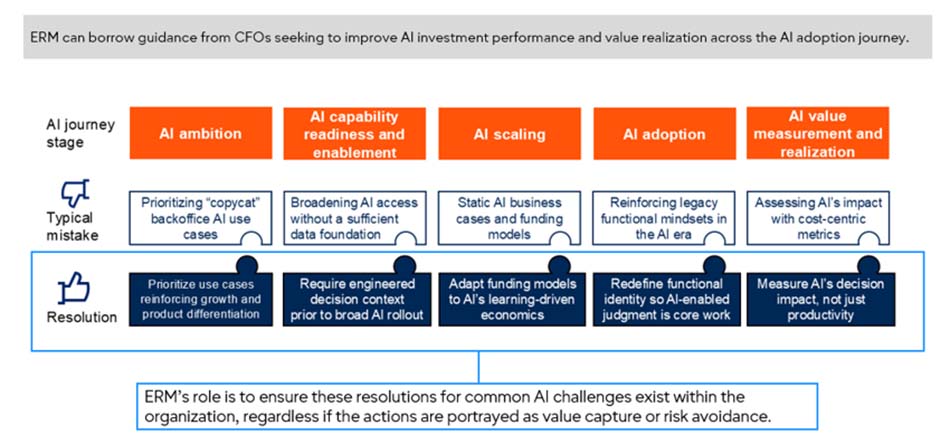
Gartner analysts recommend creating a strategic AI action plan to help ERM leaders manage risk and create value by addressing common mistakes at each stage of the AI journey.
Strategic AI Action Plans Can Manage Risk and Create Value
Source: Gartner (November 2026)
Risk leaders can help embed these kinds of resolutions across the organisation, regardless of whether they are framed as value-creation initiatives or risk-mitigation activities.
This includes ensuring that AI investments are tied to strategic priorities, that readiness and governance requirements are addressed before scaling, and that value is measured through AI’s impact on decision-making, not just productivity.
“Organisations should evaluate AI as a portfolio of business decisions,” says Mercado. “The organisations most likely to realise sustained value will connect AI investments to clear business outcomes, validate readiness before scaling and establish governance that supports responsible experimentation.”