
In a few days, NASA’s ESCAPADE (Escape and Plasma Acceleration and Dynamics Explorers) will perform a manoeuvre that no agency spacecraft has flown before — and do it twice.
Each of the two ESCAPADE spacecraft will execute a “powered” flyby of Earth, combining Earth’s gravity with an engine burn, to slingshot itself toward Mars.
The first spacecraft will conduct its flyby and engine burn around 5 am EST on Saturday 7 November, and the second will do so two days later, around 6 am EST on Monday 9 November.
As each spacecraft flies close to Earth, our planet’s gravity will speed it up and redirect it toward Mars.
At the spacecraft’s closest approach to Earth, it also will perform a “trans-Mars injection burn”, firing its engine for about nine minutes to give itself an extra boost toward the Red Planet.
In November 2026, each of NASA’s two ESCAPADE (Escape and Plasma Acceleration and Dynamics Explorers) spacecraft will execute a powered flyby of Earth, combining Earth’s gravity with an engine burn, to slingshot itself toward Mars. In this animation, each spacecraft’s approximately nine-minute trans-Mars injection burn appears as an orange arc along the spacecraft’s trajectory.
Advanced Space/Matt Bolliger
The trans-Mars injection burn will increase each spacecraft’s speed by more than 1 000 miles per hour, or from about 6,3 miles per second to about 6,7 miles per second (from about Mach 30 to Mach 31). At that final speed, the spacecraft could fly from Washington, DC, to San Francisco in less than seven minutes.
After completing their successful powered flybys, the two spacecraft will then have a 10-month cruise to Mars, arriving at the Red Planet on 7 September 2027 and 9 September 2027, respectively.
At Mars, ESCAPADE will become the first multi-spacecraft mission to fly in formation around the planet. The ESCAPADE mission will study how a million-mile-per-hour stream of material flowing from the Sun, known as the solar wind, interacts with the Martian environment and how that drives atmospheric loss at Mars.
Some spacecraft have used Earth flybys to direct themselves to other destinations in the solar system, but no Mars-bound spacecraft has successfully executed a powered flyby, also known as an Oberth maneuver.
Previous missions that reached Mars launched from Earth at a time when the two planets were aligned in space — which only happens every 26 months — to shorten the trip and use the least amount of fuel.
However, ESCAPADE launched in November 2025, when Earth and Mars were on opposite sides of the Sun. Instead of heading directly to Mars, ESCAPADE pioneered a new route. The two spacecraft flew in a kidney-bean-shaped loop around a place in space called the Earth-Sun Lagrange point 2 and then headed back toward Earth so they could use Earth’s gravity to propel themselves toward the Red Planet once the planets returned to alignment, which is now.
The ESCAPADE mission is pioneering a unique path to get to Mars. After launching in November 2025, the two ESCAPADE spacecraft looped around the Earth-Sun Lagrange point 2 (L2), in an “Earth-proximity” or “loiter” orbit that allowed the spacecraft to return to Earth in November 2026 and use our planet’s gravity to slingshot themselves to Mars.
Advanced Space/Matt Bolliger
This unique route already has allowed ESCAPADE to collect some “bonus” science as the spacecraft flew through a distant region of Earth’s magnetotail, a part of Earth’s magnetic environment that gets stretched out away from Earth by the solar wind.
No spacecraft had directly explored that part of Earth’s magnetotail before. Mission scientists report that ESCAPADE observed some interesting activity and structure in the magnetotail and are planning to share those findings soon.
As the two ESCAPADE spacecraft perform their Earth flybys on 7 November and 9 November, some observers on the ground might be able to spot them, though the spacecraft will be faint and a telescope will most likely be needed to find them as dim points moving against the stars.
At their closest approach to Earth, the spacecraft, which are each about the size of a standard refrigerator, will be between 600 and 1 100 miles above the planet’s surface, which is higher than most Earth-orbiting satellites.
Each spacecraft will fire its engine as it flies over southern Australia and should be visible with telescopes from there.
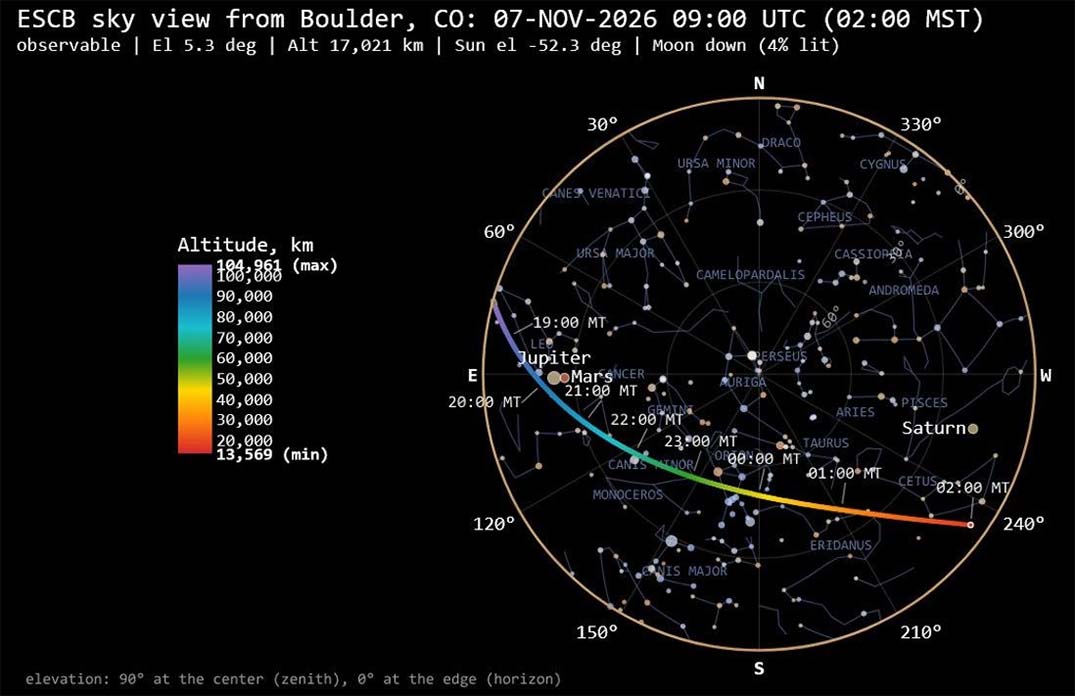
As they fly close to Earth, the two ESCAPADE spacecraft could be visible through telescopes. Maps for locations can be found at https://svs.gsfc.nasa.gov/15114/.
Advanced Space
Each spacecraft will appear to move through the sky relatively slowly and take several hours to cross from east to west overhead.
If you would like to try to spot the ESCAPADE spacecraft with a telescope, you can use the NASA Jet Propulsion Laboratory’s Horizons System to get coordinates for the two spacecraft at various times for your viewing location.
Several days after ESCAPADE’s trans-Mars injection burns, the mission team will know how well the spacecraft are aimed for Mars. The team will use multiple trajectory correction maneuvers to adjust the path of the two spacecraft during their journey to Mars, ensuring they are on a precise course to rendezvous with the Red Planet in September next year.
Article by Vanessa Thomas, NASA’s Goddard Space Flight Centre