
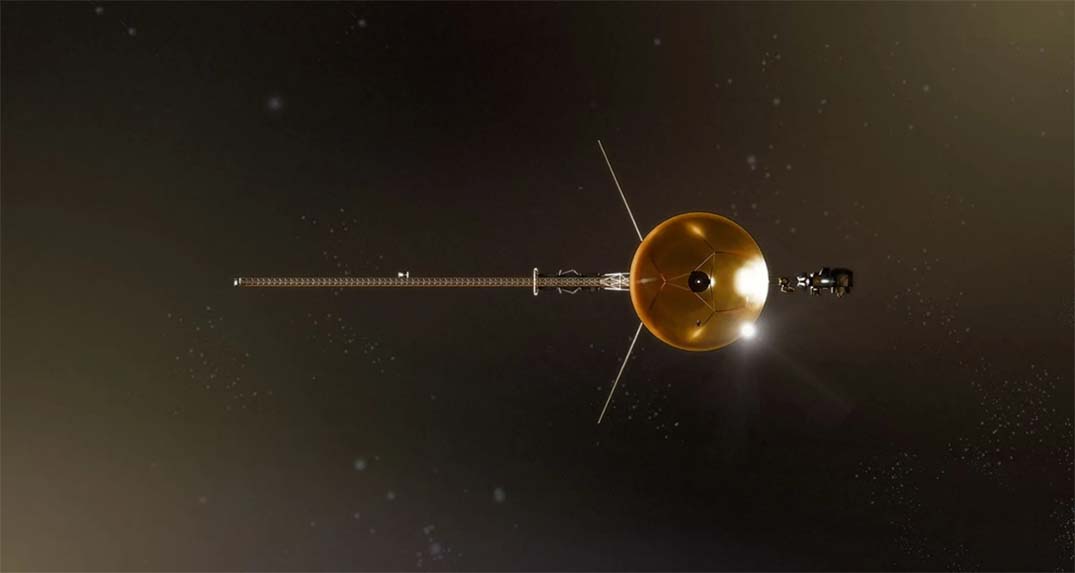
On Wednesday this week (18 November), NASA’s Voyager 1 will be exactly one light day – or 25,9-billion kilometres – away from Earth.
The spacecraft launched in 1977 and, after travelling alone through the solar system for almost 50 years, will become the most distant human-made object, and any light from Earth would take 24 hours to reach the spacecraft.
Voyager 1 and its twin, Voyager 2 are the only spacecraft to ever operate outside the heliosphere, the protective bubble of particles and magnetic fields generated by the Sun.
The two craft were designed to explore the outer planets by taking advantage of a planetary alignment that occurs once every 176 years. Voyager 1 entered interstellar space in 2012. Following a different trajectory, Voyager 2 entered in 2018.
Voyager 1 has flown past Jupiter (1979) and Saturn (1980), capturing iconic images of Jupiter’s storms and Saturn’s rings, as well as Saturn’s moon Titan.
Voyager 2, on a slower trajectory, executed a “Grand Tour” visiting Jupiter (1979), Saturn (1981), Uranus (1986 – the only spacecraft to visit it) and Neptune (1989).
Voyager 1 and Voyager 2 are powered by radioisotope thermoelectric generators (RTGs) that are slowly fading, with total operational shutdown expected in the 2030s.
Both craft carry a gold-plated phonograph record containing sounds, images, music, and greetings in 55 languages as a message to any future extraterrestrial intelligence.
To celebrate the latest achievement, NASA is inviting people around the world to participate in “Shine Bright for Voyager’s Light-Day” event today (Monday 17 November).
They aim to create a symbolic wave of golden light encircling the planet after sunset. NASA has created a website that enables smart phones and tablets to flash “VGR”, Voyager’s call sign, in morse code.
Everyone is encouraged to capture photos or videos of their light-day signal and share it on social platforms, tagging @NASA.
For more information about how to participate in “Shine Bright for Voyager Light-Day,” visit:
Featured picture: An artist’s concept depicting a Voyager spacecraft.
Credit: NASA/JPL-Caltech