
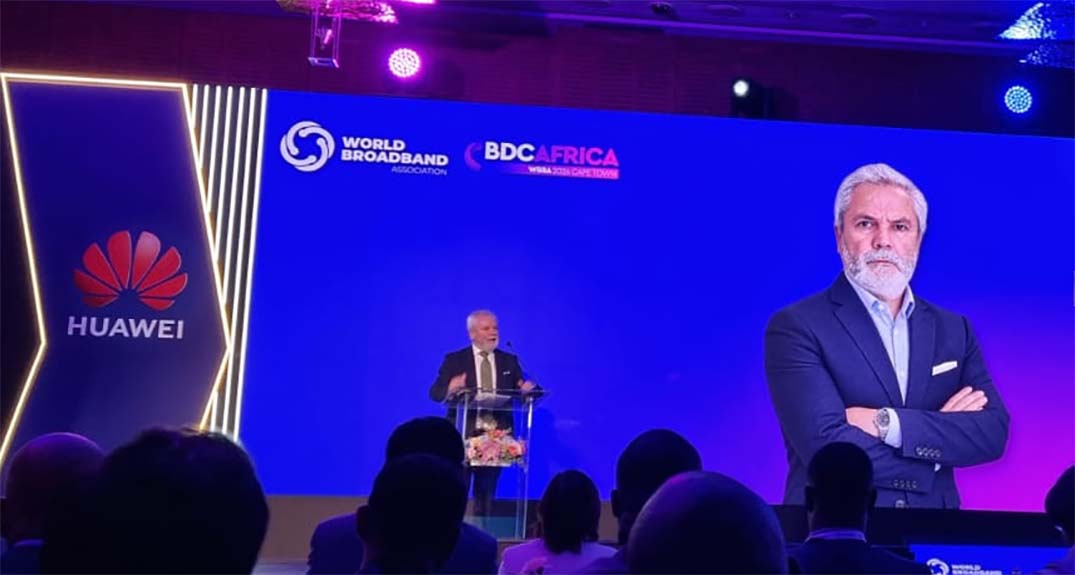
Kathy Gibson reports from Cape Town – Africa has a generational opportunity to use AI as a catalyst to finally bridge the digital divide and compete on an equal footing with the rest of the world.
Dr Sunil Piyarla, head of business development at OpenServe, tells delegates to the WBBA Broadband Development Congress Africa 2026: “People rarely notice the network – they notice what it lets them do. They don’t think about tokens, latency or connections – they just want an answer.
“So as we bring AI , broadband and cloud together, we need to ask these questions: what service does it make possible? How quick will it be? Did it work; was it quick; and was it worth the price?”
In answering these questions, Dr Piyarla says, telcos will find it easier to plan their networks and justify new investments.
Martin Creaner, director-general of the World Broadband Association (WBBA), explains that AI is affecting every aspect of work in telecoms operators: people , data, services, security, and business models.
This is why the WBBA has put its weight behind the ITU’s ION-2030 (International Optical Networks towards 2030 and Beyond), which aims to enable the next generation of optical networks.
The WBBA is working with the ITU to promote ION-2030, helping to ensure that it enshrines the right standards.
“We view this as an important initiative for the industry,” he adds. “Fixed broadband is becoming the defining technology to enable and use, and to win from AI.
“And we need to include Africa’s voice in shaping the vision,” Creaner says.
To this end, members of the WBBA have launched the ION-2030 vision for Africa in Cape Town.
Is Africa’s network good enough?
Amu Maja, executive: carrier and global at OpenServe, asks is the infrastructure connecting Africa is sufficient.
The answer is a resounding no.
Maja explains that Africa is very dependent on submarine cables today, and needs to develop terrestrial fibre – not only to connect landlocked countries, but to create resilience, lower connectivity costs, and achieve regional integration.
Interconnected terrestrial fibre will also attract more growth for the countries involved, he adds.
“From operators’ perspective we have built routes to neigbouring countries, using the latest optical networks.
“The problem is our story also ends at the border, where we hand over capacity.”
Right now, this means that network connection is not efficient.
“For data connectivity, is the border the right place to hand over?” Maja asks. “Or should it be the data centre?”
OpenServe believes we should be looking at a wider network that doesn’t rely only on submarine cables for international connectivity.
“What we need is a continental backbone with high capacity, using redundant fibre routes to connect the coastal gateways.”
The only way to achieve this is through an open access network, Maja adds.
The way forward for countries like South Africa is to be clear in expanding AI in the continent, which will enable growth and harness the potential of our youthful populations.
First of all, countries need to map their existing fibre and identify priority corridors. This would require regional partnerships and co-ordinated investments.
Next, they should develop connections between regional hubs and close cross-border gateways. This could be done with public-private partnerships and infrastructure sharing.
Thirdly, we need to link submarine landing stations to inland fibre, which can be achieved with aligned licensing, access, and interconnection rules.
The final step would be to expand access, improve affordability, and establish sustainable operations. To do this, we will need to develop common standards and route protection.
“One message shines through: We need to connect Africa,” Maja concludes.
Digitalisation starts with the network
Yongqiang Yuan, vice-president: optical business product line at Huawei, believes the network is the foundation of the digitalisation journey.
“Fibre networks will facilitate Africa’s digital leap,” he says.
Over the past year, Africa’s AI and data centre traffic, and home broadband (HBB) users are set to accelerate.
AI traffic has grown by 16% and data centre traffic by 12%. Africa’s international traffic has grown by 25%, and domestic traffic across Africa by 32%.
At the same time, the use of AI has also shot up, with foundation model use and token consumption recording exponential growth.
“It is the right moment for Africa to catch up,” Yuan says.
He points out that, while AI is important for Africa’s future, the true foundation is the network. “Otherwise it is just an information island in the cloud.”
The AU Commission’s digital transformation strategy 2020-2039 aims for 100% meaningful and affordable broadband connectivity by 2039, adding 30-million digital jobs and growing the digital economy to over 10% of Africa’s GDP.
“The network is vital to build this bridge,” Yuan says.
He describes two pillars as necessary to achieving the goal. Giga-HBB will increase digitalisation and popularity, while digital express offers quality and efficiency.
Giga-HBB needs to be addressed in three phases: fibre coverage, speed boost, and an experience improvement.
Coverage can be achieved with rapid fibre rollout to develop FTTH (fibre to the home).
“In Africa, there are 205-million households that can afford it, but that are without fibre connections,” Yuan points out. “There is a huge opportunity for the industry.”
And, for the economy, a 10% broadband penetration will typically result in 1% GDP growth.
In terms of speed, Africa’s average download speed has increased by more than 100% between 2023 and 2026. But, at 78Mbps, it is still below the global average broadband speed of 100Mpbs.
“Increasing speed is actually cost-effective for operators,” Yaun explains. “Higher speed results in higher ARPU (average revenue per user) and new investments.”
It is important to improve user experience: 70% of customers have a poor WiFi experience today.
“But Africa’s home networking market has enormous potential,” Yuan says, explaining that 4,5-million set-top boxes are sold each year – and operators could capitalise on this market.
When it comes to digital express, the goal is a 99,999% highly resilient digital infrastructure, with 1-5-20ms deterministic latency digital substrate and 0 congestion data transmission foundation.
A resilient infrastructure will deliver always-on connectivity to every sector for service reliability, Yuan says.
Today, fibre interruptions are a major issue for Africa, with 100 000 fibre cuts per year. To fix these issues operators should aim for submarine and terrestrial cables to provide mutual backup, and for a mesh backbone network to provide multiple protections.
At the same time, the latency substrate needs to deliver deterministic speed to every enterprise, tailored to their needs.
And addressing the capacity need requires a congestion-free foundation to deliver efficient data transmission everywhere.
AI key to network efficiency
Ziaad Suleman, CEO of Cassava Technologies, agrees that AI is rewiring the way we build and run broadband.
“But the reality is that you have to have a foundation, the steps that determine success.
“And proper connectivity is vital for the world of AI, with the type of connection determining the yield you will get.”
When it comes to building and managing the network, Suleman explains that AI can perform predictive analytics, pick up warning signs, and automate remedial action.
“Telcos have to start thinking about how they can progress their business with AI,” he says. “But this doesn’t just happen: it is an outcome from data.”
Because the fourth industrial revolution (4IR) is about the convergence of technology, it generates a huge amount of complexity, Suleman says. In turn, this adds more dynamics and drives up cost pressures.
This has to be balanced against a customer expectation of better quality and reduced costs.
Data drawn from all the network sources can help to ease complexity, reduce costs and ease pressure on the field teams, while ensuring intelligence is spot on, Suleman adds.
“Fundamental to all this is the network,” he says. “As we plan for networks and where to invest, we need to ensure smarter rollout, predictive fault finding and a self-healing network that improves customer service.
“The thinking network and the future of digital transformation recognises that the volume and velocity of data is only increasing – and coming from a variety of sources. Connectivity is fundamentally important and the foundation without which we cannot advance.”
In the world of intelligence, customers expect intelligence as they need it. So sovereignty is another major issue, Suleman says.
The final part of the equation is the people who will participate in the revolution. “So we have got to think about skills.”