
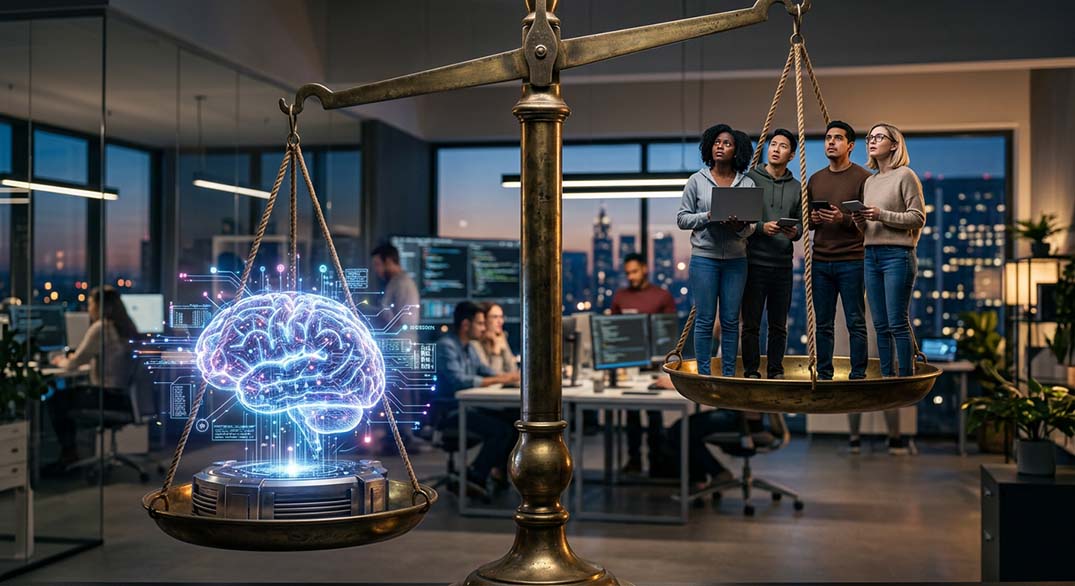
In a world where artificial intelligence (AI) has permeated everywhere, Cambridge Dictionary has announced that its Word of the Year 2026 is “human”.
It is described thus in the dictionary:
human
adjective
relating to people, as opposed to animals, machines, or gods
The organisation outlines why the word was the top pick this year.
“Throughout history, the adjective human has signified people, as opposed to animals and gods (and, more recently, machines),” the announcement reads. “Increasingly seen in compounds such as human-written, human-generated, and human-made, it now also denotes that something is created by or typical of people as opposed to AI.”
Colin McIntosh, Cambridge Dictionary chief editor, comments: “Artificial intelligence has been a growing presence in society for years now, but this year it seemed to be everywhere.
“In many areas of life this has led to a re-evaluation of what it means to be human, as a counterbalance to AI.
“2026 has been all about a refound appreciation of the human factor in what we consume (with a consequent human premium), and a new value is being placed on the human element in our lives in general: all confirmed by our analysis of the language data, internet trends, and search habits.
“With that background, human was the perfect choice for our Word of the Year.”
Other words that made the shortlist for Word of the Year were broadly in the same theme: analogue; agent; wholesome; and chic.
In 2026, AI reached a level of sophistication where individuals and companies started highlighting what was human and what was computer-generated.
“As AI-generated content becomes ubiquitous, simply saying that something was made by a person has started to gain new meaning,” according to Cambridge Dictionary announcement.
“Now, we are seeing more emphasis on the people behind products and experiences – the writer, artist, designer. Their involvement becomes part of the value, particularly at a time when AI can produce almost anything quickly and cheaply.
“Actual craftsmanship is a kind of ‘human premium’ – the idea that we might value something more because we know a person made it.”