
As generative artificial intelligence (GenAI) rapidly reshapes work, especially for less experienced employees, Gartner predicts that by 2030, 30% of enterprises will face declining decision-making quality due to an overreliance on AI.
Chief human resources officers (CHROs) must accelerate learning and experience development in these early career roles to sustain performance and maintain talent pipelines.
Kaelyn Lowmaster, director: research in the Gartner HR practice, discusses the different tactics CHROs can implement to prevent GenAI-driven skills loss for early career talent.
Should early career talent worry about AI impacting their roles the most?
It’s not a clear yes/no answer. Employees should be aware of the potential impact of AI on their roles, as we’ve seen some roles being impacted more than others.
According to an August 2025 survey of 114 HR leaders, more than one-in-four have already redefined job roles or skills due to AI and emerging technologies.
However, AI is not impacting roles consistently. Some employees may benefit greatly from using GenAI tools, while others do not.
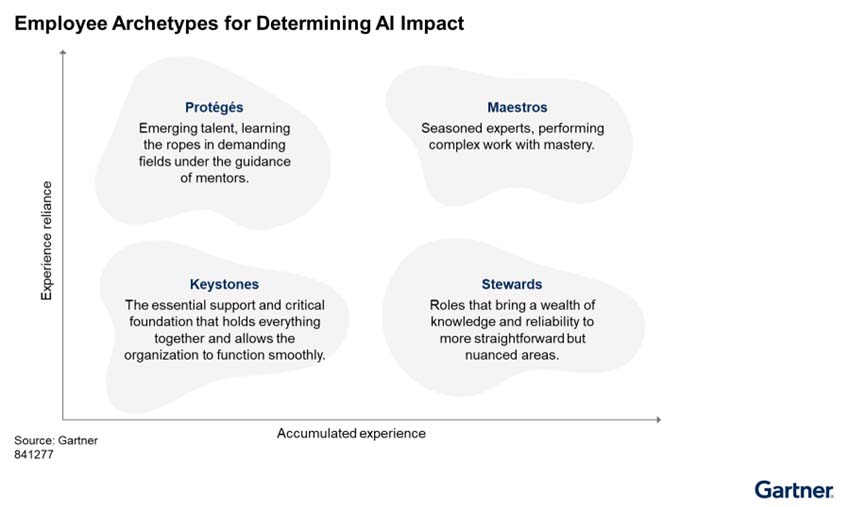
To help determine the impact of AI on employees, CHROs can use the following framework created by Gartner that splits employees into four archetypes, based on the combination of their accumulated experience and experience reliance:
- Protégés: Early-career talent in judgment-heavy roles who may struggle to judge the quality of GenAI outputs.
- Maestros: Experienced experts who use GenAI to enhance their work in complex roles.
- Keystones: Less-experienced employees in support roles who can learn to execute their work better with GenAI.
- Stewards: Experienced staff in straightforward roles, seeking efficiency gains.
Source: GartnerWhat are the risks associated with early career talent using GenAI?
The use of GenAI by early career or less experienced talent poses three key risks for CHROs to address:
- Increased errors due to lack of judgment; For example, security vulnerabilities in code or fabricated information in legal documents that can put an organisation and its customers at risk.
- Fewer opportunities to build experience as GenAI automates tasks, or more experienced employees may require less junior support; Without the chance to learn tasks on the job, GenAI inhibits the development of the very skills and judgment that protégés need to avoid making costly mistakes with AI.
- Weakened talent pipelines for senior roles; The pipeline of specialised professionals has not grown at the same rate as the need for advanced roles which can lead to a long-term supply shortage.
What can CHROs do to help bridge the experience gap for early-career talent?
CHROs must focus on three tactics to help protégés build critical thinking and judgment skills quickly without relying on time or repetition of traditional development tasks.
- Build peer learning channels: Partner with learning and development teams to create forums where protégés can share challenges, GenAI successes, and best practices.
- Formalise infrastructure for expert knowledge transfer: Ensure protégés have ongoing access to more seasoned colleagues to learn from, even if they don’t work together regularly.
- Explore GenAI simulators: Use GenAI-powered practice environments to help protégés build skills and judgment quickly in risk-free, realistic scenarios.