

The 2030 Reading Panel’s 2026 report reveals that reading levels for South African children are still at crisis point – but some progress is being made.
Released today, and drawing on nationally representative data on foundational reading skills across all South African languages, the report analyses data from the Department of Basic Education’s Funda Uphumelele National Survey (FUNS), which for the first time measured reading outcomes in Grades 1–4 in all home languages against national benchmarks.
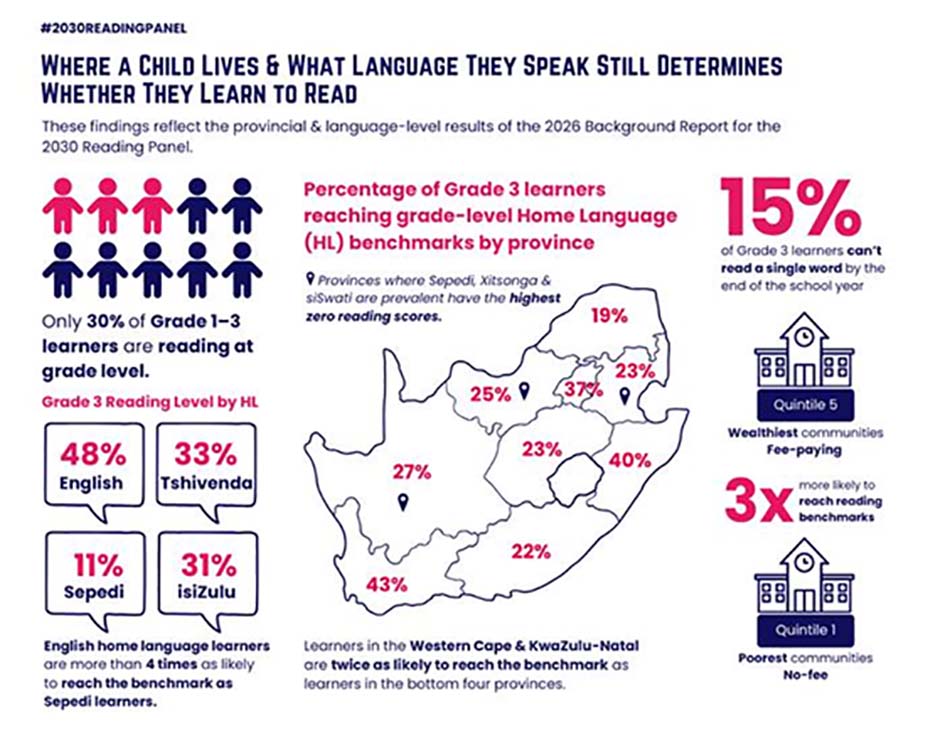
Only 30% of learners in Grades 1–3 are reading at grade level in their home language. In some languages, up to 25% of Grade 3 learners cannot read a single word.
Across the system, 15% of Grade 3 learners scored zero on reading assessments – which means they are unable to decode even a single word by the end of their third year of formal schooling.
“We can see the full picture of where South African children stand in the earliest, most critical years of learning,” says former deputy president Dr Phumzile Mlambo-Ngcuka, who chairs the Panel. “The data shows us the scale of the challenge and exactly where intervention is most urgent. Importantly, it also shows us where success is being achieved.”
Provincial and language breakdowns
The data reveals major variation across languages, provinces and socio-economic contexts, with learners in higher-income schools significantly more likely to reach grade-level benchmarks.
“These are not abstract statistics,” says Sipumelele Lucwaba, who leads the Panel’s secretariat. “They represent millions of children in our system without the ability to read in any language.
“As a country, we have analysed this crisis from every angle, but diagnosis is no longer enough – the point now is to change it. Without urgent intervention, these children have no pathway to educational success.”
Six provinces now implementing large-scale interventions
Change and improvements are happening. There has been significant progress since 2022, when no provinces were implementing large-scale, evidence-based reading interventions.
Today, six of the nine provinces – the Eastern Cape, Free State, Gauteng, Mpumalanga, KwaZulu-Natal and the Western Cape – are rolling out structured literacy programmes that reach hundreds of thousands of learners.
These interventions share common features: structured lesson plans and aligned classroom materials, high-dosage teacher training (typically two days per term over two years), and systematic measurement of learner outcomes. They are funded through a combination of provincial budgets and philanthropic resources, with a new funder collaborative called Float supporting programmes across three provinces that will reach approximately 390 000 learners over the next three years.
The Eastern Cape’s Mabafunde Bonke programme is targeting 1 652 Quintile 1–3 schools in four predominantly rural districts, focusing on isiXhosa and Sesotho instruction in Grades R–3.
The Free State’s Operation Tharollo will reach 89% of Grade R–3 learners who do not have English as a home language, covering Sesotho and Afrikaans. Gauteng’s Grade 3 intervention targets 588 schools with structured materials and coaching support.
Mpumalanga’s Grade R programme reaches all 965 Quintile 1–3 primary schools in the province.
The Western Cape, which began large-scale implementation in 2021, has gone further – adding two additional hours per week to the foundation phase timetable for home language instruction and one hour for mathematics, and introducing standardised baseline assessments within the first 10 days of each school year.
“We are incredibly encouraged by these improvements. These interventions represent a fundamental shift in the system,” notes Dr Mlambo-Ngcuka.
What the evidence shows works – and what doesn’t
The report synthesises a growing body of South African evidence on effective reading interventions.
Three categories of intervention show the strongest impact: provision of learning and teaching support materials (workbooks, graded readers and aligned teacher guides); effective deployment of unemployed youth as teaching assistants; and structured teacher coaching.
The Panel also examines new research on grade repetition, which reveals substantial learning gains for learners who repeat Grade 1 – estimated at 18.1 percentage points in Grade 2, declining to 5.2 points by Grade 4.
However, repetition currently accounts for an estimated 8% of the national basic education budget (R20-billion in 2018), raising urgent questions about whether those resources would deliver greater impact if redirected to early-grade remediation programmes.
On Grade R, the report sounds a note of caution. While making Grade R compulsory is a positive step, new data from the Western Cape shows that the quality of Grade R teaching varies dramatically by school type.
Learners in mid-fee schools make more than double the learning gains of learners in no-fee schools – 18.7 ELOM (Early Learning Outcomes Measure) points versus 8.6 points.
Without strengthening teacher preparation and classroom resourcing, expanding Grade R risks deepening inequality rather than reducing it.
The Panel’s recommendations
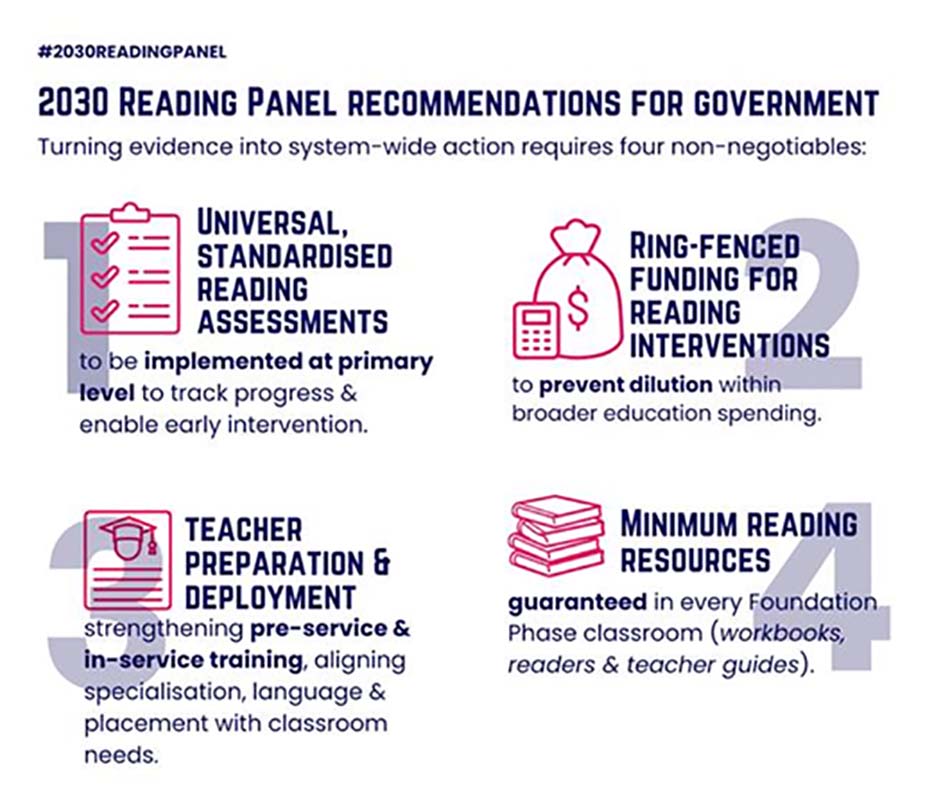
The 2026 report sets out four clear recommendations for government:
The Panel emphasises that while recent public statements continue to reference early literacy, the most recent Medium-Term Development Plan has subsumed reading under a broader outcome of “improved education outcomes and skills”.
The only specified target is an increase in South African Systemic Evaluation (SASE) performance – with no mention of new workbooks, graded readers or structured teacher training.
“Reading for meaning by age 10 is not one priority among many,” notes Lucwaba. “It is the foundation on which every other educational outcome rests. When policy documents blur reading into broader priorities, we don’t just slow progress – we signal to provinces that specificity doesn’t matter. The evidence says otherwise.”
The window for action
“South Africa is at a critical turning point. Provincial implementation of evidence-based reading programmes is expanding, but progress remains uneven and vulnerable without national policy alignment and sustained funding,” says Dr Mlambo-Ngcuka.
The evidence on what works is now clear, and large-scale interventions are already underway in multiple provinces. The next phase requires nation al coordination to ensure every Foundation Phase classroom has the materials, training and accountability systems needed to deliver results.
“We know what works. What is needed now is sustained national commitment to scale it,” says Lucwaba.
The 2026 report is available here.