
More than half (55%) of supply chain leaders expect that advancements in agentic AI will reduce the need to hire for entry-level positions, while 51% believe the technology will drive a shift to overall workforce reductions, according to Gartner.
Gartner surveyed 509 supply chain leaders globally across industries from July to October 2025.
While the view of agentic AI’s ultimate impact on headcount plans remains split, there is wider agreement among respondents (86%) that adoption of agentic AI will require new processes for developing future talent pipelines, signaling a need to rethink how supply chain organizations build skills and utilise talent.
“The highest performing supply chain organisations are using AI to reinvent how work gets done and how talent is developed. They are not treating AI as a blunt instrument for headcount reduction,” says Marco Sandrone, vice-president analyst in Gartner’s Supply Chain practice. “The priority for chief supply chain officers (CSCOs) should be redesigning roles, skills, and workforce processes, so people and machines can create value together.”
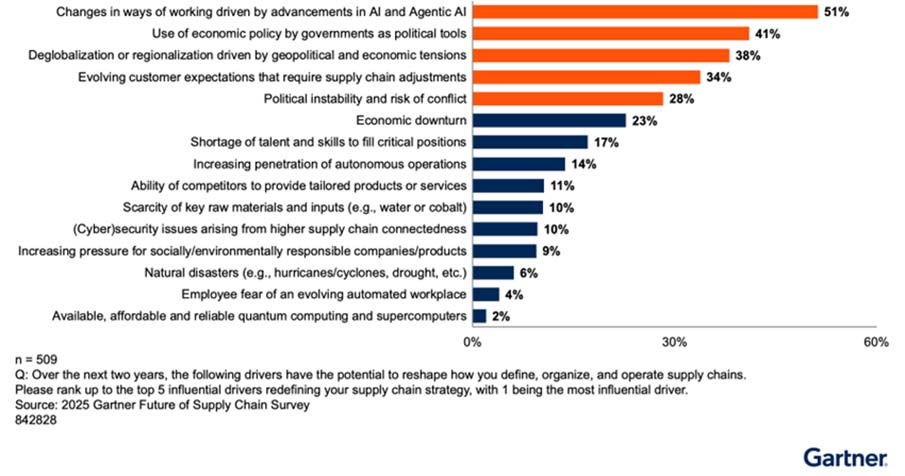
The most influential driver redefining supply chain strategy over the next two years was cited as “Changes in ways of working driven by advancements in AI and agentic AI”.
Top Influential Drivers Redefining Supply Chain Strategy Over the Next Two Years (Sum of Top 3)
Source: Gartner (February 2026)
Human-machine collaboration strategies
Gartner’s survey analysis identified respondents from high-performing organizations that exceeded expectations in areas, such as customer lead time, satisfaction, time to market, revenue growth, and sustainability goals over the past year.
Analysts also interviewed 15 supply chain leaders from companies with a consistent presence in the Gartner Supply Chain Top 25, uncovering the strategies and practices driving their success.
These high-performing respondents’ adoption of agentic AI was significantly higher than other respondents across procurement, production, logistics, warehouse management, and planning.
As a result, the high-performing respondents were more likely to recognize that the traditional talent pyramid will change.
While this may reduce the need for traditional entry-level roles, these leaders are prioritising talent strategy reinvention, rather than headcount reduction.
Over the next two years, these high-performing leaders plan to prioritize the following talent strategies:
- Upskill talent for the AI era
- Use AI-enabled tools to optimize workforce planning and candidate engagement
- Increase automation and advanced technologies to improve efficiency and reduce reliance on manual labour
“Entry-level roles as understood today may fade in importance, but supply chains will still need emerging talent that is highly adaptive and innovative,” says Sandrone.
“As organisations identify new ways of working through the use of AI, they will also have an advantage in identifying and attracting the kinds of talent that will sustain these new working models, including successfully reskilling current staff to take on new, higher-value roles.”