
Astronomers from the University of Cape Town (UCT) – working with colleagues from Université Claude Bernard Lyon 1 (France), Swinburne University of Technology (Australia) and the INAF Osservatorio Astronomico di Cagliari (Italy) – have uncovered the true scale of one of the largest hidden structures in the nearby Universe.
Their findings reveal the immense extent of the Vela Supercluster, a colossal concentration of galaxies that had remained concealed behind the dense dust and stars of our own Milky Way galaxy.
The international collaboration, led by researchers including UCT’s Emeritus Professor Renée Kraan-Korteweg from the Department of Astronomy, used a novel hybrid technique that combines different types of galaxy measurements to map this previously obscured region of the cosmos.
The discovery fills a major gap in astronomers’ understanding of the large-scale structure of the Universe and sheds new light on the forces that shape how galaxies move across vast cosmic distances.
Emeritus Professor Kraan-Korteweg says the discovery builds on more than a decade of work by the UCT team. “I am truly exhilarated that the data gathered by my group could be successfully incorporated into this novel methodology.
“It has finally confirmed the prominence of the Vela-Banzi supercluster — something I suspected more than a decade ago — and shows that it plays an important role in the large-scale cosmic flows in our region of the Universe, including our own Local Group of galaxies.”
The ‘Zone of Avoidance’
About 20% of the sky is difficult to observe because it lies behind the Milky Way’s dense disk. This region, known as the Zone of Avoidance, hides distant galaxies behind thick clouds of dust and billions of foreground stars.
For decades, this blind spot prevented astronomers from obtaining a complete picture of the large-scale structure of the Universe.
As a result, scientists struggled to fully understand the origin of large cosmic flows, the large-scale motions of galaxies caused by the gravitational pull of massive structures.
A new way to map the hidden Universe
To overcome this obstacle, the research team developed a hybrid reconstruction technique that combines two types of galaxy measurements:
- Galaxy redshifts, revealing how fast galaxies are moving away from us as the Universe expands, and
- Galaxy distances and peculiar velocities, revealing how galaxies move under gravity across enormous cosmic distances.
By combining these measurements, scientists can reconstruct the underlying distribution of matter in the Universe, including invisible dark matter.
The team used more than 65 000 galaxy distance measurements from the CosmicFlows catalogue and added over 8 000 new galaxy redshifts observed close to the plane of the Milky Way.
A major breakthrough came from observations with two world-leading facilities in South Africa, the Southern African Large Telescope (SALT) and the MeerKAT radio telescope, operated by the South African Radio Astronomy Observatory.
These instruments allowed astronomers, including the UCT team, to detect galaxies deep inside the most obscured regions of the Zone of Avoidance.
MeerKAT can detect hydrogen gas at radio wavelengths that pass through dust. This enables astronomers to observe galaxies that would otherwise remain hidden.
For the first time, astronomers systematically probed this hidden region of the sky and revealed the massive cosmic structure behind it.
The true size of the Vela Supercluster
These new observations reveal that the Vela Supercluster is far larger and more massive than previously thought.
Located roughly 800-million light-years away, the structure stretches across about 300-million light-years and contains an enormous amount of matter. This is equivalent to about 30-million billion Suns (around 3 × 10¹⁶ solar masses).
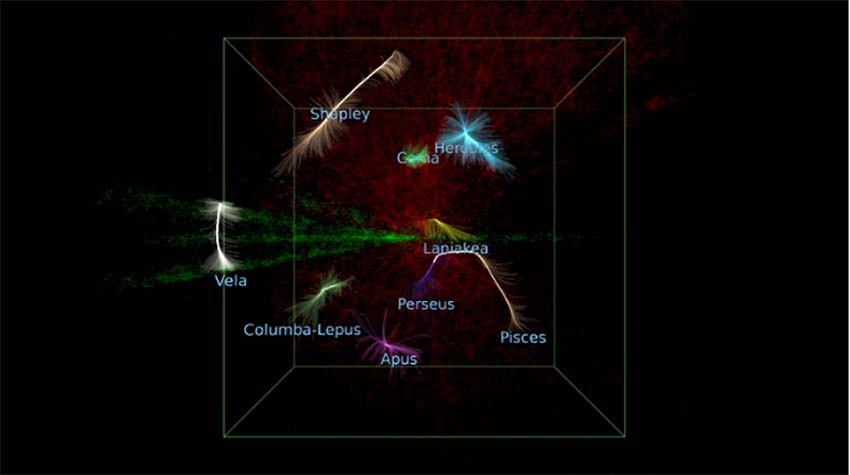
The analysis shows that Vela rivals the famous Shapley Supercluster, which has long been considered the most massive structure in the nearby Universe.
Vela itself has a complex internal structure, with two main dense cores moving toward each other. This makes the system even more remarkable. Its gravitational influence exceeds that of other well-known regions such as Laniakea, the supercluster that contains our own Galaxy, and the Great Attractor.
Understanding cosmic flows
Massive structures like Vela exert a powerful gravitational pull on surrounding galaxies. This shapes the large-scale motions of matter in the Universe.
By revealing the true extent of the Vela Supercluster, astronomers can now better understand the cosmic flows that influence the motion of galaxies across hundreds of millions of light-years.
A preview of the future of cosmic mapping
The study demonstrates the power of combining different types of astronomical observations to reconstruct the structure of the Universe, even in regions that are difficult to observe directly.
Such hybrid techniques will become increasingly important as the next generation of astronomical surveys and observatories unfolds. These will allow scientists to map the cosmic web with unprecedented precision and reveal the hidden architecture of the Universe.
INAF Osservatorio Astronomico di Cagliari academic and former UCT PhD student Sambatriniaina Rajohnson, says: “This discovery helps complete our map of the nearby Universe. For the first time, we can clearly see one of the major gravitational players hidden behind our own galaxy.”
An affectionate name for the Vela Supercluster: ‘Vela-Banzi’
The team of astronomers also acknowledged the land in South Africa and Australia on which the telescopes used in the research are located, recognising the communities and custodians of these lands.
Given the importance of the SARAO MeerKAT data in revealing galaxies at the lowest latitudes of the sky, the team has introduced a locally inspired affectionate name for the Vela Supercluster, “Vela-Banzi”.
Derived from isiXhosa, the name means “revealing widely”. This describes a structure that is now emerging from behind the Milky Way as one of the most extended and massive superclusters in the nearby Universe.
Kraan-Korteweg highlights the important role played by young researchers at UCT.
“I am extremely proud of the many UCT students who contributed to the challenging task of peering through the Milky Way’s disk over the years, among them six PhD and nine MSc students.”
Featured picture: A map of the Local Universe highlighting the main superclusters. Vela, a massive hidden structure, is on the left. The image shows how galaxies flow through space and the large-scale“basins” that channel them.
Photo: Dr Jerome Leca, RSA Cosmos, St Etienne, France