
Harnessing rapidly evolving AI technologies while keeping enterprises and their staff on track amidst a turbulent, high-change environment are the biggest chief financial officer (CFO) challenges in the next six months, according to Gartner.
“CFOs are having to manage through levels of change and volatility that just seem to be accelerating each year: whether it’s technology, society, geopolitics or macroeconomics – it’s hard to find stability,” says Mallory Bulman, senior director analyst in the Gartner Finance practice.
“CFOs will find hiring AI and digital talent to meet their top challenge is not easy and it’s expensive. In the near term, they should focus on upskilling their existing workforce to close digital capability gaps and drive more value from the tools they already own,” Bulman adds.
“That means making technology feel practical and accessible for employees and establishing a role-specific AI literacy strategy that builds skills across AI foundations, value, engineering, and governance.”
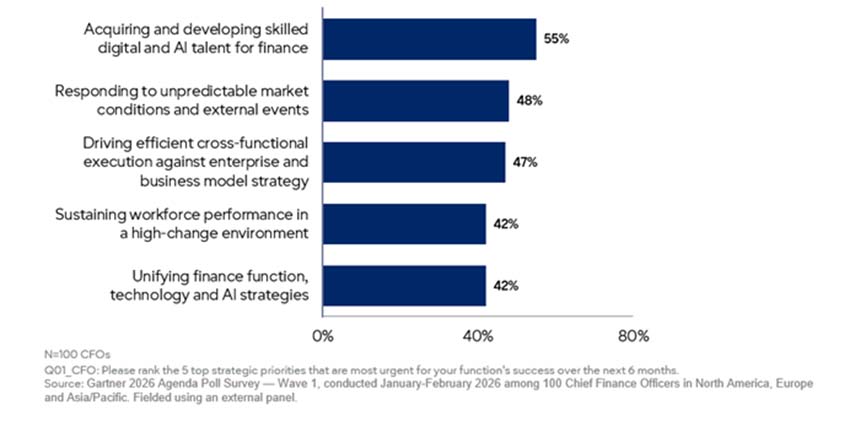
According to a Gartner survey of 100 CFOs, taken from January through February 2026, respondents identified building AI talent in the function and responding effectively to unpredictable market conditions and events as their two most challenging priorities in the next six months.
Biggest CFO Challenges for Q2/Q3
Source: Gartner (March 2026)
“After this survey was taken, global disruption has further accelerated with events in the Middle East,” says Bulman. “CFOs and their teams have to actively work on handling volatility and shocks because on multiple fronts this is the operating environment organisations are facing today.”
Gartner outlines how to manage these five top challenges:
- Acquiring and developing skilled digital and AI talent – Gartner analysts advise that by 2030 leading finance organisations will be reshaped by AI and automation, with finance teams shifting from traditional control and business-partnering roles toward digitally skilled “catalysts” who build tools, manage AI-driven workflows, and deliver insight at scale.
- Responding to unpredictable market conditions – Traditional scenario planning is no longer effective in today’s volatile environment because it relies on static assumptions, over weights internal drivers, and responds too slowly to external shocks.
- Driving cross functional execution against enterprise and business model strategy – CFOs and finance leaders should move away from judging technology investments only through traditional financial ROI, and instead they should use outcome-driven metrics that connect technology to a broader set of business outcomes, including financial, intangible, and innovation returns.
- Sustaining workforce performance in a high change environment – CFOs should make change management a continuous operating discipline by maintaining a live transformation calendar, adapting narratives to stakeholder personality and context, and activating change agents across finance to sustain momentum and reduce resistance
- Unifying finance function technology and AI strategy – While most finance functions are experimenting with AI, impact is often limited because of piecemeal experimentation with isolated tools instead of following a disciplined, structured finance AI roadmap.