
The University of Cape Town’s African Compute Initiative (ACI) aims to establish Africa’s largest graphics processing unit (GPU)-intensive compute cluster dedicated to artificial intelligence (AI) research in a higher education institution.
The initiative is part of the AI for Development (AI4D) programme, a £58-million co-funded partnership between the United Kingdom (UK) government’s Foreign, Commonwealth and Development Office and Canada’s International Development Research Centre (IDRC).
It will give African researchers and innovators access to the computing infrastructure needed to develop, train and test AI systems locally – an area where the continent has faced persistent and growing constraints.
By combining state-of-the-art GPUs, high-capacity, secure storage and high-speed networking in UCT’s new data centre, the ACI will provide African researchers with the infrastructure they need to develop, train and test AI systems on the continent, shifting them from consumers to creators of frontier AI.
A solar installation will enhance the platform’s sustainability, making the ACI a model for greener, affordable and African-led compute that underpins AI4D labs, local language initiatives and innovation work across the continent.
“African researchers have the ideas and the talent, but they have been held back by a lack of access to the computing power that AI development demands,” says Associate Professor Jonathan Shock, associate professor of Applied Mathematics at UCT and interim director of the UCT AI Initiative.
“The African Compute Initiative changes that. It means researchers and students across Africa can work at the frontier of AI, not just consume what is built elsewhere.”
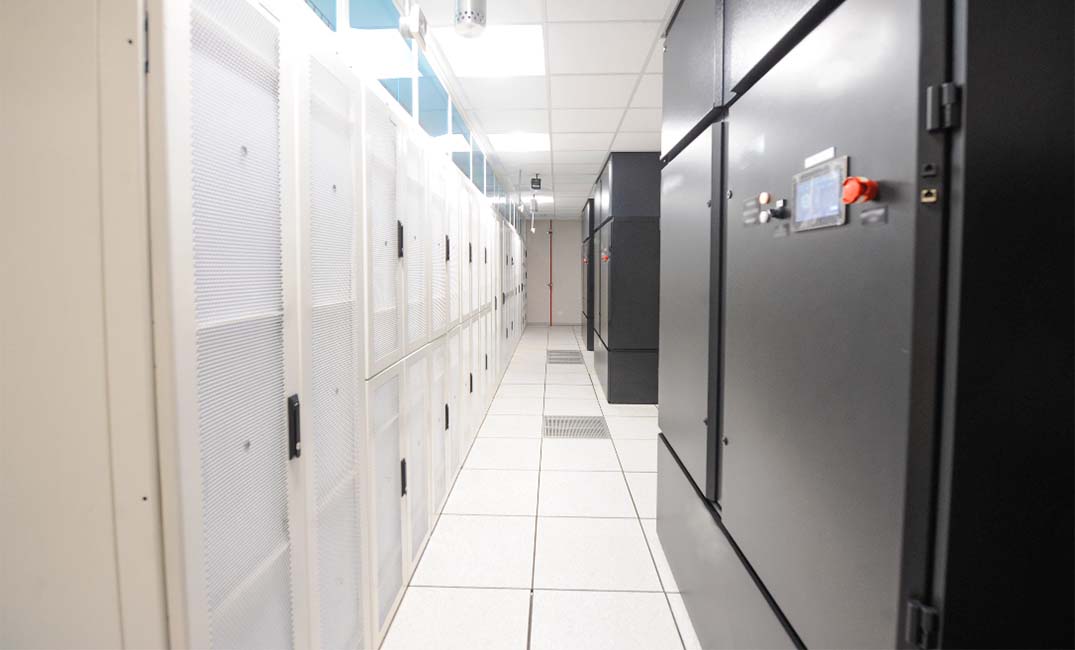
The ACI will be housed in UCT’s recently refurbished High Performance Computing Data Centre. It will combine modern GPU servers, multi-petabyte storage and high-speed networking to support AI-intensive workloads, including model training, fine-tuning, inference and large-scale simulations.
The cluster is targeted to be operational within 12 months, with around 100 active users in its first year and a target of 300 active users across at least five institutions by the end of year three.
The project leverages infrastructure and expertise already established at UCT through the Inter-University Institute for Data Intensive Astronomy (IDIA), which operates the ilifu research cloud, an award-winning, large-scale computing platform that has supported over 1000 researchers in astronomy and bioinformatics since 2015.
The ilifu system (meaning “cloud” in isiXhosa) has been in operation at UCT for over a decade. It currently supports more than 600 active users, with a strong focus on preparing South African and African researchers for the Square Kilometre Array Observatory, which will be one of the largest scientific infrastructures ever built. It runs on the same OpenStack and Ceph technologies that will underpin the ACI, significantly reducing technical risk and accelerating delivery.
In 2024, IDIA received the NSTF-South32 Award in the special theme of the Fourth Industrial Revolution for its computing infrastructure and management.
UCT’s existing central high-performance computing (HPC) cluster has been crucial for research but is increasingly oversubscribed. The ACI addresses this gap directly, and its technical team draws on deep institutional expertise.
Key personnel will include staff from the UCT AI Initiative, the Inter-University Institute for Data Intensive Astronomy, UCT Information and Communication Services, and UCT’s Environmental Sustainability department.
The initiative will expand UCT’s technical team by four new staff members and will provide training workshops and onboarding for students and researchers, with a particular focus on early-career researchers and those from underrepresented groups.
Beyond serving UCT’s own rapidly growing AI community – including students enrolled in the university’s new AI Major, launched in 2025 – the ACI will extend access to AI4D labs and hubs across Africa already supported by FCDO and IDRC.
As with the ilifu cluster, a key feature of the initiative’s design is its accessibility. Researchers at institutions with intermittent internet connectivity will be able to prepare and submit computing jobs and retrieve results when connectivity is available, ensuring the infrastructure serves the full breadth of African research institutions rather than only those with reliable, high-speed access.
A federated model will allow researchers to use their home institution credentials to access resources at partner institutions across the continent.
The physical infrastructure is complemented by an interdisciplinary social science and operational research programme, funded by IDRC and FCDO through the Mozilla Foundation and led by Dr Annette Hübschle of the Global Risk Governance Programme in the Department of Public Law, with collaborators drawn from across the university.
The programme will examine how African researchers access and experience the facility, identify barriers to equitable participation and develop tools to ensure compute resources are allocated fairly and sustainably across the continent.
The ACI also integrates an environmental sustainability component, with approximately 180 kWp of solar photovoltaic installations planned for UCT’s upper campus. This is expected to generate between 220 and 240 MWh of renewable energy annually, offsetting roughly 200 tonnes of CO₂ per year and contributing to UCT’s broader decarbonisation commitments.
Longer-term sustainability will be supported through integration into UCT’s institutional computing lifecycle, partnerships with African and global research networks and potential cost-recovery mechanisms for industry collaborations. UCT will document the process through a detailed case study and produce a replication toolkit to help other African universities build similar capacity.
Featured picture: UCT’s new data centre
Photo: Lerato Maduna