
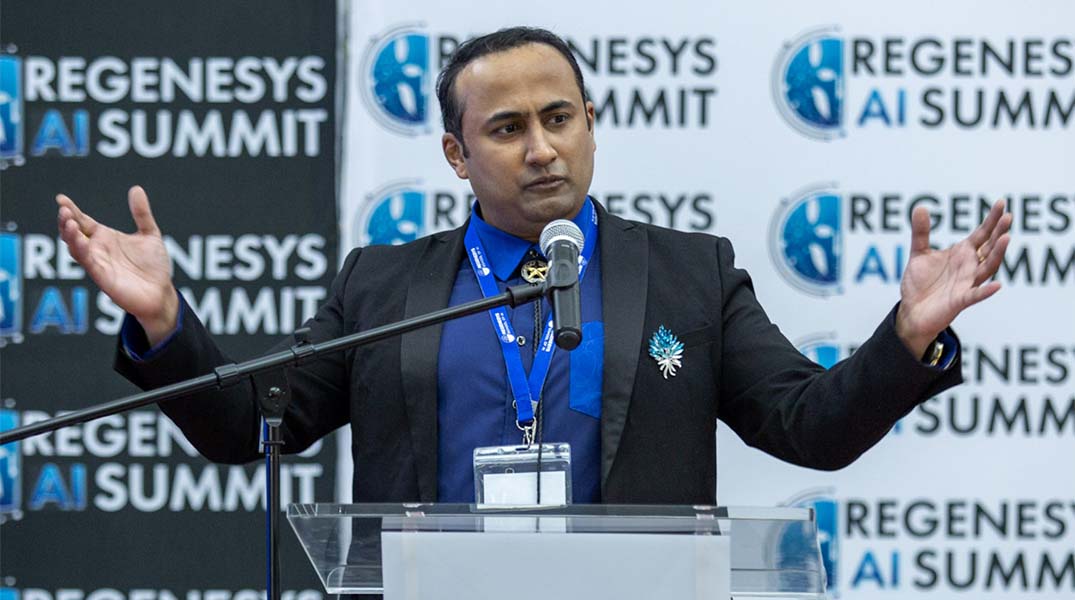
Regenesys Education has launched what it believes to be Africa’s first institution dedicated to artificial intelligence (AI) education.
The School of AI is a dedicated academic institution offering structured programmes across AI fundamentals, machine learning engineering, governance and ethics and applied AI in financial services, healthcare and public administration.
Curricula were co-developed with industry to ensure graduates are employment-ready.
The school’s founding argument, set out by Dr Nishal Khusial, managing partner: AI Africa at Regenesys, is that Africa cannot keep importing AI solutions designed for western data, western infrastructure and western regulatory assumptions.
The continent needs practitioners who understand its own conditions, he notes, including for work already underway on off-grid and offline AI agents.
At the AI Summit ahead of the school’s launch, Regenesys Business School’s Indherani Reddy commented: “AI can generate knowledge and predict behaviour, but we still cannot replicate consciousness, integrity and purposeful leadership.”
Antony Makins, chairman of the IITPSA’s Special Interest Group for AI and Robotics, said: “South Africa does not have an AI challenge. We have an AI execution challenge.”
National AI policy frameworks are, by his assessment, sound. What breaks down is the translation of those frameworks into practice: a cycle he described as “pilot purgatory, uncontrolled deployments and compliance theatre”; governance as performance rather than substance.
Closing that gap, said Makins, requires AI accountability embedded at board level, with clear ownership of risk, data, transparency, human oversight and continuous monitoring. The skills to do that do not yet exist at scale.
Microsoft’s Ayanda Ngcebetsha mapped the landscape these graduates will enter. He described a shift from the cloud era into a “cognitive era” in which intelligence is scalable, and in which the organisations that thrive will be what he called “frontier firms”, defined by how effectively they harness and direct intelligence.
Africa, he argued, has a genuine opportunity to leapfrog rather than merely catch up, but only if it builds the human capital to lead from the front rather than implement from behind.
The economic argument for urgency was quantified by Abongile Mashele, Google South Africa’s head of government affairs and public Policy. AI already contributes an estimated $3-billion to South Africa’s economy, she told the room, with that figure set to grow substantially by 2030 if the right foundations are in place.
Google has invested in subsea and fibre connectivity, local data centre capacity, AI research on the continent and language models designed for African contexts. A partnership with Discovery, using Google’s Gemini platform to personalise health recommendations, illustrated the potential of locally grounded innovation to scale globally.
“We cannot be passive consumers of these technologies. We must be active participants shaping AI to reflect our own values.”
The infrastructure reality was addressed by Cisco South Africa’s country leader Smangele Nkosi, who warned that while most organisations recognise AI’s importance, the majority lack the skills and foundations to act on it.
She described the shift underway as a move from digital transformation to “intelligent transformation”, with AI evolving from a tool into an autonomous collaborator.
Nkosi’s three-pillar framework for readiness – infrastructure, integration and people – placed human capability last on the list for a reason: it is the hardest to build and the slowest to scale: “The era of agentic AI is already here. We must shape the future and inclusive societies of tomorrow.”
The human cost of getting this wrong was made most tangible by Ayanda Swana, CEO of Siemens Healthineers South Africa, who said that in healthcare, AI has already moved from aspiration to operational necessity.
Against a backdrop of severe shortages of healthcare professionals and growing demand across the continent, AI-assisted diagnostics, automated radiology and “digital twin” technology for personalised treatment are already compressing turnaround times and improving clinical accuracy.
“AI is essential to improving the efficiency of medicine in Africa,” Swana said. “Where you live should not determine how long you live. But African countries must retain sovereignty over their health data. Trust is essential.”