
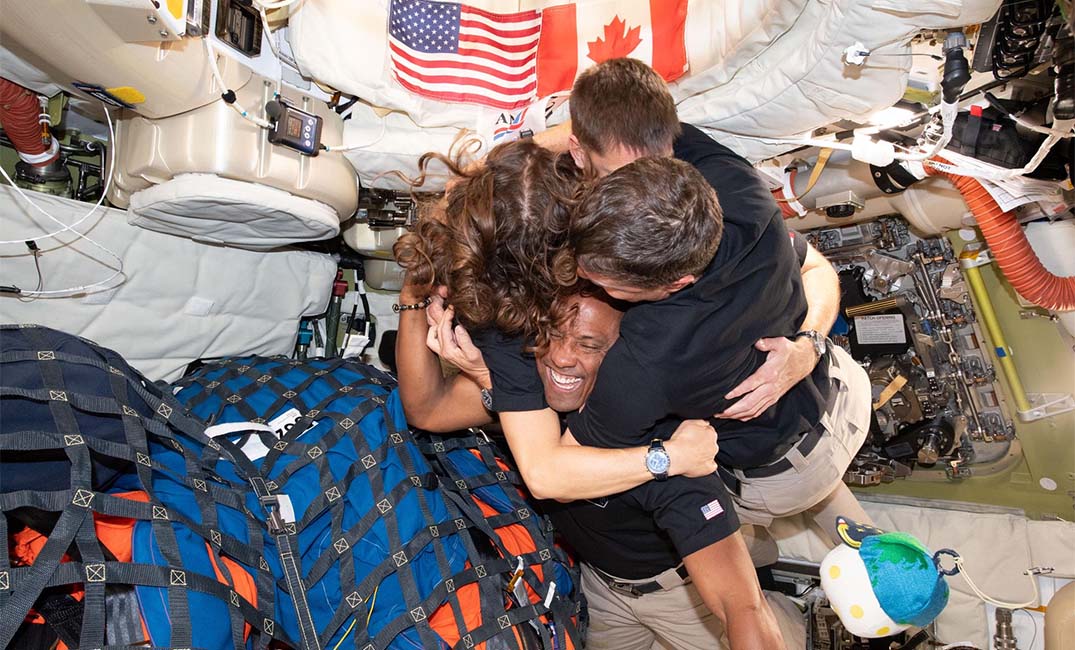
NASA astronauts Reid Wiseman, Victor Glover, and Christina Koch and CSA (Canadian Space Agency) astronaut Jeremy Hansen will return to Earth tonight.
Orion’s thrusters are scheduled to ignite for the second return trajectory correction burn at 9:53 pm EDT to fine‑tune the spacecraft’s path toward Earth. The manoeuvre will further refine Orion’s trajectory and ensure the spacecraft remains aligned for atmospheric re-entry.
During the burn, Hansen will review the procedure steps and monitor Orion’s guidance, navigation, and propulsion systems.
As Artemis II nears its return to Earth, NASA teams on the ground are completing final preparations for Orion’s re-entry and splashdown around 8:07 pm Friday, 10 April, off the coast of San Diego.
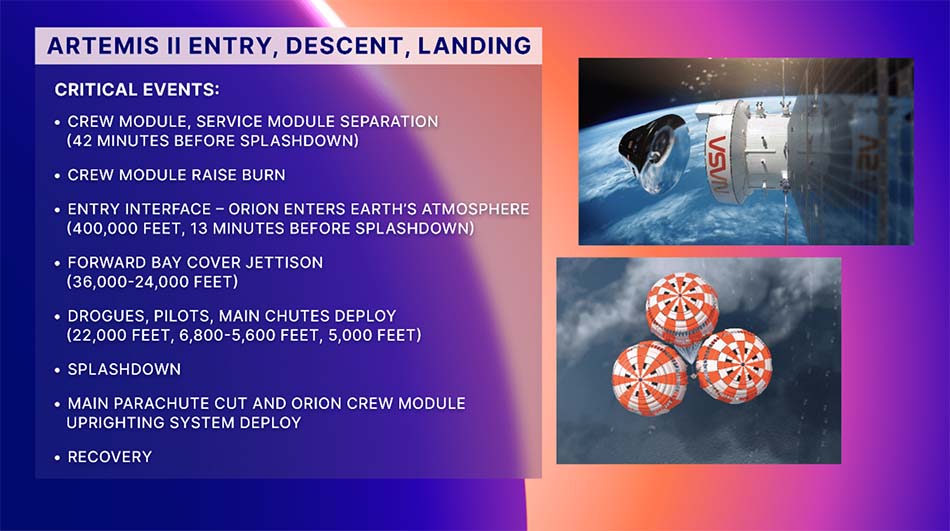
Artemis II infographic showcasing the missions entry, descent, and landing milestones. This graphic was presented by Artemis II Flight Director Rick Henfling during the mission status briefing to the media and public on 8 April 2026.
Credit: NASA
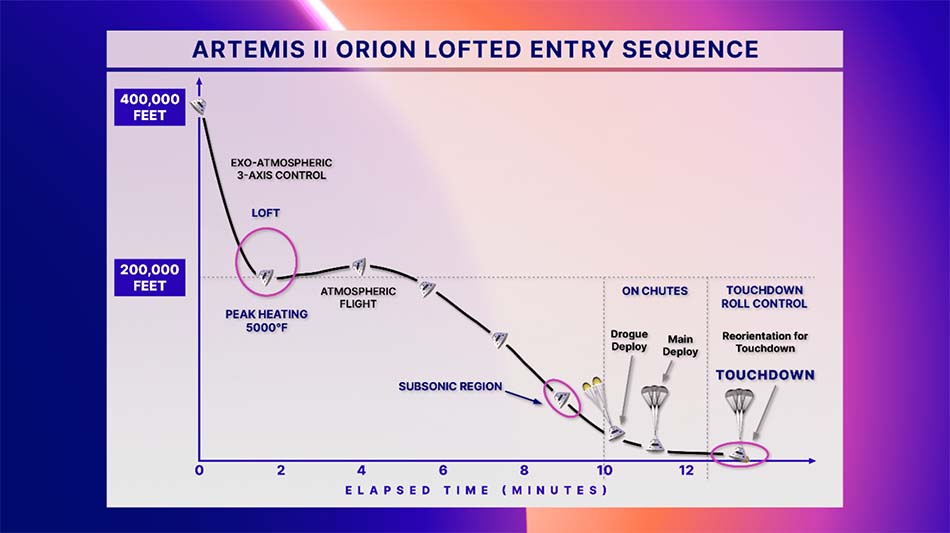
Infographic featuring the Artemis II Orion lofted entry sequence. This graphic was presented by Artemis II Flight Director Rick Henfling during the mission status briefing to the media and public on 8 April 2026.
Credit: NASA
During re-entry, the service module will separate around 7:33 pm, about 20 minutes before Orion reaches the upper atmosphere southeast of Hawaii.
At 7:37 pm, a final trajectory‑adjustment burn will fine‑tune the flight path before the spacecraft begins a series of roll maneuvers to safely distance itself from departing hardware.
Orion will reach its maximum velocity — approximately 23 864 miles per hour — just before entry interface.
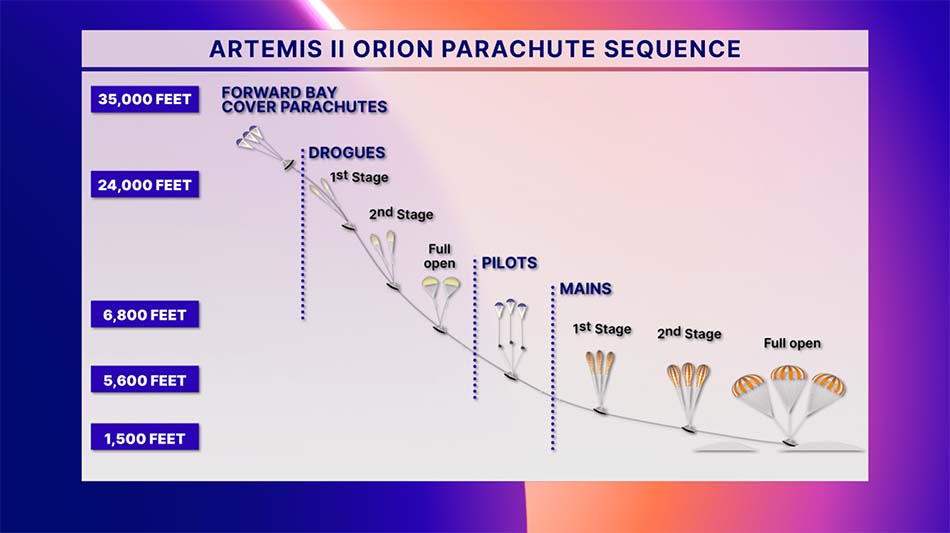
Infographic displaying the Artemis II Orion parachute sequence. This graphic was presented by Artemis II Flight Director Rick Henfling during the mission status briefing to the media and public on 8 April 2026.
Credit: NASA
As Orion descends through about 400 000 feet, the spacecraft will enter a planned six‑minute communications blackout at 7:53 pm as plasma forms around the capsule during peak heating.
The crew is expected to experience up to 3,9 Gs in a nominal landing profile.
After emerging from blackout, Orion will jettison its forward bay cover, deploy its drogue parachutes near 22 000 feet at 8:03 pm, and then unfurl its three main parachutes around 6 000 feet at 8:04 pm to slow the capsule for splashdown off the coast of San Diego.
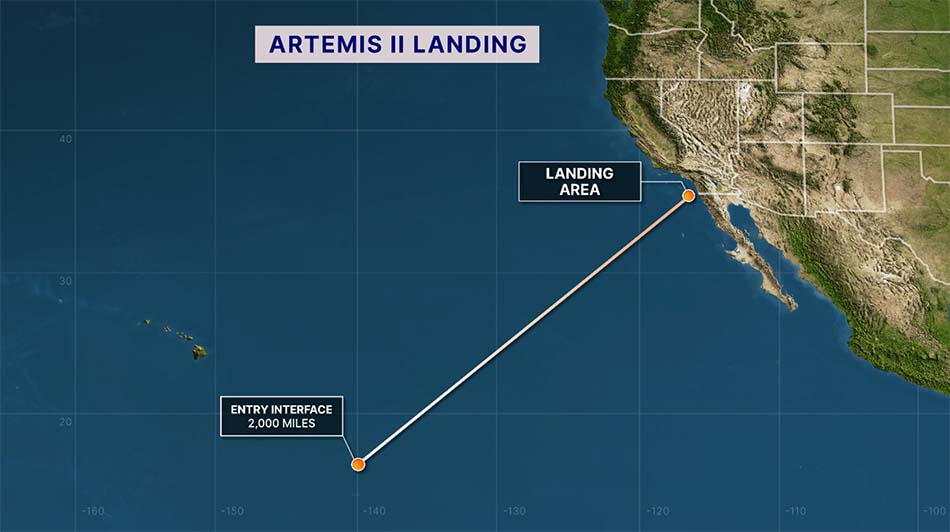
Ground track map displaying the Artemis II Orion parachute sequence. This graphic was presented by Artemis II Flight Director Rick Henfling during the mission status briefing to the media and public on 8 April 2026.
Credit: NASA
Within two hours after splashdown, the crew will be extracted from Orion and flown to the USS John P Murtha.
Recovery teams will retrieve the crew using helicopters, and once aboard the ship, the astronauts will undergo post‑mission medical evaluations before returning to shore to board an aircraft bound for NASA’s Johnson Space Center in Houston.
Watch the reentry and splashdown live:
Watch on NASA+ from 06h30 EDT
Watch on YouTube from 06h30 EDT
You can also follow live views from Orion; and track Artemis II in realtime
Featured picture: The Artemis II crew – (clockwise from left) mission specialist Christina Koch, mission specialist Jeremy Hansen, commander Reid Wiseman, and pilot Victor Glover – take time out for a group hug inside the Orion spacecraft on their way home. Following a swing around the far side of the Moon on 6 April 2026, the crew exited the lunar sphere of influence (the point at which the Moon’s gravity has a stronger pull on Orion than the Earth’s) on 7 April, and are headed back to Earth for a splashdown in the Pacific Ocean tonight (10 April). The crew was selected in April 2023, and have been training together for their mission for the past three years.
Credit: NASA