
Appetite for offering cyber insurance remains mixed, as difficulties in assessing risks create challenges in ensuring profitability. Insurers need to continuously monitor and adopt to an ever-changing cyber risk landscape.
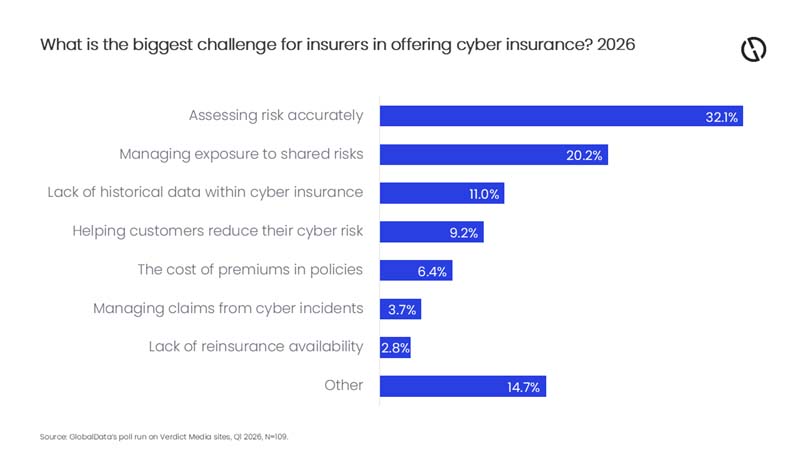
According to a poll conducted by GlobalData on Verdict Media sites in Q1 2026, which garnered responses from industry insiders, accurately assessing cyber risks remains the biggest challenge that insurers must overcome to offer cyber cover, with almost a third of respondents (32,1%) citing this.
The proportion of respondents identifying risk assessment as the key hurdle is significantly higher than managing exposure to share risks (20,2%), such as multiple clients hit by the same cyber-attack, the next most prominent response.
Beatriz Benito, lead insurance analyst at GlobalData, comments: “Unlike traditional insurance lines, underwriters cannot rely on comprehensive historic data to assess cyber risks. In addition, cyber risks are constantly evolving and unpredictable, with hackers becoming savvier and more sophisticated in their techniques.
“Increasingly, AI is being used in attacks. This adds a further layer of complexity owing to the fast-evolving nature of AI, with many insurers now adding AI-specific exclusions.”
High profile attacks are not unheard of and can be costly for insurers, raising concerns around how to price cyber cover correctly. Multiple companies could be hit in the same major event, leading to huge claims costs. In turn, this is linked to the difficulty of adequately assessing risks.
Benito concludes: “Insurers typically have high premium base lines to ensure offering cyber insurance is profitable. Given the rapidly changing conditions and unpredictability of risks, insurers need to take an active approach – continuously monitoring risks and adapting to emerging threats.
“Better adaptability among insurers will be key in improving capacity. However, smaller insurers may just not yet have the ability to offer cyber insurance, while appetite for this risk varies among larger providers.”