

Worldwide adoption of artificial intelligence continued to rise in the first quarter of 2026, according to Microsoft’s Global AI Diffusion Q1 2026 Trends and Insights report from its AI Economy Institute.
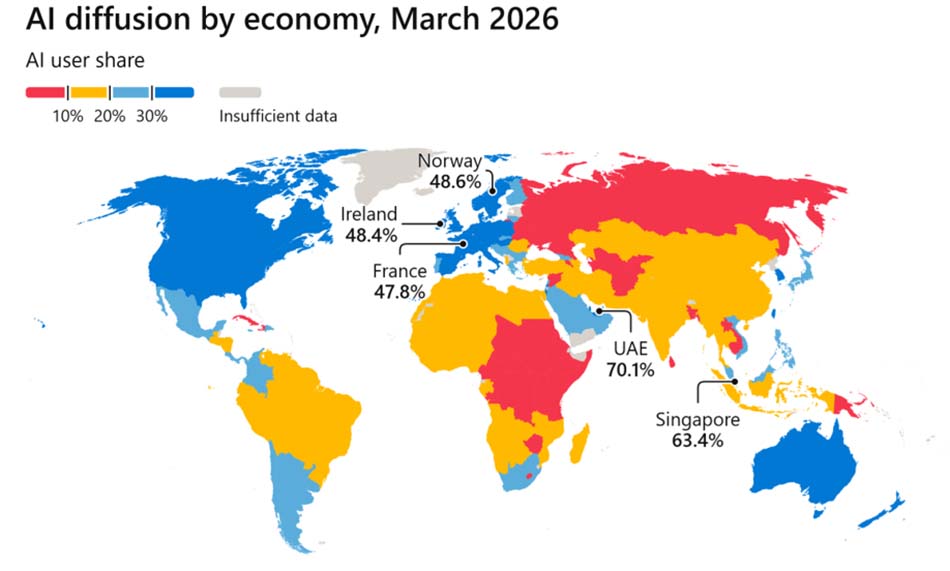
During the quarter, AI usage increased by 1,5 percentage points from 16,3% to 17,8% of the world’s working age population. Intensity of use among economies with the highest rates of AI diffusion also increased, with 26 economies now exceeding 30% of the working age population using AI.
Locally, South Africa ranks 46 of 147 economies measured and its AI usage increased by 2% from 21,1% in H2 2025 to 23,1% in Q1 2026.
“Our latest AI Diffusion report findings show that AI is moving rapidly from experimentation to practical, everyday use, but the benefits are not yet evenly shared. For South Africa, the rise in local AI usage to over 23% is encouraging progress, yet our position globally underscores the urgency of investing in digital infrastructure and skills,” says Ravi Bhat, commercial solutions and AI officer at Microsoft South Africa. “We view this phase of AI growth as an opportunity to help ensure AI supports inclusive growth, innovation, and long‑term competitiveness across South Africa’s economy.”
At the top of Microsoft’s National AI Leaderboard, the UAE continued to lead global AI diffusion at 70,1%. Ten of the 147 economies measured, led by the UAE, now have AI usage above 40%, placing them in a leading cohort of high AI-adoption economies.
Notable developments in the quarter included accelerating AI adoption in Asia driven in part by improving AI capabilities in Asian languages. South Korea, Thailand, and Japan saw the greatest movement.
More broadly, the quarter brought continued widening of the AI gap between the Global North and South, with usage now at 27,5% in the North and 15,4% in the South.
The widening divide
In Q1 2026, 27.5% of the population in the Global North used generative AI, up from 24,7% in H2 2025, a gain of 2,8 percentage points. In the Global South, usage reached 15,4%, up from 14,1%, a gain of just 1,3 percentage points.
Adoption in the North is growing at more than double the rate as in the South.
This divide reflects the systemic challenges facing the Global South, underscoring the need to address foundational gaps in electricity, connectivity, digital skills, and local language access. Until these gaps are addressed, the benefits of generative AI will remain unevenly distributed, risking a deepening of existing global inequalities.
Bridging this gap requires interventions that go beyond access to technology alone and focus on building the foundational enablers that allow AI to be meaningfully used in local contexts. One of the most critical, and often overlooked, barriers is language, as many African languages remain underrepresented in the datasets and models that underpin modern AI systems, limiting who can benefit from these advances.
The collaboration between Microsoft AI for Good Lab and the Masakhane African Languages Hub, through the LINGUA Africa initiative, aims to accelerate the development of African language AI datasets, models and tools to address the continent’s linguistic under-representation in technology.
Uneven AI reach
AI adoption continued to accelerate in Q1 2026, but the benefits are spreading unevenly.
The clearest sign of AI’s near-term economic impact is software development, where new coding models and agentic tools are dramatically increasing code production, repository creation, and AI-assisted development activity.
Together, these trends suggest that AI diffusion is entering a new phase: broader, faster, and more practical, but also one that requires deliberate action to ensure its benefits are shared globally.
Coding as a leading indicator
Africa is emerging as a powerful force in the global software economy, with an estimated 4.7 million developers as of 2024, according to Boston Consulting Group’s Develop the Developers: A Strategic Priority for Africa report.
South Africa, with more than 500 000 developers and a growth rate of nearly 15% between 2019 and 2024, ranks alongside Egypt and Nigeria as one of the continent’s largest developer hubs, reflecting the maturity and depth of their established tech ecosystems.
Overall, between 2019 and 2024, Africa’s developer base expanded at an annual rate of 21% – the fastest of any region – creating a strong foundation for participation in an increasingly AI-accelerated future.
At the same time, AI is reshaping how software gets built, and developer activity on GitHub reflects the shift. Microsoft’s Global AI Diffusion report finds that over the past year, global Git pushes – through which software developers put coding changes online – rose 78%, and new repositories increased by 45%.
Interestingly, the quarter brought added evidence that, at least for now, AI coding capabilities may be increasing demand for the employment of software developers. When developer productivity increases, the cost of building software declines. If demand for software is elastic, organisations can respond by building more software across a wider range of use cases, including across broader economic sectors.
Meanwhile, GitHub pull request activity tied to AI coding agents has surged more than 28 times. The acceleration coincides with major model advances: Anthropic’s Claude Opus and OpenAI’s GPT-5 Codex family advanced the state-of-the-art in real-world software engineering, while GitHub Copilot evolved into a broader AI coding platform with multi-model support and autonomous coding agents. Copilot, and other AI coding tools like Claude Code and Codex, are now active participants in the software development lifecycle.