
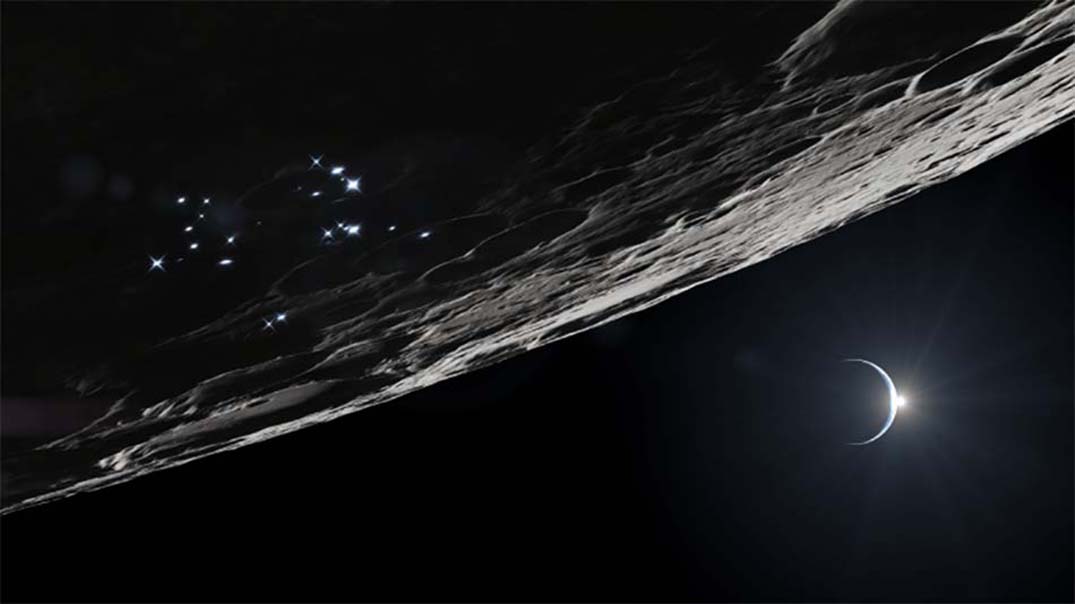
NASA is embarking on one of the most ambitious space endeavors in its history: building the Moon Base near the lunar South Pole, establishing humanity’s first sustained presence on the Moon.
The lunar South Pole is one of the most strategically and scientifically valuable regions on the Moon, offering unique environmental conditions that make it well suited for long-term human exploration.
Unlike many regions of the Moon that experience long periods of darkness followed by long periods of daylight, parts of the South Pole receive extended sunlight and shorter periods of shadow. These lighting conditions can support more consistent solar power generation and improved thermal stability for exploration systems and surface operations.
At the same time, permanently shadowed regions remain in continuous darkness, creating extremely cold environments where water ice and other volatiles may be preserved.
These ice deposits may contain a record of how water and other materials moved through the solar system over time. Studying samples from these deposits could help scientists better understand the history of the Moon, Earth, and the processes that shaped conditions for life.
The identification and analysis of these volatiles may also help support a more sustained human presence on the Moon by informing how local resources could one day be utilised for exploration activities.
The South Pole region is also scientifically significant because it lies near some of the oldest terrain on the Moon, including the South Pole–Aitken Basin, the largest and oldest known impact basin in the solar system. Samples collected from this region could provide insight into the early history of the Moon, the Earth-Moon system, and the broader evolution of the solar system.
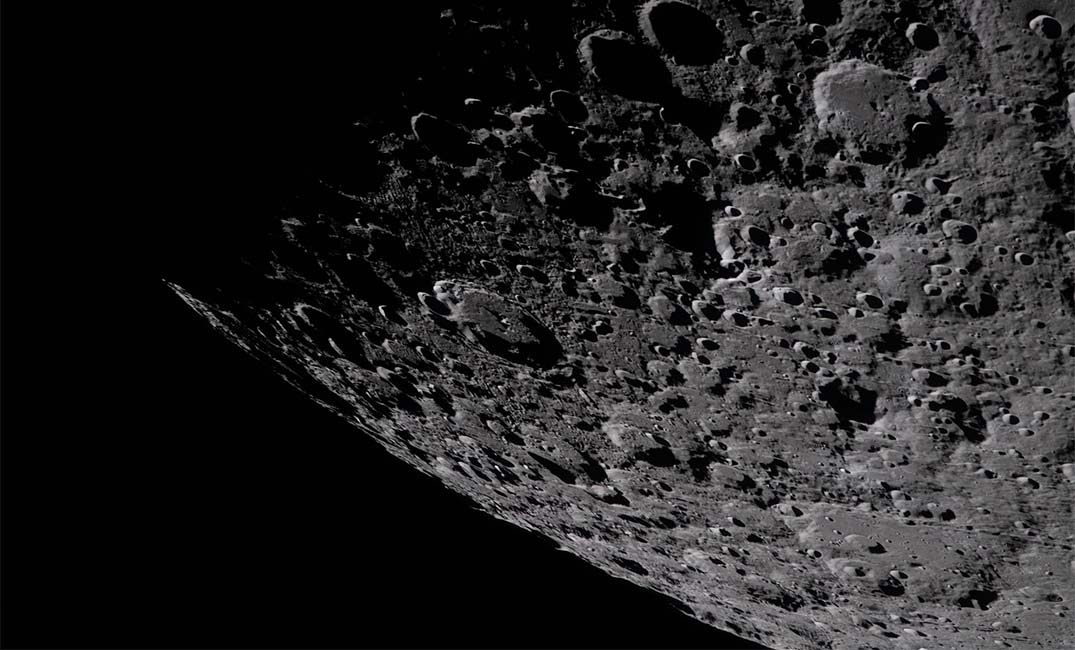
Captured by the Artemis II crew, the heavily cratered eastern edge of the South Pole-Aitken Basin — the Moon’s oldest and largest impact basin — offers a glimpse into billions of years of lunar geologic history.
NASA
NASA will establish the Moon Base in the lunar South Pole region through a phased, iterative approach that builds capability over time. By starting with near-term technology demonstrations, robotic missions, and early experiments, NASA and its partners can test systems, learn quickly, and steadily mature the capabilities required for continuous human presence on the Moon.
Phase One (Now–2029): Experiment and learn
NASA will begin with a rapid series of robotic missions to scout the lunar South Pole region, test technologies, and prepare for surface operations ahead of future astronaut missions.
- A major increase in lunar activity, with up to 25 missions, including 21 landings.
- Crewed and autonomous rovers for mobility demonstrations and surface preparation, along with four drones known as MoonFall and communications relay and observation satellites.
- Early demonstrations of power, navigation, communications, and nuclear radioisotope heater unit technologies designed to endure the long lunar night.
- Scientific payload opportunities integrated across landers and rovers.
- The first tangible footprint of Moon Base effort, with four tons of payload delivered to test what works on the lunar surface.
Phase Two (2029–2032): Early habitation
By 2029, NASA will transition to assembling semi-permanent infrastructure and initiating early habitation and logistics operations.
- Deployment of expanded solar power systems and initial nuclear surface power capabilities, potentially including fission reactors and radioisotope power systems.
- Upgraded rovers, potential advanced MoonFall drones, and early habitation elements.
- Enhanced surface-to-orbit communications networks to provide reliable connectivity across the lunar South Pole region.
- Delivery of up to 60 tons of cargo through as many as 24 landings using low-, medium- and heavy-class cargo landers.
Phase Three (2032 and beyond): Sustained human presence
This phase will scale operations to achieve a true enduring presence, with routine crew rotations and continuous surface activity. This is when living and working on the Moon becomes a reality.
- Semi-permanent habitation modules with spacious interior for crew living and operations.
- Operational fission surface power systems capable of delivering steady, reliable energy through the long lunar nights, leveraging in situ resource manufacturing.
- Advanced logistics networks supported by crewed and autonomous rovers to keep the base supplied and functioning year-round.
- Delivery of up to 38 tons of cargo annually to sustain habitats, power systems, logistics operations, and major science outposts, enabled by low-cost reusable heavy-lift capabilities.
Did you know?
Temperatures at the lunar South Pole can range from more than 54°C in sunlit areas to as low as -203°C inside permanently shadowed craters.
Shackleton Crater is more than twice as deep as the Grand Canyon. Its permanently shadowed interior is believed to contain ice, making it a leading target for future lunar exploration.
As part of Moon Base, NASA is advancing radioisotope heating demonstrations to help protect surface assets during cold lunar nights and operations in permanently shadowed regions.
Built on the legacy of NASA’s Ingenuity Mars Helicopter, MoonFall drones are designed to reach locations on the Moon that are difficult or impossible for traditional rovers to access.
NASA’s VIPER (Volatiles Investigating Polar Exploration Rover) will conduct the first resource-mapping mission of the Moon, using advanced instruments to identify the location and concentration of water at the lunar South Pole region.
NASA is partnering with American industry through the CLPS (Commercial Lunar Payload Services) initiative to deliver a steady cadence of robotic missions to the lunar South Pole region in support of Moon Base development.
NASA is advancing fission power technologies to provide reliable, long-term energy for future operations on the Moon.
During Phase Two of Moon Base development, a pressurized rover supplied by JAXA is expected to dramatically expand how far astronauts can explore across the lunar South Pole.
Lunar regolith may one day help support life on the Moon. Researchers are studying how Moon dust could be used to build structures, grow crops, and even produce oxygen and rocket propellant for future exploration.
Featured picture: Artist’s rendering of the lunar South Pole region.
NASA