
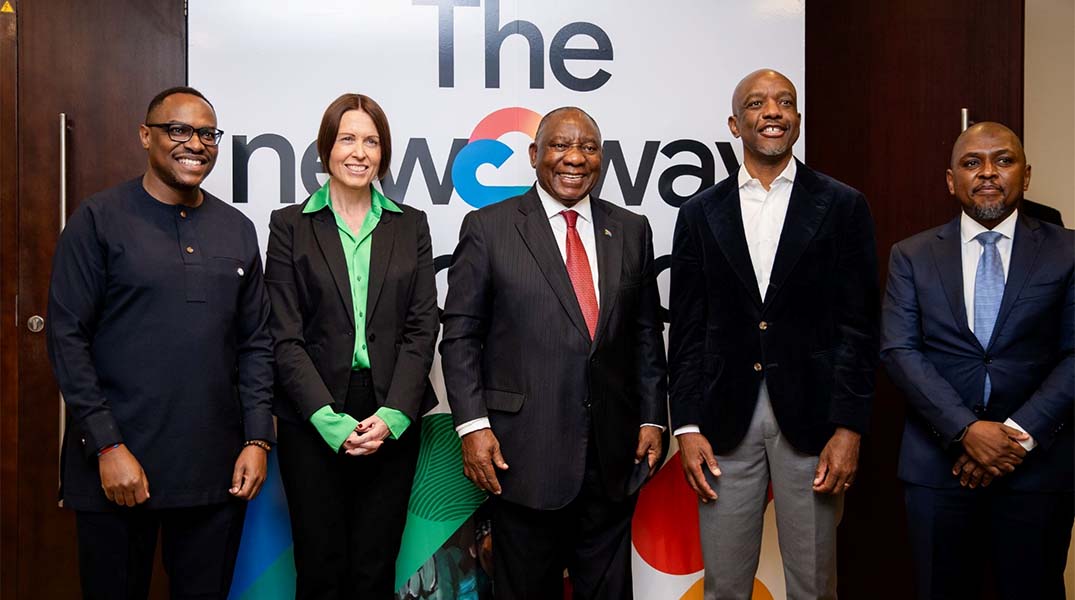
Kathy Gibson reports from Google Cloud Summit in Johannesburg – As artificial intelligence (AI) permeates every level of the economy, we need to guard against letting the digital divide extend to becoming the AI divide.
That’s the word from James Manyika, senior vice-president: research, labs technology and society at Google, who comments: “We believe that technology can act as a catalyst for economic growth. But technology alone is not enough: to realise the full potential requires visionary leadership, robust partnerships and sustainable commitment to building a thriving and inclusive ecosystem.
“At Google, we’ve been quite committed to doing our part to contribute to what Africa can do.”
Manyika points out that Google has been investing in Africa’s digital transformation since 2006, when it helped to land the Seacom cable. “More recently we pledged $1-billion over five years to further Africa’s digital transformation – and last year we exceeded that commitment ahead of schedule.”
But there’s still more to be done, he adds, outlining where investments are required, and how Google is getting involved.
“First, more investment is needed in infrastructure, especially in connectivity and computing,” Manyika says. “Today, we’re announcing a new connectivity hub, the South African Digital Exchange port in the Eastern Cape, which connects directly to Australia via our Umoja cable.
“The exchange port will significantly expand local compute capacity, while its enterprise-grade security and compliance allows companies to scale confidently within local regulations.”
The new hub builds on last year’s launch of the Google Cloud region and other long-term investments in infrastructure and its strategic partnerships with leading African companies.
Another area where Google is investing on the continent is in research.
“It is important that as much of this innovation and research as possible is led by Africans on the continent. We support institutions like University of Pretoria, Wits and many more, and we’ve established two first of a kind research AI research labs in Ghana and Kenya that are innovating for Africa and for the world.”
Working with startups to develop new businesses is a key endeavour for Google, Manyika adds.
“When it comes to entrepreneurs, we have seed funded and accelerated over 320 startups across 17 countries since 2018 – and today we’re inviting Africans to join our 2026 South African startup cohort.
“Companies selected for this program will receive an AI-focused curriculum, mentorship and equity-free funding.”
Today, Google also announced what it believes to be Africa’s first applied AI lab, in a joint initiative betwee Google AI Futures Fund, Google research and leading venture capitalist firms. “The vision is to build, fund, and scale Africa’s first generation of AI native unicorn startups,” Manyika explains.
For AI to succeed in Africa, human capital is key, he adds. “That’s why education and skill building are so critical to enabling Africans. We’ve made our most advanced AI tools available to eligible university students across Ghana, Kenya, Nigeria, Rwanda, South Africa and Zimbabwe free of charge for a yea. This will provide access to over a 1-African students with that free access.”
In addition, Google is working with the African Union Commission to bring Gemini for education and related training to universities across all 55 member states.
“We’ve also taken on a bunch of really exciting new projects to reach new talent,” Manyika says. “Here in Johannesburg, we’re working with the WeThinkCode to build a R3-million digital innovation center in Soweto, which will serve as a scalable skills platform, so that people everywhere don’t get left behind, including townships.”
Today, Google also announced a new project to empower creative talent in sub-Saharan Africa, in parnership with Sir Idris Elba’s Akuna Group.
Speaking to the Google Cloud Summit via video link, Elba comments: “As you know, Africa is bursting with untold stories. We have creators with raw talent, unique voices and perspectives that the world desperately needs to see and hear.
“But too often the barrier isn’t a lack of vision, it’s a lack of access,” he points out. “Together, the Akuna Group and Google are launching an AI education initiative for sub-Saharan African creators.
“This work will be backed by more than $1-million of support from google.org, specifically designed to empower underrepresented creators across the continent.
“We are going to help storytellers develop AI upskilling, opening doors and giving them access to Google’s most advanced storytelling tools.
“This is more than just about making content, it’s about delivering real impact. The talent is already here. Now we’re giving them the tools to build a real future in storytelling.”
Manyika concludes that, underpinning the many AI initiatives across Africa, policies and regulations are going to be key enablers.
“We need to make sure that we have policies that enable the opportunities while also balancing the risks, complexities, and gaps – and doing all of this responsibly.
“It is also important that we create in-country and continental scale and global partnerships to accelerate and skills opportunities for Africans.
“If we get this right, the opportunity today for future generations is immense. The technological progress underway is nothing short of astonishing. It’s time to harness that progress and use it to amplify scale Africa’s incredible vibrancy, hustle, innovation for Africa and for the world, and all of you in this room have an important role to play to make these possibilities real.”