
Kathy Gibson reports form Johannesburg – Cisco and Jozi My Jozi today launched a new partnership aimed at harnessing technology to help develop the Johannesburg inner city.
The new initiative, Masibambisane, is part of Cisco’s global 40 Communities social impact programme that brings together technology, cross-sector partnerships and community leadership in 40 cities around the world.
The aim is to create more resilient, inclusive and economically vibrant cities.
Masibambisane is a Nguni word meaning “let us walk together” and the multi-year partnership aims to unite more than 140 public, private and community organisations to help reimagine Johannesburg through technology-enabled collaboration and local leadership.
Innocent Mabusela, CEO of Jozi My Jozi, explains that the basic tenet of Jozi My Jozi is to enable community-led inner city revitalisation, supported by businesses and government.
The organisation works to ensure security and safety, address social issues, provide education, address homelessness, rehabilitate transport and logistics, and revitalise commerce.
The partnership with Cisco began last year, Mabusela says. “Like us, Cisco believes Johannesburg can be saved.”
The two organisations have settled on four interconnected workstreams where Cisco will contribute: safety, digital education, responsible giving; and public transport.
Brian Tippens, senior vice-president and chief social impact and sustainability officer at Cisco, explains that Johannesburg is the third city globally and first in Africa to join the 40 Communities programme.
The initiative was set up as part of Cisco’s 40th birthday celebrations as a way of giving back to the communities where it does business, working with partners to build communities.
“Over the next 10 years, our plan is to contribute to 40 connected, thriving communities across the globe,” he says.
The first community was in North Carolina, which had been devastated by Hurricane Helene; and the second is in Mumbai.
“The third had to be on the African continent as US companies cannot not invest here. Johannesburg was an immediate standout: we have a history of 30 years in South Africa and have already launched the Network Academy here.”
One of the basic tenets of the programme is to work within the ecosystem and infrastructure on the ground, with the Cisco solution adapted to fit that.
“We identified the four workstreams that can drive durable change. But they are just the beginning. The art of the possible is what comes after today,” Tippens says.

US ambassador Brent Bozell III
Brent Bozell III, US ambassador, says partnerships like this are reminiscent of how many US cities were built.
He cites some of the cities in Texas – previously little more than when he calls “cow towns” – that have been developed into world-leading venues.
“Every success has been from a vibrant public-private partnership, building remarkable engines to provide and create wonderful growth and opportunity.”
The role of philanthropy in the African context could complete the equation, he adds.
He believes that every “bad thing” in Africa could be reversed, and drive an extraordinary blast of economic success in South Africa.
“I believe Africa, in the second part of the century, will decide where the world goes,” Bozell says. “And South Africa could be the leader by far.”
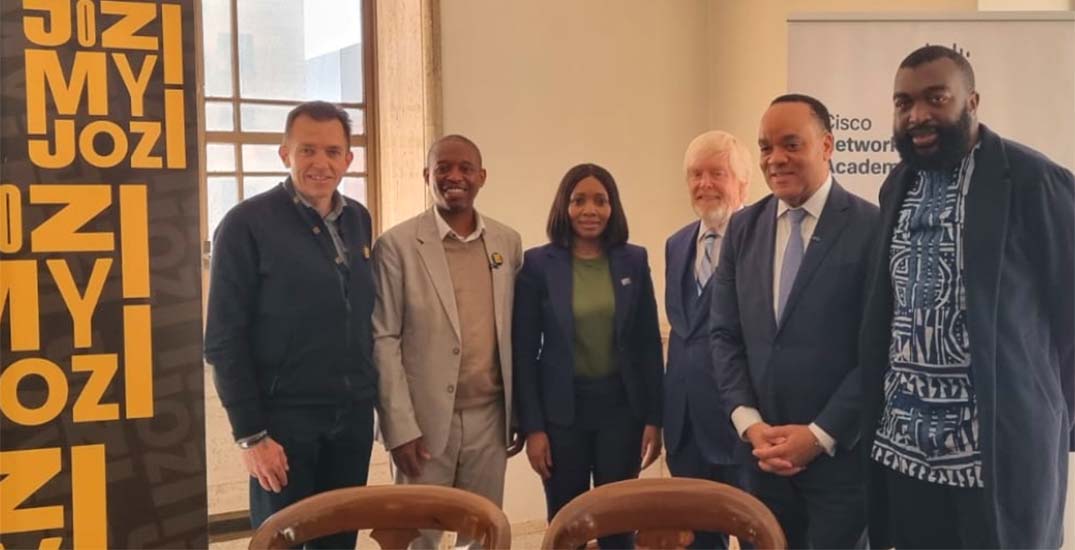
Featured image: Innocent Mabusela, CEO of Jozi my Jozi (second from left) with Smangele Nkosi, country manager of Cisco South Africa, US ambassador Brent Bozell III and Brian Tippens, senior vice-president and chief social impact and sustainability officer at Cisco.