
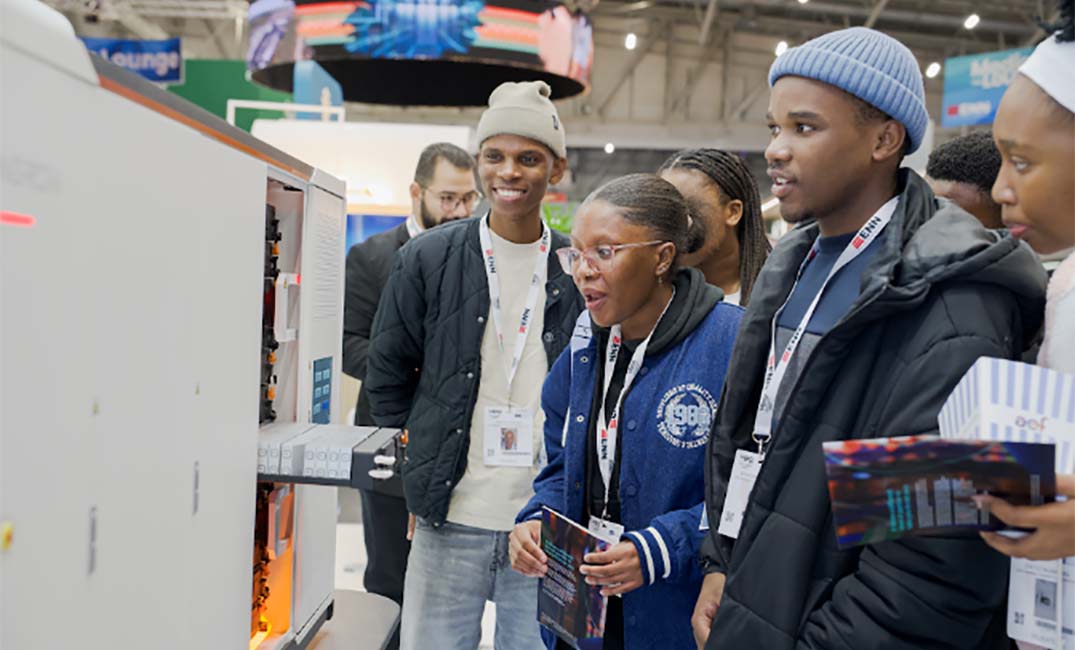
The African Energy Forum runs over four days. On the fourth day, at the same venue, the forum hosts YES, the Youth Energy Summit, its sister event for students and young people entering the sector. Students attending YES have the chance to walk the exhibition floor, and many make their way to our stand.
By Nigel Sun, president of Sungrow Sub-Saharan Africa
What we see there, every time, is something the industry should pay more attention to. Electronic engineering students standing in front of a live inverter or battery energy storage system, often for the first time outside of a classroom. They have seen the diagrams. But standing in front of the actual equipment, understanding how it works, what it does on a real project, how it fits into the grid, changes the conversation entirely.
The questions get sharper. The curiosity becomes visible. That enthusiasm, and the genuine sense of possibility behind it, is a reminder of what is at stake as Africa’s energy sector grows: not just the infrastructure being built, but the people who will sustain it.
The opportunity is real, and it is now
Across Africa, the renewable energy sector is expanding faster than its pipeline of skilled professionals. Solar, wind and battery storage projects continue to grow, and with every new project comes demand for engineers, technicians, operations and maintenance specialists and project managers. This is not a future problem. It is a present one.
What many young people, including those currently studying electrical and electronic engineering, may not fully appreciate is the range of roles the sector requires. The work does not stop at installation. Every project that goes into operation creates a long-term need for people who can run, maintain and troubleshoot the systems it depends on.
As the number of projects across Africa grows, so does the need for the people who keep them running. From South Africa to Nigeria, Kenya to Zambia, infrastructure is being built, and behind every megawatt is a career opportunity.
A growing industry in an evolving continent
South Africa’s renewable energy sector has matured considerably over the past decade. Regulatory frameworks are established, experienced project developers are active in the market, and a base of local technical expertise has been built through successive rounds of procurement and construction. That maturity is an asset, and it is also a sign of what is possible elsewhere on the continent.
Across other African markets, the industry is at earlier stages, but the trajectory is clear. Countries are building capacity, attracting investment and developing the project pipelines that will create sustained demand for skilled professionals for years to come. For young people entering the field today, the question is not whether the work will be there. It is whether they will be ready to do it.
From textbook to real world
What struck us most at YES was not the size of the crowd. It was that moment at our stand when a student connected something they had studied in a diagram with a piece of equipment they could see, touch and ask questions about. That moment of recognition, of possibility, is exactly what is missing for too many young people when they consider their career options.
Renewable energy is not always a visible industry. Students are often directed toward more traditional engineering roles without being shown what working in solar, wind or storage actually looks like, what the work involves day to day, and where it can lead.
Events like YES exist to close that gap. But industry has a role to play too. Being more present where students are, making career pathways more visible, and working with educational institutions to ensure young people understand what this sector looks like from the inside are steps that would make a real difference.
The door is open
For young people studying engineering or electrical technology: this sector is hiring, it is growing across the continent, and it needs technically skilled people who are ready to learn on the job. The energy transition will not be built by technology alone. It will be built by the engineers and technicians who understand that technology, install it, maintain it and improve it over time.
The talent is already there. So is the demand. What is still missing, for many young people, is the connection between the two. As a company operating in this space, we see that gap clearly. We also believe that the more visible this industry becomes to the next generation, the stronger Africa’s energy future will be.