
Robotics is no longer a bet on the future – it’s a plan for the next five years – but according to new research from Intel, most organisations are moving faster than their operating models can support.
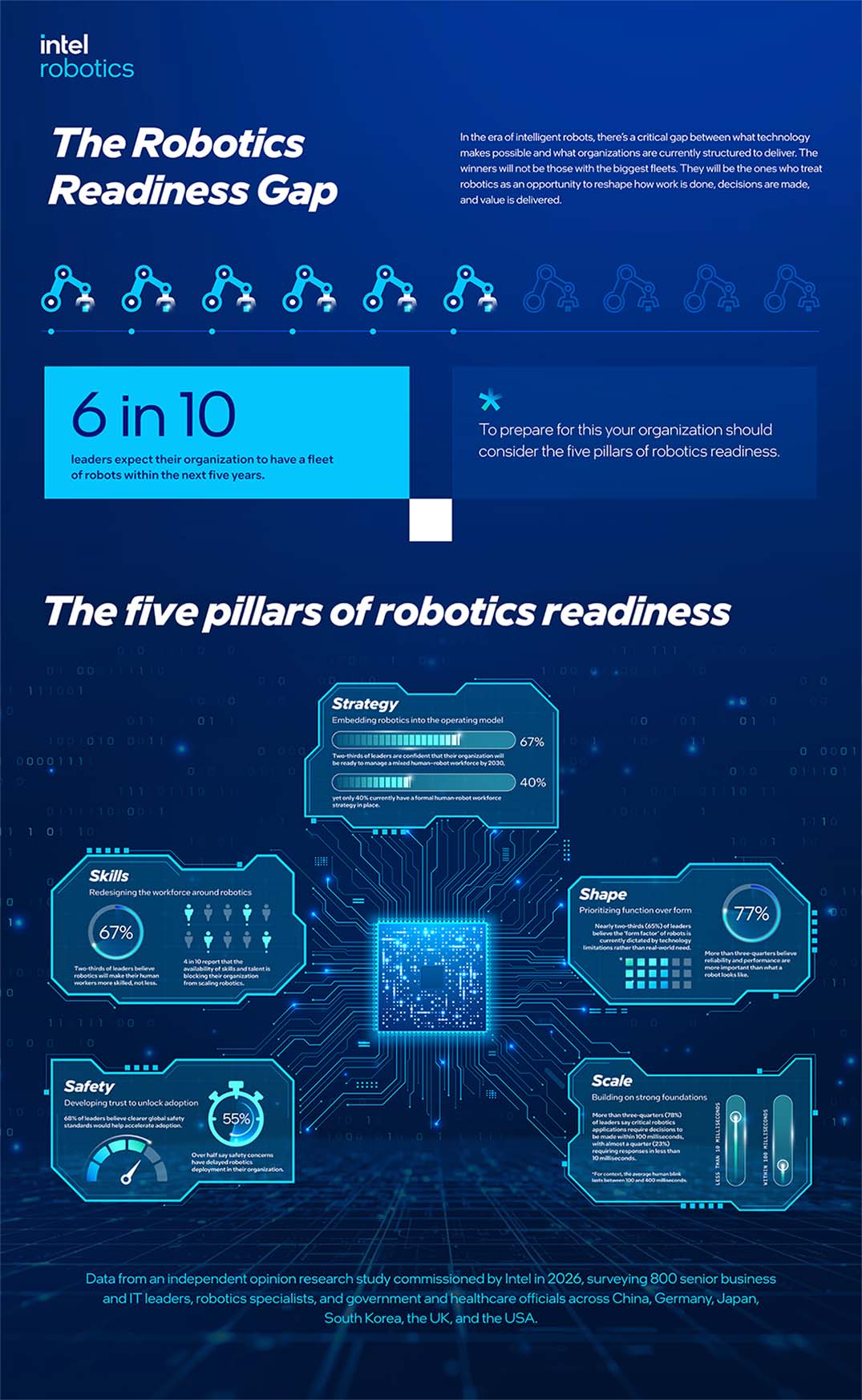
The new study – The Robotics Readiness Gap – finds a stark disconnect: six in 10 senior leaders expect their organisation to operate a fleet of robots within five years, but only four in 10 currently have a formal strategy to manage a mixed human-robot workforce.
That gap between ambition and operational readiness is the central finding of the report.
Conducted in partnership with Man Bites Dog and Coleman Parkes Research, the research surveyed 800 senior business and IT leaders, robotics specialists, and government and healthcare officials across the US, UK, Germany, Japan, China and South Korea. Respondents represented organisations with annual revenue exceeding $500-million.
The Robotics Readiness Gap confirms robotics has moved beyond experimentation. Organisations already deploying robots report measurable gains in productivity, quality and speed of service, and increasingly view robotics not as a pilot project, but as a competitive necessity.
“The next phase of robotics adoption won’t be defined by whether organisations can deploy robots – it will be defined by whether they’re ready to scale them,” says John Healy, vice-president and GM, Industrial and Robotics Division at Intel. “Those that embed robotics and Physical AI into their core operations, rather than layering them on top of existing systems, will be the ones who capture the full value of this shift.”
Five factors of robotics readiness
Intel’s research identifies five factors that will separate organisations that scale robotics successfully from those that stall at the pilot stage:
- Strategy: Two-thirds (67%) of leaders are confident that their organisation will be ready to manage a mixed human–robot workforce by 2030. Yet only 40% currently have a formal human-robot workforce strategy in place.
- Skills: Two-thirds of leaders believe robotics will make their human workforce more skilled, not less. At the same time, four in 10 report that the availability of skills and talent is blocking their organisation from scaling robotics.
- Safety: 31% of leaders cite safety as the area where robotics has delivered the greatest value. Meanwhile, 55% say safety concerns have delayed robotics deployment and 68% believe clearer global safety standards would help accelerate adoption.
- Shape: 77% of leaders say robotic performance matters more than appearance. Yet nearly two-thirds (65%) believe the “form factor” of robots is currently dictated by technology limitations rather than real-world need.
- Scale: More than three-quarters of leaders say critical robotics applications require decisions within 100 milliseconds, with almost a quarter requiring responses in less than 10 milliseconds. Currently, 42% of organisations have a defined, funded edge or on-device AI strategy, while 39% are actively developing one.
Robotics and Physical AI are converging
Robotics and Physical AI are fast becoming the next frontier of enterprise transformation, bringing AI-powered perception, reasoning and decision-making into dynamic industry environments.
As adoption moves from pilots to scaled deployment, Intel says its role is turning what works in the lab into infrastructure the whole market can build on. From edge AI silicon to the Intel Robotics AI Suite and OpenVINO Physical AI tools, Intel says it is building the foundation organisations need to close the readiness gap – not just participate in the robotics opportunity, but scale it.