

As AI continues to accelerate the pace and scope of work, CIOs must prepare for four shifts that will influence the future of work, says Gartner.
“When business and IT executives look back on the early AI-era, they will realise their greatest mistake was believing that work automation was the point, when workforce amplification was the opportunity,” says Tori Paulman, VP analyst at Gartner. “The competitive advantage will go to the CIOs and business executives who build an AI-shaped organisation where AI value compounds by reshaping roles and allowing workflows to cross traditional boundaries, increasing velocity and reducing friction.”
Gartner predicts that by 2029, 30% of employees laid off due to replacement by AI will need to be rehired, often at a significantly higher cost.
While workforce cuts may deliver short-term financial gains, they deplete talent pipelines and erode institutional knowledge. With labour force growth flat or declining worldwide, competition for the talent organisations need will be high, ultimately increasing recruitment, training and onboarding costs.
“Business and IT executives who use AI primarily as a tool for cost cutting risk making reductions that are too deep and too soon – affecting their ability to innovate their business model and compete in new markets as AI continues to mature. Instead, they should develop a ‘talent remix’ strategy that uses AI to reshape roles and redirect workers from less productive work to new opportunities.” says Paulman.
Hype Cycle for the Future of Work, 2026
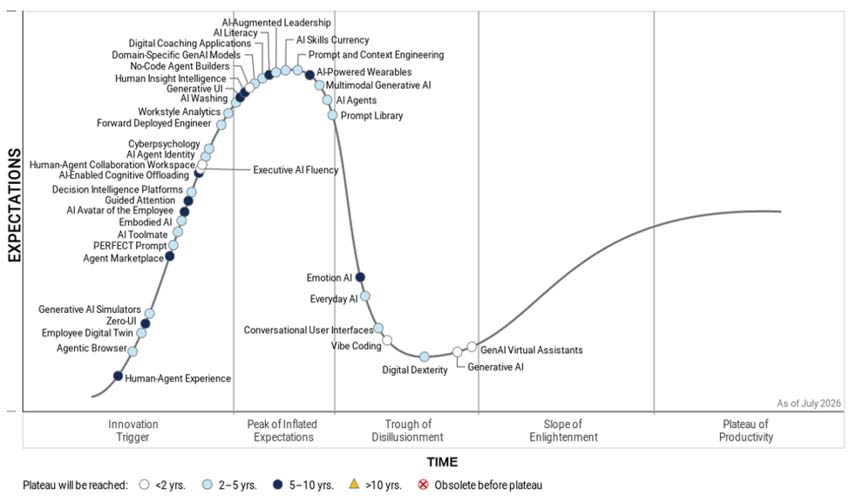
Source: Gartner (September 2026)
The most effective organisations will resist the temptation to automate every task and delegate every decision to AI.
“The Gartner 2026 Hype Cycle for the Future of Work shows that as early AI investments hit the Trough of Disillusionment, the challenge facing CIOs and business executives is no longer technological; it is using AI to amplify human intelligence, expertise and creativity,” says Paulman.
To navigate the evolving landscape of human-AI workforce transformation, CIOs and business executives must consider those changes that influence how work gets done and where organisations create value.
Shift 1: Expand human capability through the human-AI relationship
As AI evolves into a “toolmate,” organisations must create richer forms of collaboration that enhance human capability while preserving accountability. The most successful companies will use AI to strengthen employees’ judgment, creativity, leadership and decision-making rather than replace them.
Technologies that can help enable this shift include AI avatar of the employee, AI toolmate, digital coaching applications, employee digital twin and emotion AI.
Shift 2: Empower an AI-ready workforce that adapts (not just adopts)
The pace of technological change is exposing critical gaps in skills, adaptability and workforce readiness. Organisations need employees who can continuously learn, collaborate across disciplines, and thrive in increasingly fluid roles.
Future-ready organisations will invest in building AI literacy, AI-enabled skills management, digital dexterity and workstyle analytics among their workforce, and ensure their executives are “AI savvy”.
Shift 3: Deepen context, judgment and meaning
As AI becomes embedded in more business processes, organisations face a growing risk that context, human judgement and institutional knowledge could be lost. Future-ready companies will design systems that strengthen decision quality, maintain human oversight, and ensure workers understand not only how a process is performed, but also why it is performed that way.
Technologies that CIOs can consider include conversational user interfaces, decision intelligence platforms, and generative UI.
Shift 4: Build a foundation for compound value
Long-term success will depend on going beyond the adoption of everyday AI tools by creating the conditions where each use case is faster, less expensive and safer than the one before it.
Gartner predicts that by 2027, 75% of organisations that prioritise capturing AI productivity gains as cost savings will be eclipsed by competitors that aggressively reinvest those gains into innovation, modernisation and upskilling.
Technologies that can help CIOs enable this shift include AI-powered wearables, domain-specific GenAI models, embodied AI, and vibe coding.