
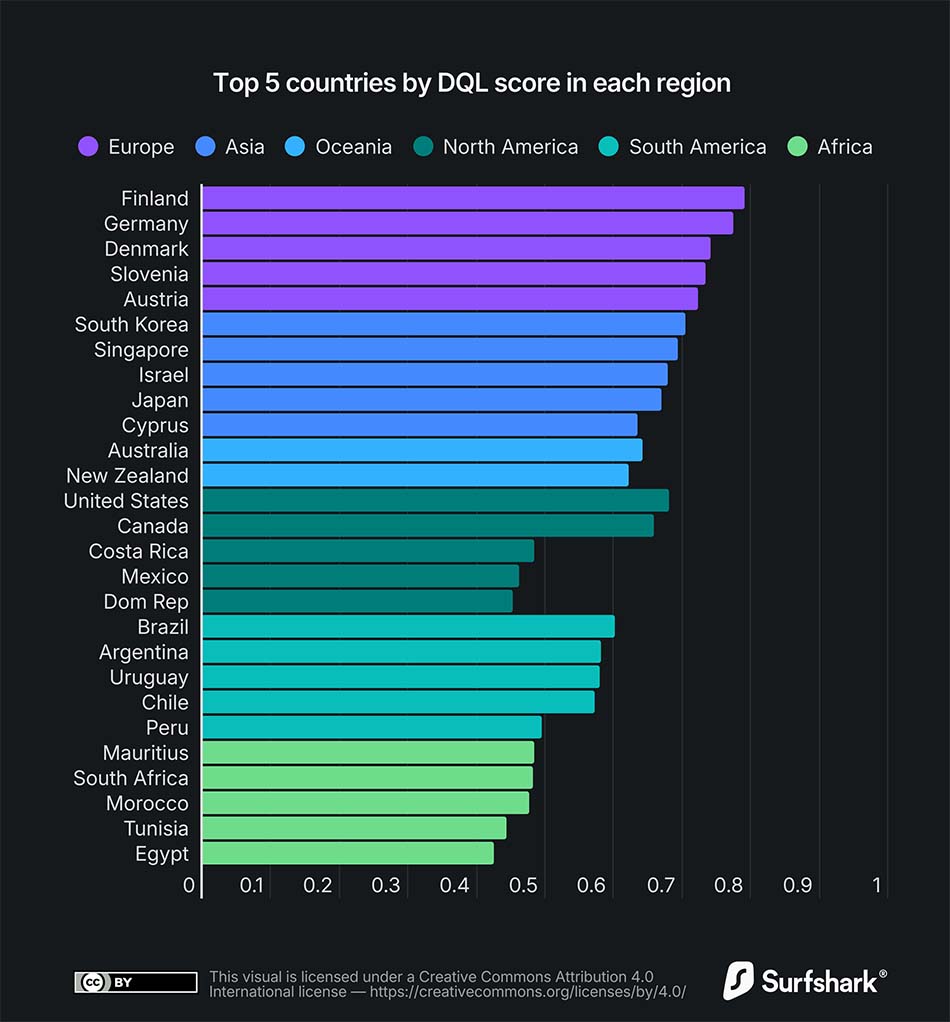
Finland, Germany, and Denmark have taken the top three spots in the eighth Surfshark Digital Quality of Life Index 2026 (DQL).
While Europe continues to dominate overall digital wellbeing and in cybersecurity, it lags behind in AI development, where the US is a clear winner.
Interestingly, when it comes to people’s safety online and AI adoption, the top-tier countries vary significantly.
“We have the era of the AI-powered cyberattacks. AI has effectively removed the ‘human bottleneck’ for hackers, where a threat actor used to spend weeks researching, targeting, localizing content, and creating fake websites to target someone,” says Tomas Stamulis, chief security officer at Surfshark. “They can now use AI to automate social engineering at a scale 100-times faster than before. For every one manual scam we saw several years ago, we are now facing a thousand automated, high-quality attacks that we can’t distinguish.
“In this new landscape, online security cannot be a secondary thought to technological growth. A single online security tool is not enough. To stay safe within this AI-powered threat environment, every citizen and organization must adopt a multi-layered protection, integrating real-time scam detection, privacy tools, and autonomous endpoint protection, to fight machines with machines.”
Digital Quality of Life research assesses countries’ overall digital wellbeing across five areas: internet affordability, internet quality, digital infrastructure, digital security, and artificial intelligence. Finland tops the overall global digital quality of life ranking, followed by Germany, Denmark, Slovenia, and Austria. Europe accounts for all the top ten countries.
In AI development, US is in the lead, followed by UK and France. Europe has four countries in the top rankings: the United Kingdom, France, Germany, and the Netherlands.
Money doesn’t always guarantee a higher digital quality of life
Western Europe continues to set the benchmark in the Digital Quality of Life Index while standing as the world’s most prosperous sub-region.
Interestingly, Northern Europe ranks higher on the DQLi than North America, despite a lower GDP per capita.
Similarly, Eastern Europe achieves an above-average DQL score despite its GDP per capita reaching only 86% of the global benchmark.
All the top countries in digital security are located in Europe, but US leads in AI
Czechia secures the top global position, showcasing unmatched readiness against cybersecurity risks alongside robust data protection frameworks. Estonia takes second place, while Finland follows in third.
A strong contingent of European nations – including Lithuania, Belgium, Hungary, Poland, Romania, Slovakia, and Germany – likewise demonstrate exceptional digital security standards, strongly fortified by the General Data Protection Regulation (GDPR).
The US takes the lead in artificial intelligence, making it highly attractive for capital investment while demonstrating strong readiness to integrate AI technology into public services. The UK and France follow closely behind, ranking second and third respectively.
Looking strictly at investment appeal, France and Singapore drop out of the top-10 tier. Conversely, Canada fails to reach the top ten in government AI readiness. Meanwhile, Norway surges into 10th spot worldwide for public sector AI integration. In parallel, Denmark and Sweden enter the top rankings, placing ninth and 10th for overall AI investment potential.
Notable variability among countries within the same region
Western Europe shows the smallest disparity in DQL, with Germany, the top country, having a score only 17% (1,17-times) higher than Belgium, which ranks last in this group.
In contrast, Western Asia exhibits the largest gap, where Yemen’s score is 5,2-times (81%) smaller than that of Israel, the top-ranking country in the subregion.