
Despite the rapid risks introduced by AI, CIOs remain well-positioned to effectively manage AI governance and deliver business value, says Gartner – value and risk are interconnected, and the challenge for CIOs is to compound value faster than risk.
“People are doing more with AI than ever before and 58% of leaders said they are seeing some positive value from their AI initiatives, according to a Q2 2026 Gartner survey of over 1 000 functional leaders,” says Daryl Plummer, VP, distinguished analyst and Gartner Fellow. ”While many organisations are seeing pockets of AI success, they are struggling to consistently replicate and scale that value across the enterprise.”
At the same time, AI risk continues to accelerate. CIOs and IT leaders report to Gartner that AI risk is growing faster than AI value in their organisations. “However, the value-potential is high. The new CIO imperative is to align value with risk and align safety with governance,” says Plummer. “Alignment is the key.”
However, only 25% of CIOs align technology and business risk, according to a Q3 2026 Gartner survey of 303 CIOs and IT risk management leaders.
“Alignment doesn’t mean everyone gets the same value or the same risk. It provides a consistent way to shape value-risk relationships,” says Kristin Moyer, VP, distinguished analyst and Gartner Fellow. “For example, a Q2 2026 Gartner survey of over 2 000 CIOs and technology executives found that 71% of organisations expect to deploy agentic AI within the next 12 months, yet only 21% currently have agentic AI governance capabilities in place.
“That imbalance makes it difficult to create value faster than AI creates risk,” Moyer adds. “Managing value and risk is about building the right kinds of momentum while avoiding the wrong kinds of drag.”
Gartner recommends that CIOs take three actions to align decision making, AI governance, and accountability with their AI value and risk objectives:
Use the Gartner Value-Risk Flywheel to align value with risk
The Gartner Value-Risk Flywheel visualises the relationship between compounding value and compounding risk (see Figure 1). It helps organisations analyse what is compounding and why.
The Gartner Value-Risk Flywheel
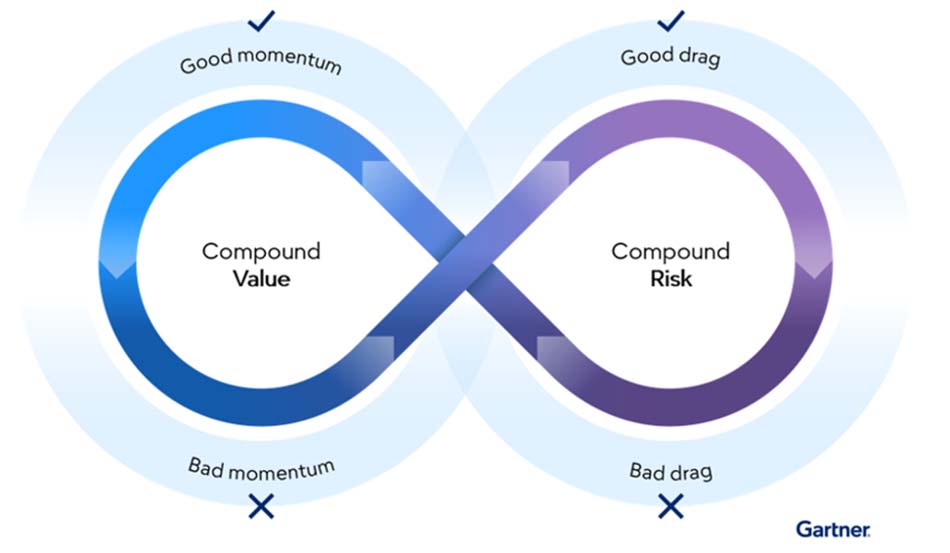
“Two forces shape the Gartner Value-Risk Flywheel: momentum and drag,” says Plummer. “Momentum accelerates outcomes, while drag slows outcomes. But momentum itself is not always good, and the right kind of drag can be beneficial. CIOs who outperform know how to create positive momentum and strategically introduce good drag, while reducing bad momentum and bad drag.”
For example, in software development value can compound faster than risk. AI is now generating a significant share of the code in production software.
As a result, AI is freeing software developers from the drag of manual coding, so they can drive good momentum through rapid prototyping, requirements-driven development, architectural thinking, and product engineering.
There is no perfect, one-size-fits-all balance between value and risk. The flywheel can be value-heavy, neutral, or risk-heavy, depending on the situation. The right shape of the Gartner Value-Risk Flywheel depends on the organisation’s strategy and risk appetite.
Align safety with governance through an AI Central Bank
“Organisations can establish an AI Central Bank to ensure transparency, coordination, and accountability for both humans and machines,” says Moyer. “It’s not about centralisation. It’s about alignment, coordination, and collaboration.”
The AI Central Bank serves as a virtual control plane for AI decision-making across the enterprise.
“It creates accountability, governs technology, manages economics, and creates shared intelligence,” says Plummer. “That promotes safety everywhere because it is universal governance, not centralization. What it will not do is eliminate risk, and it will not drive value. The only thing that can do that, is people.”
Cultivate AI entrepreneurs across the enterprise
People will always be the arbiters of AI success. Advanced AI users, or AI artisans, are emerging as the ultimate value drivers. They’re delivering creative solutions with AI that are reinventing work.
“Our position is that people will fill in the gaps in AI value discovery,” says Moyer. “To expand the value side of the flywheel, empower AI entrepreneurs. Build a culture of creative people who know AI. Give them the freedom to reinvent work through serendipity and reward them when they do. When artisans are empowered to act as AI entrepreneurs, you’ll find your next great compound-value proposition.”