
CIOs and IT leaders report that AI risk is growing faster than AI value in their organisations and, as a result, the new challenge for CIOs is to compound value faster than risk, says Gartner.
Gartner analysts say that value and risk are interconnected, and CIOs must balance AI value and risk to create lasting success.
“People are doing more with AI than ever before and 58% of leaders said they are seeing some positive value from their AI initiatives, according to a Q2 2026 Gartner survey of over 1 000 functional leaders,” says Daryl Plummer, distinguished VP analyst, Gartner Fellow and chief of Research. “While many organisations are seeing pockets of AI success, they are struggling to consistently replicate and scale that value across the enterprise.”
AI success will come from creating the right momentum to compound value while preventing risk from escalating. “The best thing a CIO can do is to align value with risk and align safety with governance,” says Plummer. “Alignment is the key.”
“Alignment doesn’t mean everyone gets the same value or the same risk. It provides a consistent way to shape value-risk relationships,” says Kristin Moyer, distinguished VP analyst and Gartner Fellow. “For example, a Q2 2026 Gartner survey of over 2 000 CIOs and technology executives found that 71% of organisations expect to deploy agentic AI within the next 12 months, yet only 21% currently have agentic AI governance capabilities in place.
“That imbalance makes it difficult to create value faster than AI creates risk,” Moyer adds. “Managing value and risk is about building the right kinds of momentum while avoiding the wrong kinds of drag.”
Gartner recommends that CIOs take two actions to compound AI value and manage risk:
Use the Gartner Value-Risk Flywheel to align value with risk
The Gartner Value-Risk Flywheel visualises the relationship between compounding value and compounding risk. It helps organisations analyse what is compounding and why.
The Gartner Value-Risk Flywheel
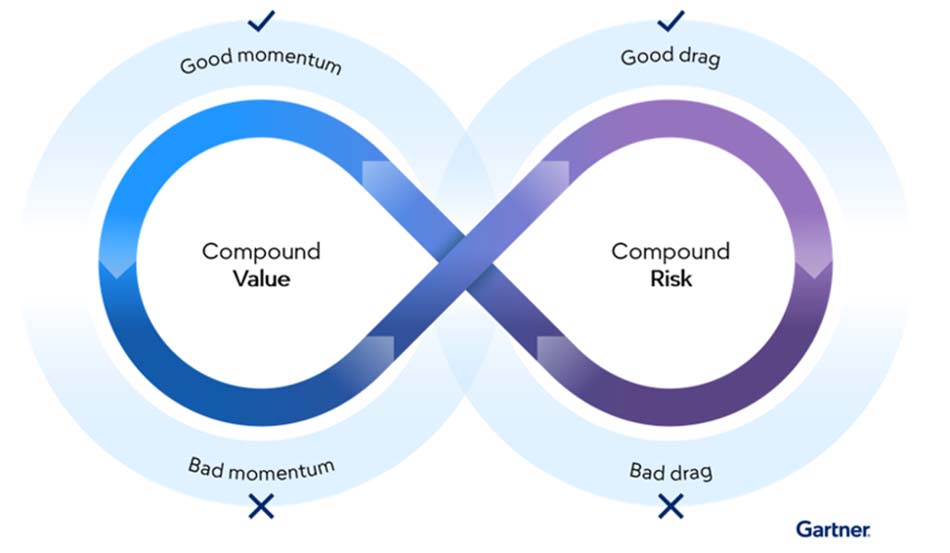
“Two forces shape the Gartner Value-Risk Flywheel: momentum and drag. Momentum accelerates outcomes, while drag slows outcomes,” says Plummer. “But momentum itself is not always good, and the right kind of drag can be beneficial. CIOs who outperform know how to create positive momentum and strategically introduce good drag, while reducing bad momentum and bad drag.”
For example, in software development, value can compound faster than risk. AI is now generating a significant share of the code in production software. As a result, AI is freeing software developers from the drag of manual coding, so they can drive good momentum through rapid prototyping, requirements-driven development, architectural thinking and product engineering.
Align safety with governance through a Flywheel governor
“Everyone sees value and risk a little bit differently, so something must coordinate the entire system,” says Plummer. “Flywheels need a governor, right at the centre, who decides when value is worth the risk, what perspective on value should dominate, and how to keep an organisation safe. That’s the role of the flywheel governor for everything.”
“For example, with AI, different functions see different versions of the same AI initiative,” explains Moyer. “A Flywheel governor is a virtual organisation that owns the plan to keep AI safe. It is a centralised decision-authority that drives advice and guides actions on accountability, technology and economics.
“This Flywheel governor is the final piece of the value-risk puzzle that organisations must have,” Moyer adds. “It is where momentum and drag go from bad to good. And with it, value and risk Flywheels will always stay in alignment.”